

Drawings and documents
National Archives restored drawings: drawing
James Stimpson's Patent Drawing for an Improvement in the Manufacture of Running Geers of Rail Road Carriages

National Archives, Restored Patent Drawings (Record Group 241) · Full-size scan at the National Archives · Catalog record
Show the text on the drawing Hide (114 words)
Words on the drawing as machine-read by the National Archives; not checked. Useful mainly for searching.
105, Railway Rolling Stock, / JAMES STIMPSON'S IMPROVEMENT IN THE Patientico / les / RUNNING GEERS OF RAIL ROAD CARRIAGES. / Axles, Divided, / №1 A cross / With Couplings, / $1 / transversely W. / the position of the alleswithin tn / №1. / box.- / No2. A cross section of the Boxkaxle, at / muffu / right angles to the First, shewing the / screw-bolls to connect the two parts / #8467x / of the box together.- / №2. / №3. HPerspective view of the Juinted-Axle, / and half the Box.- / No.4. A top view ora car, with the Jointed- / №4. / CLASSIFICATION / axle b in the hind part c' OF it when / XL9t18 / running.- / DIVISION. / №3 / Patented Oct. 23ᵗʰ,1834
USPTO scan
The patent as scanned by the USPTO
-
 Page 1
-
 Page 2
-
 Page 3
-
 Page 4
-
 Page 5
-
 Page 6


U.S. Patent and Trademark Office · Google Patents
Show the transcription Hide (1,888 words)
Machine transcription (LightOnOCR) of the pages as scanned by the USPTO, most of them the handwritten copies made when the records were restored after the 1836 fire. Not checked; it can misread handwriting, so compare it with the scan.
Page 1.
8467X
J. STIMPSON.
Car Wheel.
Patented Oct. 23, 1834.
Fig. 2.
Fig. 1.
AM. PHOTO-LITHO. CO. N.Y. (OSBORNE'S PROCESS)
Page 2.
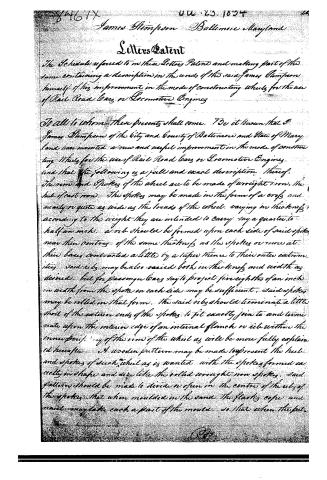
James Thompson Baltimore Maryland
Letters Patent
The Schedule referred to in these Letters Patent and making part of the same containing a description in the words of the said James Thompson himself of his improvement in the mode of constructing wheels for the use of Rail Road Cars or Locomotive Engines
To all to whom these presents shall come. Be it known that I James Thompson of the city and county of Baltimore and State of Maryland have invented a new and useful improvement in the mode of constructing Wheels for the use of Rail Road Cars or Locomotive Engines and that the following is a full and exact description thereof.
The rim and spokes of the wheel are to be made of wrought iron. The hub of cast iron. The spokes may be made in the form of a croft and nearly or quite as wide as the broads of the wheel, varying in thickness according to the weight they are intended to carry, say a quarter to half an inch. A rib should be formed upon each side of said spoke near their centres of the same thickness as the spokes or more at their bases contracted a little by a taper thence to their outer extremities. Said ribs may be also varied both in thickness and width as desired, but for passenger cars say to project five eighths of an inch in width from the spoke on each side may be sufficient. Said spokes may be rolled in that form. The said ribs should terminate a little short of the outer ends of the spokes to fit exactly join to and terminate upon the interior edge of an internal flanch or rib within the inner periphery of the rim of the wheel as will be more fully explained hereafter. A wooden pattern may be made to represent the hub and spokes of such wheel as is wanted with the spokes formed exactly in shape and size like the rolled wrought iron spokes. Said pattern should be made to divide or open in the centre of the ribs of the spokes that when moulded in the sand the flanks cope and run, may take each a part of the mould, so that when the pat-
Page 3.
24th
When the arm is withdrawn from the sand the iron spokes may be laid into the mould and the cope closed down over them. In this way the hub may be cast upon the spokes. The hub should be sufficiently large to enclose a proper length of the spokes for strength, and yet their inner ends should not be allowed to extend to within about one half of an inch of the axle. Thus when the hub is cast it will represent a hub and spokes without a rim, but the ribs on the spokes should not be allowed to extend into the hub over an eighth of an inch, for they would very nearly divide the hub into two parts perpendicularly through it and thereby make it unsafe for use. The rim on the exterior may be formed as usual with a flanch and cone, or one cone as desired. On the exterior there are to be formed two internal flanches or ribs projecting inwards from the interior of the rim as wide or deep as may be desired, varying according to the objects which they are intended to be used. One of said rims or flanches should be formed at the edge of the inner periphery of the outside of the wheel diagonally opposite to the external flanch, and it may be made say three quarters of an inch thick at the base tapering to half an inch across the inner edge more or less and one inch and a half wide or deep including the thickness of the rim of the wheel, more or less. This proportion may be proper for a passenger Car, and the average thickness of the rim three eighths of an inch. The other rib may be placed midway between this internal and the external flanch, or nearer to the external if desired. This rib may not be so deep as the other, it may project within the rim say five eighths of an inch more or less, and must be as thick as the ribs on the spokes as they are to be fitted to it, and it, minute upon the inner periphery of this rib, it may be made as thin as the ribs on the spokes if desired. I use from nine to twelve spokes for a three to four feet wheel, and then nine to twelve ribs are to be formed or made in the last described internal flanch or equidistant from each other of a form and size just to fit near to the outer ends of the spokes. These notches are only to be cut for deep enough to allow the outer ends of the spokes to pass through.
Page 4.
When the rim is expanded by heat, to the extent it will bear without injury, there must also be formed notches in the exterior ends of the spokes just as deep as the sole of the notch made in the internal rim is from the inner periphery of the rim of said wheel, and also as wide as the rib itself, so that the notch in the end of the spoke shall exactly span and fit tight to the rib on the inner periphery of the wheel within the said notches and at the same time the ribs of the ribs on such side of the spokes are to be formed so exactly to fit upon the inner periphery of the rib when the tire or rim of the wheel is shrunk by cooling to its natural size. Though care must be had to calculate and make the diameter of the spokes and rim so to agree with each other that when cold the rim shall hug the spokes as tight as they will bear and at the same time be the most secure, lasting and safe for use.
Now then it will be seen that the objects of these internal ribs or flanges are to answer two special purposes. The first is to secure strength and firmness in the rim from flexure with but as small quantity and weight of metal, and the second is to secure the rim to the spokes against any lateral or other movement without screw bolts, nuts or rivets.
This form of rim will evidently save great weight of iron and yet be much stronger than cast iron wheels as usually made. The internal ribs are a complete substitute for the cast iron rim in point of strength and firmness, while the rim itself will not be near so liable to stretch whereby to become loose upon the spokes as the usual wrought iron tire when shrunk in the usual way over a solid cast iron rim, neither could wood within any tire be of any use, no screw bolts, nuts or rivets to work loose, which again to be looked after, and with spokes formed as described their lightness and yet firmness all combine to make a wheel of light material by one half the usual cast iron wheels intended for passenger cars and yet will withstand a blow of more than twice the force that a cast iron wheel could without breaking. Hence wheels of this construction may be made large, the necessary weight being so small as not to be regarded. For a team this will be an immense saving of power, wear and tear to the road and cars. The
Page 5.
outer edges of the spokes should be made to fit up tight to the inside of the outer flange or rib as it will add great additional security to the notches in the spokes against lateral movement, as the inclination the peripheries of the wheels is inwards or towards each other; hence, inside of the deep rib as well as the space beyond the sole of the notches, abundantly secure the rims to the spokes from any lateral movement.
It is my intention first to roll the rim in a set of dies approximating in a small degree towards the shape of the rim when finished by an estimate based upon a calculation of the necessary weight, and a few experiments the exact weight necessary to form a wheel of a certain diameter by the roller dies may be had to make us to round up and weld a rough rolled bar before passing it through the finishing dies. In the last state the rollers when brought tight together will leave the rim, and so perfect on the surface as to require no burning and yet be made the exact size that may be wanted. The upper roller of course a form the external flange concave and the face of the tread of the wheel and a part of the thickness of the rim while the under roller will form the remainder of the thickness of the rim and the internal flanges over the dies in the under roller must be on the outside of its journals while the upper roller must be made so as to be raised by two screws geared together to receive the hoops for rolling and then force the upper roller gradually by the screws as the rollers revolve, until they touch each other when the rim will be finished and must then be removed as quickly as possible. The hub and spokes must be put into a lathe. The hole bored out to receive the axle, then filed upon an arm in a lathe, the ends of the spokes ground off by passing round by an emery wheel in quick motion with a lateral movement to the emery wheel to keep it level or straight upon its surface, or before a stone and then a burnisher so formed as to make a finish to the ends, the ribs, and also the notches in the ends of the spokes and after are thus prepared the rim must be heated in a close furnace or shrouded upon the spokes, which will then form a wheel perfectly true from the centre every way or it may be done in any other way.
Page 6.
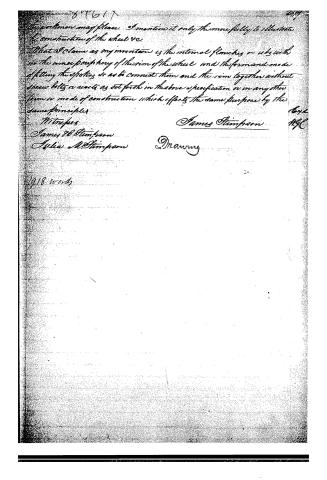
the workmen may please. I mention it only the more fully to illustrate the construction of the wheel &c
What I claim as my invention is the internal flanches or ribs with in the inner periphery of the rim of the wheel and the form and mode of fitting the spokes so as to connect them and the rim together without screw bolts or warts as set forth in the above specification or in any other form or mode of construction which effects the same purpose by the same principles
Witnesses
James W. Stimpson
Julia M. Stimpson
James Stimpson
Drawing
1918 words
Published accounts: journal notice
Notice in the monthly list of patents, with remarks
Journal of the Franklin Institute, new ser., vol. 15 (1835), p. 328 · View the page
39. For an improvement in the Running Gears of Railroad Carriages; James Stimpson, city of Baltimore, October 23.
Remarks. This improvement consists simply in dividing the axle of the hind wheels in two at the middle, and forming a flanch on each end, which may rise one-fourth of an inch, and fit into a corresponding cavity in a coupling box fixed under the centre of the carriage. The object to be attained is to allow the hind wheels to run with different velocities upon curved parts of the road, and thus to follow the fore wheels, the cone upon the tread of which will guide them correctly; whilst the vibration of the axles, to preserve their parallelism, is rendered unnecessary. The claim is to "the application of the joint to one of the axles of any description of rail-road carriages and locomotives, whereby to allow the hind wheels to yield to the direction required to be given by any change in the direction of the road; or to the conical form of the wheels, upon the fore axle, or any other mode whereby the same object is attained by the same principle of action, or construction; and also for all other carriages to which it may be beneficially applied." We do not perceive the difference in principle, or in effect, between this plan, and that of allowing one of the hind wheels to turn on the axle, whilst the other is fastened thereto; a practice which was adopted on rail-road cars, many years since.
About this record
- Patentee
- DATAMP
- Date
- the Name and Date index of patents, DATAMP, USPTO records
- Invention
- DATAMP
- Listed in
- the Name and Date index of patents, DATAMP, USPTO records, Jim Shaw's X-patent list, the Journal of the Franklin Institute, Burke's List of Patents (1847)
- Burke's 1847 Patent Office list gives the same patent.