

Drawings and documents
National Archives restored drawings: drawing
Raymond French's Patent Drawing for Auger Bitts

National Archives, Restored Patent Drawings (Record Group 241) · Full-size scan at the National Archives · Catalog record
Show the text on the drawing Hide (50 words)
Words on the drawing as machine-read by the National Archives; not checked. Useful mainly for searching.
sot / 76. METAL WORKING, / metals / AUGERS. / haymond French / Patented 11th Noobr. 1834 X / No / CLASSIFICATION / 8491+ / Auger Bitts. / DIV ISION. / Plate No.1. / Pl. N°2. / Pls N.3. / class / an extension was applied for. menther any models / Correnfrom Patent
USPTO scan
The patent as scanned by the USPTO
-
 Page 1
-
 Page 2
-
 Page 3


U.S. Patent and Trademark Office · Google Patents
Show the transcription Hide (661 words)
Machine transcription (LightOnOCR) of the pages as scanned by the USPTO, most of them the handwritten copies made when the records were restored after the 1836 fire. Not checked; it can misread handwriting, so compare it with the scan.
Page 1.
8491X
No Printed Specification Available
R. French,
Making Ringers,
Patented Nov 11, 1834.
Plate 1 Plate 2 Plates 3
M. PETERS, PHOTO-LITHOGRAPHER, WASHINGTON, D. C.
Page 2.
291
Raymond French.
Letters Patent dated November 11, 1854
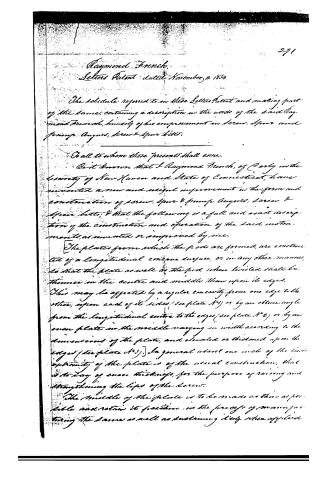
The schedule referred to in these Letters Patent and making part of the same, containing a description in the words of the said Raymond French, himself of his improvement in Screw, Spun and Pump Angles, Screw & Spun Bits.
To all to whom these presents shall come.
Be it known that I Raymond French, of Derby in the County of New Haven and State of Connecticut, have invented a new and useful improvement in the form and construction of Screw, Spun & Pump Angles, Screw & Spun Bits; & that the following is a full and exact description of the construction and operation of the said instruments, as invented or improved by me.
The plates from which the rods are formed, are constructed of a longitudinal concave surface, or in any other manner, so that the plate as well as the rod when twisted shall be thinner in the centre and middle than upon its edges. This may be effected by a regular concavity from one edge to the other, upon each of its sides (see plate No 1) or by an obtuse angle from the longitudinal centre to the edges (see plate No 2) or by an even plate in the middle varying in width according to the dimensions of the plate, and elevated or thickened upon the edges (see plate No 3). In general about one inch of the lower extremity of the plate is of the usual construction, that is to say of even thickness, for the purpose of raising and strengthening the lips of the screw.
The middle of the plate is to be made as thin as possible and rotate it position in the process of manufacturing the same as well as sustaining itself when applied
Page 3.
to use being generally about one sixteenth part of inch thick on a plate of one inch in breadth, and varying with the size of the plate as well as the quality of metal. The edges of a plate of one inch breadth are to be rounded generally about three eighths of one inch thick varying still with the breadth of the plate (See illustrations). These instruments are twisted and finished, in other respects in the usual manner.
The object attained by this method of constructing the plate is, that it gives the spiral of the drill when twisted, a greater capacity towards the inner surface of the hole, and more perfectly envelops the core or chips within a metallic surface, on their passage from the bottom to the top of the hole while boring, by which the chips or waste permitted to rise and flow off more freely and rapidly being prevented in a great degree from friction upon the surface of the hole, and from clogging within the flutes. A cause deemed may be given to the tool constructed in this manner, than in the usual form, and the strength and durability of the instrument are increased by extending the principal part of the metal more remotely from the axis or longitudinal centre of the instrument.
In short all I claim as my invention, in the foregoing improvement, is the principle and its application to one of constructing the plate and feed of screw lags and bits, thicker upon the edges than in the middle, under the modifications and as the same more specifically, and that the same principle and form may be applied to all tools used for boring holes and holes or timber having a twisted feed, and two spiral forms.
Witnessed
John Clark Wheeler
Raymond French
Recommended and patented June 9th 1845.
Published accounts: journal notice
Notice in the monthly list of patents, with remarks
Journal of the Franklin Institute, new ser., vol. 15 (1835), p. 393 · View the page
11. For an improvement in Screw Augers; Raymond French, Derby, New Haven county, Connecticut, November 11.
Remarks. This is said to be an improvement on screw, pump, and spur augers, and consists in giving to the plates which are to be twisted, a Iongitudinal, concave surface, so that the plate, as well as the pod, when twisted, shall be thinner at the centre than at the edges, either by a regular curvature, by a diminution of thickness formed by straight lines, or by lines in part curved, and in part straight. "All that I claim as my invention in the foregoing improvement, is, the principle and its application to use, of constructing the plate and pod of screw augers and bitts, thicker upon the edges than in the middle, under the modifications, and in the manner above specified, and that the same principle and form may be applied to all tools used for boring holes in wood or timber, having a twisted pod, and two spiral semi-cylinders." The advantage derived from this construction is said to be, that it gives to the spiral cavities of the pod, when twisted, a greater capacity towards the inner surface, and more perfectly envelopes the core, or chips, within a metallic surface, in their passage from the bottom to the top of the hole while boring, by which they are caused to rise and flow off more freely and rapidly. A coarser screw than usual may, it is also observed, be given to an instrument of this construction, and its strength and durability are increased from the manner of distributing the metal.
About this record
- Patentee
- the Journal of the Franklin Institute, Journal
- Date
- the Name and Date index of patents, USPTO records, Jim Shaw's X-patent list
- Invention
- the Name and Date index of patents
- Listed in
- the Name and Date index of patents, USPTO records, Jim Shaw's X-patent list, the Journal of the Franklin Institute, Burke's List of Patents (1847)
- The patentee's full name comes from the Franklin Institute's journal.
- Burke's 1847 Patent Office list gives the same patent.