

Drawings and documents
USPTO scan
The patent as scanned by the USPTO
-
 Page 1
-
 Page 2
-
 Page 3
-
 Page 4


U.S. Patent and Trademark Office · Google Patents
Show the transcription Hide (1,014 words)
Machine transcription (LightOnOCR) of the pages as scanned by the USPTO, most of them the handwritten copies made when the records were restored after the 1836 fire. Not checked; it can misread handwriting, so compare it with the scan.
Page 1.
8507X
A. D. Lord,
Washing Machine,
Patented Nov. 24, 1834.

Page 2.
Mar. 24, 1834
Mandon D. Lord
Letters Patent
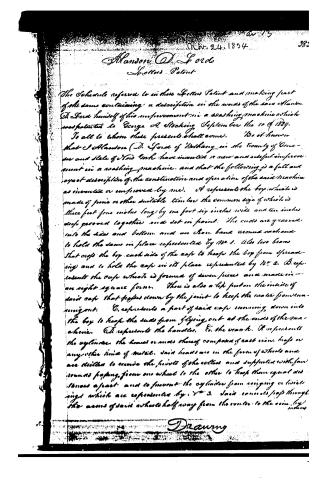
The Schedules referred to in these Letters Patent and making part of the same containing a description in the words of the said Mandon D. Lord himself of his improvement in a washing machine which was patented to George A. Stocking September the 10 of 1829.
To all to whom these presents shall come. Be it known that I Mandon (D. Lord of Albany in the County of Oneida and State of New York have invented a new and useful improvement in a washing machine, and that the following is a full and exact description of the construction and operation of the said machine as invented or improved by me.
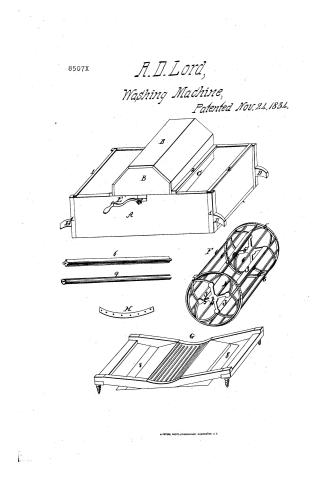
A represents the box which is made of pine or other suitable timber the common size of which is three feet four inches long by one foot six inches wide and ten inches deep grooved together and set in frame. The ends are grooved into the sides and bottom and an iron band around each end to hold the same in place represented by No 1. Also two beams that cross the box each side of the axis to keep the box from spreading and to hold the axis in its place represented by No 2. B represents the cask which is formed of seven pieces and made in an eight square form. There is also a lip put on the inside of said cask that projects down by the joint to keep the water from running out. C represents a part of said cask running down into the box to keep the cask from flying out at the ends of the machine. D represents the handles. E the crank. F represents the cylinders the heads or axes thereof composed of cast iron, brass or any other kind of metal. Said heads are in the form of wheels and are drilled to receive the pivots of the rollers and supported with four screws passing from one wheel to the other to keep them equal distances apart and to prevent the cylinders from swinging or twisting which are represented by No 3. Said screws pass through the arms of said wheels halfway from the center to the rim.
Drawing
Page 3.
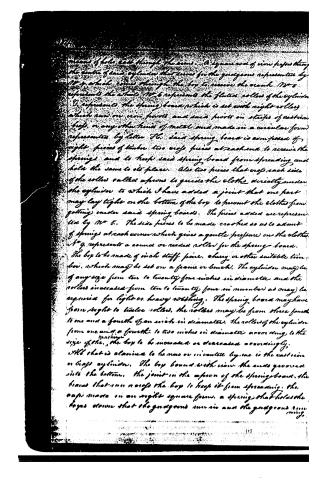
means of holes cast through the same. A square rod of iron passing through the centre of said cylinder that serves for the guageons represented by No. 4, which comes through the box to receive the crank. No. 5 represents the wheel. No. 6 represents the fluted rollers of the cylinder. G represents the spring board which is set with eight rollers which are on iron pivots and said pivots on strips of cast iron, brass, or any other kind of metal and made in a circular form represented by letter H. Said spring board is composed of eight pieces of timber, two cross pieces at each end to receive the springs and to keep said spring board from spreading and hold the same to its place. Also two pieces that cross each side of the rollers called aprons to guide the clothes directly under the cylinder to which I have added a joint that one part may lay tight on the bottom of the box to prevent the clothes from getting under said spring boards. The pieces added are represented by No. 5. The side pieces to be made crooked so as to admit of springs at each corner which gives a gentle pressure on the clothes. No. 9 represents a conical or reeded roller for the spring board.
The box to be made of inch stuff pine, cherry, or other suitable timber, which may be set on a frame or bench. The cylinder may be of any size from ten to twenty-four inches in diameter and the rollers increased from ten to twenty-four in number as may be required for light or heavy washing. The spring board may have from eight to twelve rollers, the rollers may be from three fourth to one and a fourth of an inch in diameter. The rollers of the cylinder from one and a fourth to two inches in diameter according to the size of the machine, the box to be increased or decreased accordingly.
It is that is claimed to be new or inventive by me is the cast iron or brass cylinder. The box bound with iron, the ends grooved into the bottom, the joint in the apron of the spring board, the bands that run across the box to keep it from spreading, the caps made in an eight square form, a spring that holds the boxes down that the guageons run in and the guageons moving.
Page 4.
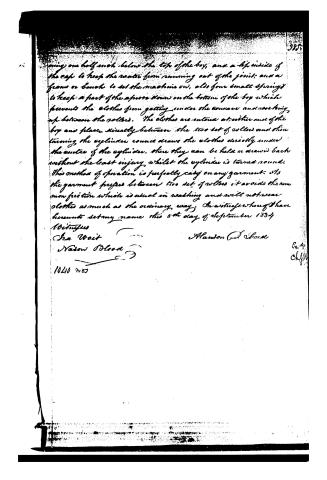
ing) one half inch below the top of the boy, and a lip inside of the cap to keep the water from running out of the joint; and a frame or bench to set the machine on, also four small springs to keep a part of the apron down on the bottom of the boy which prevents the clothes from getting under the apron and working up between the rollers. The clothes are entered at either end of the boy and placed directly between the two set of rollers and then turning the cylinder round draws the clothes directly under the centre of the cylinder, there they can be held or drawn back without the least injury whilst the cylinder is turned round. This method of operation is perfectly easy on any garment. As the garment passes between two set of rollers it avoids the common friction which is usual in washing and will not wear clothes as much as the ordinary way. In witness whereof I have hereunto set my name this 6th day of September 1834
Witnesses
Cha. Wait
Nason Blood
Hanson G. Shoul
1040 nos
Ex 40
Chf. M
Published accounts: journal notice
Notice in the monthly list of patents, with remarks
Journal of the Franklin Institute, new ser., vol. 15 (1835), p. 399 · View the page
24. For an improvement in the Washing Machine; Alanson D. Lord, Bethany, Genesee county, New York, November 24.
Remarks. This washing machine is said to be an improvement upon that obtained by G. A. Stocking, Sept. 10th, 1829, and which was noticed in vol. iv., page 403, as being very imperfectly described, and presenting no claim. We described it as consisting of "a wooden cylinder, the periphery of which is formed of rollers, turned by a crank, and having below the cylinder, a spring board furnished with rollers; when by turning the crank backwards and forwards, the clothes are made to traverse between the cylinder and spring board." The improved machine now patented bears the same general character; it is better described and represented than that upon which it purports to be an improvement, but still we are not informed in what the improvement consists, nor is there any thing in the form of a claim.
About this record
- Patentee
- the Journal of the Franklin Institute, Journal
- Date
- the Name and Date index of patents, USPTO records, Jim Shaw's X-patent list
- Invention
- the Name and Date index of patents
- Listed in
- the Name and Date index of patents, USPTO records, Jim Shaw's X-patent list, the Journal of the Franklin Institute, Burke's List of Patents (1847)
- The patentee's full name comes from the Franklin Institute's journal.
- Burke's 1847 Patent Office list gives the same patent.