

Drawings and documents
USPTO scan
The patent as scanned by the USPTO
-
 Page 1
-
 Page 2


U.S. Patent and Trademark Office · Google Patents
Show the transcription Hide (405 words)
Machine transcription (LightOnOCR) of the pages as scanned by the USPTO, most of them the handwritten copies made when the records were restored after the 1836 fire. Not checked; it can misread handwriting, so compare it with the scan.
Page 1.
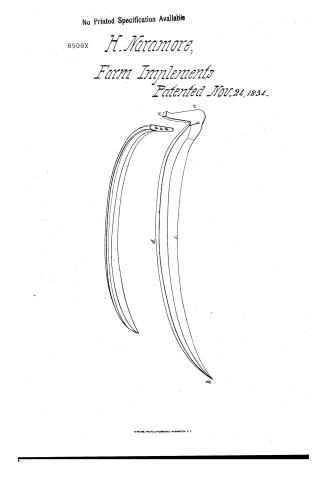
No Printed Specification Available
8508X H. Naramore,
Farm Implements
Patented Nov. 24, 1834.

Page 2.
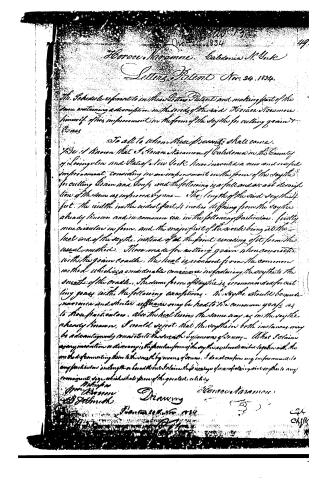
Nov. 24, 1834
Horace Naramore. California N. York
Letters Patent Nov. 24, 1834.
The Schedule referred to in the Letters Patent and making part of the same containing a description in the words of the said Horace Naramore himself of his improvement in the form of the scythe for cutting grain & grass
To all to whom these presents shall come.
Be it known that I Horace Naramore of California in the County of Livingston and State of New York have invented a new and useful improvement consisting in an improvement in the form of the scythe for cutting grain and grass and the following is a full and exact description of the same as improved by me — The length of the said scythe 4 feet. The width in the widest part 14 inches differing from the scythe already known and in common use in the following particulars. Firstly more circular in form, and the major part of the arc being at the heel end of the scythe instead of at the point, arising of it from the usual method. Those made for cutting grass when connected with the grain cradle, the heel is removed from the common method which is a considerable convenience in fastening the scythe to the mouth of the cradle. The same form of scythe is recommended for cutting grass with the following exceptions. The scythe should be made narrower and shallower otherwise may be had to the common grass as to those particular. Also the heel turns the same way as in the scythe already known. I would reject that the scythe in both instances may be advantageously connected to the mouth by means of a screw. What I claim as my invention is the scythe in the form of the scythe as described with the method of connecting them to the mouth by means of screws. I do not confine my improvement to any particular in length or breadth but I claim the privilege of manufacturing scythes to any convenient size which shall be of the greatest utility.
Witness
Horace Naramore
B. Johnson
Drawing
Horace Naramore
Patented Nov. 24, 1834
C. H. N.
49
Published accounts: journal notice
Notice in the monthly list of patents, with remarks
Journal of the Franklin Institute, new ser., vol. 15 (1835), p. 400 · View the page
27. For an improved Scythe; Horace Naramore, Caledonia, Livingston county, New York, November 24.
Remarks. The improvement claimed is in the form of the scythe. "The length is to be four feet, the width in the widest part four inches; differing from the scythe already known, and in common use, in the following particulars. It is to be more circular in its form, the major part of the circle being at the head end of the scythe, instead of the point, reversing the usual method. Those made for cutting grain, when connected with the grain cradle, have the head reversed from the common method, which is a considerable convenience in fastening the scythe to the sneath of the cradle. The same form of scythe is recommended for cutting grass, with the following exceptions; the scythe should be made narrower and shorter; reference may be had to the common grass scythe as to these particulars. The heel also turns the same way as in the scythe already known. I would suggest that the scythe may be advantageously connected to the sneath by means of screws. "What I claim as my invention, is the peculiar form of the scythe as above described, together with the method of connecting them to the sneath by means of screws. I do not confine my improvement to any particular size in length and breadth."
About this record
- Patentee
- DATAMP
- Date
- the Name and Date index of patents, DATAMP, USPTO records
- Invention
- DATAMP
- Listed in
- the Name and Date index of patents, DATAMP, USPTO records, Jim Shaw's X-patent list, the Journal of the Franklin Institute, Burke's List of Patents (1847)
- Burke's 1847 Patent Office list gives the same patent.