

Drawings and documents
National Archives restored drawings: drawing
James Child's Patent Drawing for a Stove

National Archives, Restored Patent Drawings (Record Group 241) · Full-size scan at the National Archives · Catalog record
Show the text on the drawing Hide (138 words)
Words on the drawing as machine-read by the National Archives; not checked. Useful mainly for searching.
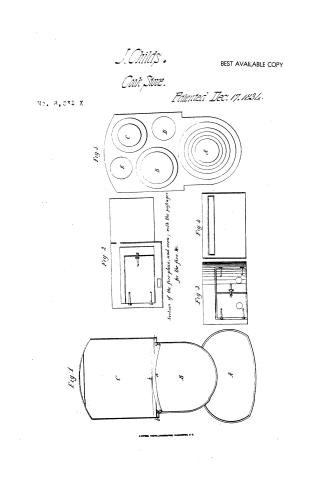
126. STOVES & FU RNACES / [154] Cooking Stoves. / dso / Stove this / JAMESCHILDS'S , / CLASSIFICATION / STOVE. / 8531-X / Patented 17th Dec." 1834. / DIV ISION. / Fig.1. / Fig. 2. / Fig. 5. / E. / C. / C. / B. / Section of the fire place, and oven ; with the pafsages / D. / h. / for the fire. &c. / a. / C. / Fig. 3. / Fig. 4. / B. / A. / A. / Front of the Store. / Back of the fire-place. / REFERENCES. / Fig 1. / Fig 5. / A. The hearth. B. Fire place. / Top plate, and diameter of its orifices. / C Back part, including oven,&c. / A. 5 orifices, varying from 6½. to 15 5/8 inches. / g.h.i. Cast oven back / B. 2 / , 11³/₃; and 83/4 inches. / 1.a.2. Back of the fire-place. / C. 2 / 83/4; and 6 1/2 inches. / b.g.& i.o. Lateral wings, to enlarge / D.1 / 744 inches. / the back part. / E. 1 / 5 inches. / B3.
USPTO scan
The patent as scanned by the USPTO
-
 Page 1
-
 Page 2
-
 Page 3
-
 Page 4
-
 Page 5


U.S. Patent and Trademark Office · Google Patents
Show the transcription Hide (1,490 words)
Machine transcription (LightOnOCR) of the pages as scanned by the USPTO, most of them the handwritten copies made when the records were restored after the 1836 fire. Not checked; it can misread handwriting, so compare it with the scan.
Page 1.
J. Childs.
Cook Stove.
Patented Dec. 17, 1834.
No. 8,531 X
BEST AVAILABLE COPY
Fig. 5
Fig. 2
Section of the fire-place, and oven; with the passages for the fire. &c.
Fig. 4
Fig. 3
Fig. 1
A. PETER, PASTOR, LONDON, 1834.
Page 2.
Dec. 17, 1854
James Childs, of Henniker, New Hampshire.
Letters Patent.
The schedule referred to in these Letters Patent and making part of the same, containing a description in the words of the said James Childs himself of his improvement in the Cooking Stove.
To all to whom these presents shall come — Be it known that J. James Childs, of Henniker, in the County of Merrimack, & State of New Hampshire, have invented a new and useful improvement in the Cooking Stove, and that the following is a full and exact description of the construction and operation of the same as improved by me. The bottom of said stove represented by figure I, accompanying this specification, is composed in part of an iron casting whose surface is represented by the section A, forming the hearth, and the section B, three quarters of an inch lower than the surface of A, forming the fire-place of said stove. The dimensions of said casting are as follows, viz: The greater diameter of the part A, Twenty-five and one half inches, & the lesser diameter to the section B, occupied by the fire, eleven inches. The greater diameter of the part B is nine and a half inches, and the lesser to the extremity denoted by the double line 1a 2, upon Fig. 1, sixteen inches, said casting projects at each side beyond the ends of the double line 1a 2 about two inches and laterally one and a half inch to b & c, in the form included within the double lines upon fig. 1.
There is then another casting extending across the extremity of the one described from b to c, with an horizontal surface one inch wide, by which it is riveted to the under side of the main casting, and a perpendicular ring two inches wide with ears upon its lower side for supporting the remaining part of the bottom. The remainder of the stove bottom represented upon fig. I by B is of thick sheet iron, twenty-two inches wide and seventeen and a half inches long exclusive of the circular projection. It is attached to the cast iron part of the bottom, by the ring appendant to it, two inches below the surface of the fire place. The front part and sides of the stove, as far as the cast iron bottom extends, are also composed of iron castings as follows, viz: one a hollow cylindrical segment forming the front part, twelve inches high, and extending o
Page 3.
inch each side beyond the heart of the stove. This contains two doors, seven and a quarter inches square, forming a double door represented by fig. III, accompanying this specification. The front part is kept in place by a slight prominence of the edges of the top and bottom of the stove, and by an iron rod passing perpendicularly through them near each end of said casting, secured by a nut and screw at the top of the stove. The sides of the stove to the extremity of the cast iron part of the bottom, are each an iron casting twelve inches high & twelve inches wide, fitted to the front casting of the stove, and secured in the same manner by the edges of the top and bottom, and by iron rods passing perpendicularly through them at 1 and 2, fig. 1. From the extreme part of each side casting extends a wing of cast iron, one and a half inches wide, for enlarging the width of the remaining part of the stove. These wings or lateral pieces have tenants at each end, fitting mortices or grooves in the bottom and top of the stove, by which they are kept in place. There are also ears upon the outer edges of said wings, by which the remaining part of the sides of the stove, and the back, formed entire, are secured. These are of Russian sheet iron, twelve inches high & of a length and form describing part C. of fig. I. from b to c.
The back has an aperture, near the middle for a funnel six inches in diameter, and the sides, or one of them, an oven door, and a small aperture under the oven for removing the ashes which may collect in the passage. The oven extends across the stove twenty-two inches & seventeen inches wide, & eight inches high, leaving a space of two inches under it, and four inches above, with a sufficient space behind it, for the passage of the fire to the funnel of the stove. The oven, except the ends, which are formed by the sides of the stove, is of thick sheet iron riveted together, and to the sides, and supported also by a piece of iron attached to the back part of the oven at each corner and passing through the top of the stove, secured by a nut & screw. Between the oven and the back of the fire place, is an iron casting, nine inches high, and extending across the stove, in the form described by the line gh i, upon fig. I. This casting is raised an inch higher than the top of the oven, and is riveted to it, serving to protect the oven from the immediate action of the fire, and also to increase the draught of the stove. There is a space between the iron casting attached to the oven and the back
Page 4.
of the fire place, represented upon fig. I, by the space between the line 1 a 2, and g h i, for the passage of fire under and above the oven of the stove to the funnel. This space is one and three quarter inches wide in the middle at h a, and about two inches at either end. The fire is admitted to it through an horizontal aperture in the back of the fire place. Two inches from the top of the stove seventeen inches long, by two inches wide, and is divided upon its passage through said aperture, a part passing over the oven, and a part under it, to the funnel. The fire may, however, be made to pass entirely over the oven by means of a damper fixed at the back part of the stove. The back of the fire place is an iron casting represented by fig. IV, twelve inches high and nineteen inches long. It rests upon the extremity of the cast iron part of the bottom, in the form of a curve describing the line 1 a 2, upon fig. I, and is kept in place by the iron rods at the points marked 1 & 2, and by slight grooves or projections from the sides and top of the stove. The top of the stove is a single iron casting with a level surface orifices, for kettles, and other furniture, represented by the circle, upon fig. V, accompanying this specification.
It corresponds in its dimensions with the bottom exclusive of the hearth. The orifices upon the top are closed by cast iron lids with holes of sizes, the larger orifices having a lid within a lid, as represented by the circle upon fig. V, for varying the sizes of the orifices, as convenience may require.
Your petitioner claims as an invention made by himself, and improvement in the cooking stove, the passage of the fire by a single horizontal aperture through the back of the fire place, and its equal division & draught under and over the oven, by the elevation of the cast iron back of the oven as high as the middle of said aperture, and above the top of the oven, thus making the space, remote from the fireplace, both under & above the oven larger than at the aperture, also thereby improving the draft of the stove, also the enlargement of the back part of the stove by the perpendicular wing at the bottom, and the wings at the side, whereby a larger oven is made than in any other stove of equal size & other conveniences, and is more uniformly heated by being on a level with the fire place, allowing the fire also, to act more directly upon whatever is placed on the orifices at the top, than in any other stove. In testimony that the above is a true
Page 5.
Specification of my said improvement, as above described, I have hereunto set my hand this twenty-second day of November, Anno Domini one thousand eight hundred and thirty-four.
Witnesses:
Samuel Smith
Calvin Smith
James Childs
Drawing
[1584.10.25]
Published accounts: journal notice
Notice in the monthly list of patents
Journal of the Franklin Institute, new ser., vol. 15 (1835), p. 144 · View the page
595. Cooking stove.-James Childs, Henniker, N. H.
Published accounts: journal notice
Notice in the monthly list of patents, with remarks
Journal of the Franklin Institute, new ser., vol. 16 (1835), p. 24 · View the page
25. For a Cooking Stove; James Childs, Henniker, Merrimack county, New Hampshire, December 17.
Remarks. The claims made by the patentee, are to "the passage of the fire by a single horizontal aperture through the back of the fireplace, and its equal division and draught under and over the oven, by the elevation of the cast iron back of the oven as high as the middle of said aperture, and above the top of the oven. The making the spaces remote from the fireplace, both under and above the oven, larger than the aperture, and thereby improving the draught of the stove. Also, the enlargement of the back part of the stove by the perpendicular wing at the bottom, and the wings at the sides, whereby a larger oven is made than in any other stove of equal size, and other conveniences, and is more uniformly heated by being at a level with the fireplace, allowing the fire also to act more directly upon whatever is placed upon the orifices at the top, than in any other stove." The drawing accompanying this specification is a very imperfect affair, not representing many of the parts described, and several of the figures are without written references; we cannot, therefore, undertake to express a judgment either of its novelty or utility.
About this record
- Patentee
- the Journal of the Franklin Institute, Journal
- Date
- the Name and Date index of patents, USPTO records, Jim Shaw's X-patent list
- Invention
- the Name and Date index of patents
- Listed in
- the Name and Date index of patents, USPTO records, Jim Shaw's X-patent list, the Journal of the Franklin Institute, Burke's List of Patents (1847)
- The patentee's full name comes from the Franklin Institute's journal.
- Burke's 1847 Patent Office list gives the same patent.