

Drawings and documents
National Archives restored drawings: drawing
William Emmons' Patent Drawing for a Machine for Producing Horse Power

National Archives, Restored Patent Drawings (Record Group 241) · Full-size scan at the National Archives · Catalog record
Show the text on the drawing Hide (101 words)
Words on the drawing as machine-read by the National Archives; not checked. Useful mainly for searching.
MECHANICAL POWERS / [159] Horse Powers. / William Emmons, / $2 / OLASSIFICATION / Horse Power / 8559- X / Patented 24 they : 1834, / DIVISION / References. / Fid.1. section. toptriew, / A.A. thirteen feet pieces. / B.B. crosspieces. / DI / C. driving wheel, / D penion on secon d shaft / Elbevel gear F horizoutal shaft, / G eighteen inch spun which H pinion m drumshaft / I.drum, X, beverste which horsesare attached, / @@@@@@@@@@@@@ / heft. / I. / NY / naps / light, / at / by / Patent office Deary 1541 / Made under the direction of the Comminizione of Patents / in conformity with act of Congres. 3'March 1537, / HL / Commisprioms
USPTO scan
The patent as scanned by the USPTO
-
 Page 1
-
 Page 2
-
 Page 3


U.S. Patent and Trademark Office · Google Patents
Show the transcription Hide (681 words)
Machine transcription (LightOnOCR) of the pages as scanned by the USPTO, most of them the handwritten copies made when the records were restored after the 1836 fire. Not checked; it can misread handwriting, so compare it with the scan.
Page 1.
8559X
W. Emmons,
Horse Power,
Patented Dec. 24, 1834.

A.M. PHOTO-LITHO. CO. N.Y. (OSBORNE'S PROCESS)
Page 2.
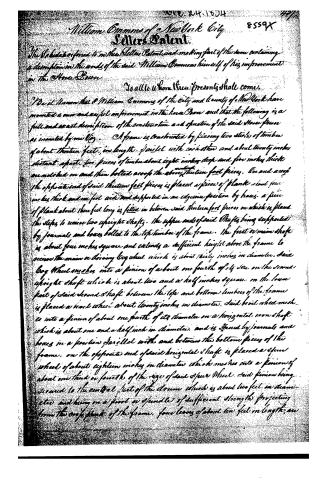
William Emmens of New York City 8559X
Letters Patent.
The Schedule referred to in these Letters Patent and making part of this same containing a description in the words of the said William Emmens himself of his improvement on the Horse Power
To all to whom these presents shall come.
Be it known that I William Emmens of the city and county of New York have invented a new and useful improvement in the horse Power and that the following is a full and exact description of the construction and operation of the said Horse Power as invented by me viz. A frame is constructed by fixing two sticks of timber of about thirteen feet, in length, parallel with each other and about twenty inches distant apart. Two pieces of timber about eight inches deep and five inches thick are notched on and then bolted across the above thirteen foot pieces. On and across the opposite end of said thirteen foot pieces is placed a piece of plank about four inches thick and one foot wide and supported in an edge-wise position by braces. A piece of plank about three feet long is fitted in between said thirteen foot pieces on which is placed the steps to receive two upright shafts. The upper ends of said shafts being supported by journals and boxes bolted to the top timber of the frame. The first or main shaft is about four inches square and extends a sufficient height above the frame to receive the main or driving Cog wheel which is about thirty inches in diameter. Said Cog Wheel meshes into a pinion of about one fourth of its size on the second upright shaft which is about two and a half inches square. On the lower part of said second shaft between the top and bottom timbers of the frame is placed a bevel wheel about twenty inches in diameter. Said bevel wheel meshes into a pinion of about one fourth of its diameter on a horizontal iron shaft which is about one and a half inch in diameter, and is secured by journals and boxes in a position parallel with and between the bottom pieces of the frame. On the opposite end of said horizontal shaft is placed a spur wheel of about eighteen inches in diameter which meshes into a pinion of about one third or fourth of the size of said Spur Wheel. Said pinion being secured to the central part of the drum which is about two feet in diameter and hung on a pivot or spindle of sufficient strength projecting from the one plank of the frame. Four levers of about ten feet in length are
Page 3.
8559X
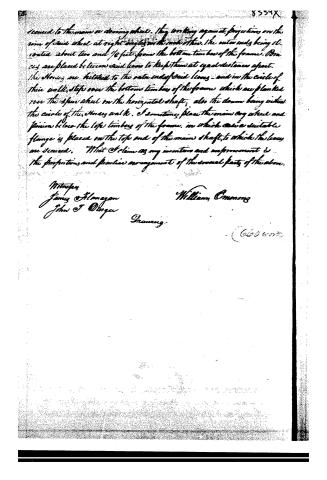
secured to the main or driving wheel. They working against projections on the rim of said wheel at right angles with each other. The outer ends being elevated about two and 1/2 feet from the bottom timbers of the frame. Braces are placed between said levers to keep them at equal distances apart. The Horses are hitched to the outer end of said levers - and in the circle of their walk, step over the bottom timbers of the frame which are planted over the spur wheel on the horizontal shaft; also the down being within the circle of the Horses walk. I sometimes place the main cog wheel and pinion below the top timbers of the frame, in which case a suitable flange is placed on the top end of the main shaft, to which the levers are secured. What I claim as my invention and improvement is the proportions and peculiar arrangement of the several parts of the above.
Witnesses
James Flanagan
John J. Olinger
William Commons
Drawing.
(660 words)
Published accounts: journal notice
Notice in the monthly list of patents, with remarks
Journal of the Franklin Institute, new ser., vol. 16 (1835), p. 36 · View the page
60. For a Horse Power; William Emmons, city of New York, December 24.
Remarks. Were all the thrashing, washing, and churning machines, and all the horse powers, which are patented, really new inventions, we should certainly find in them a most apt exemplification of the versatility of human genius; as it is, however, we must seek elsewhere for our illustrations of this topic. Each of them may be divided into two or three classes, under which, with but few exceptions, all the individuals may be arranged. The horse power before us is one of a very numerous class, and is no more than a variety of a well known species.
About this record
- Patentee
- the Journal of the Franklin Institute, Journal
- Date
- USPTO records, Jim Shaw's X-patent list
- Invention
- the Name and Date index of patents
- Listed in
- the Name and Date index of patents, USPTO records, Jim Shaw's X-patent list, the Journal of the Franklin Institute, Burke's List of Patents (1847)
- The sources give different dates; the date shown is the one most of them agree on.
- The patentee's full name comes from the Franklin Institute's journal.
- The residence comes from the Franklin Institute's journal.
- The Franklin Institute's journal confirms the date shown.
- Burke's 1847 Patent Office list gives the same patent.