

Drawings and documents
National Archives restored drawings: drawing
Issac Adam's Patent Drawing for a Machine for Breaking the Husks of Coffee Berrys

National Archives, Restored Patent Drawings (Record Group 241) · Full-size scan at the National Archives · Catalog record
Show the text on the drawing Hide (46 words)
Words on the drawing as machine-read by the National Archives; not checked. Useful mainly for searching.
83. MILLS. / Grain Scourers. / Disk Face. / OISAAC ADAM / He / 12 scourars / Machine / BERRY / 8586- CLASSIFICATION Disk Face / the HUSK S FOR OF C OFFEE / Fig 2 / Palented Jan.15ᵗʰ / ISION. 1835 / 1855. / Fig 1. / of / 00 / DE / C.
USPTO scan
The patent as scanned by the USPTO
-
 Page 1
-
 Page 2
-
 Page 3
-
 Page 4


U.S. Patent and Trademark Office · Google Patents
Show the transcription Hide (1,174 words)
Machine transcription (LightOnOCR) of the pages as scanned by the USPTO, most of them the handwritten copies made when the records were restored after the 1836 fire. Not checked; it can misread handwriting, so compare it with the scan.
Page 1.
No Printed Specification Available
8586X
I. ADAMS.
MACHINE FOR BREAKING THE HUSKS OF COFFEE BERRIES.
Patented Jan. 13, 1835.


THE NORRIS PETERS CO., PHOTO-LITHO., WASHINGTON, D.C.
Page 2.
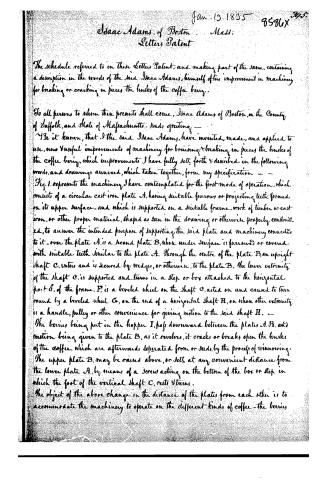
Jan. 13, 1835
Isaac Adams, of Boston, Mass.
Letters Patent
The schedule referred to in these Letters Patent, and making part of the same, containing a description in the words of the said Isaac Adams, himself of his improvement in machinery for breaking or cracking in pieces the husks of the coffee berry.
To all persons to whom these presents shall come, Isaac Adams of Boston, in the County of Suffolk, and State of Massachusetts, says greeting —
Be it known, that I the said Isaac Adams, have invented, made, and applied to use, new and useful improvements of machinery for bruising & breaking in pieces the husks of the coffee berry, which improvements I have fully set forth & described in the following words, and drawings annexed, which taken together, form my specification —
Fig. 1 represents the machinery I have contemplated for the first mode of operation, which consists of a circular cast iron plate A, having suitable furrows or projecting teeth formed on its upper surface, and which is supported on a suitable frame work of timber or cast iron, or other proper material, shaped as seen in the drawing, or otherwise properly constructed, to answer the intended purpose of supporting the said plate and machinery connected to it. Over the plate A is a second plate B, whose under surface is furrowed or covered with suitable teeth similar to the plate A. Through the centre of the plate B, an upright shaft C, enters and is secured by wedges, or otherwise, to the plate B. The lower extremity of the shaft C is supported and turns in a step or box attached to the horizontal part E of the frame. F is a beveled wheel on the shaft C, acted on and caused to turn round by a beveled wheel G, on the end of a horizontal shaft H, on whose other extremity is a handle, pulley or other convenience for giving motion to the said shaft H.
The berries being put in the hopper I, pass downward between the plates A, B, and motion being given to the plate B, as it revolves, it cracks or breaks open the husks of the coffee, which are afterwards separated from or seeds, by the process of winnowing. The upper plate B, may be raised above, or set at any convenient distance from the lower plate A, by means of a screw acting on the bottom of the box or step in which the foot of the vertical shaft C, rests & turns.
The object of the above change in the distance of the plates from each other is to accommodate the machinery to operate on the different kinds of coffee — the berries
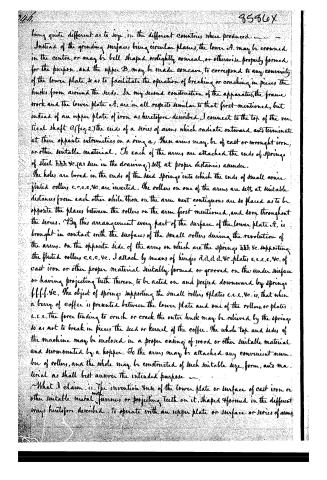
Page 3.
being quite different as to size, in the different countries, where produced.
Instead of the grinding surfaces being circular planes, the lower A may be crowned in the centre, or may be bell shaped, or slightly conical, or otherwise properly formed for the purpose, and the upper B may be made concave, to correspond to any convexity of the lower plate, so as to facilitate the operation of breaking or cracking in pieces the husks from around the seeds. In my second construction of the apparatus, the frame work and the lower plate A, are in all respects similar to that first mentioned, but instead of an upper plate of iron as heretofore described, I connect to the top of the vertical shaft C (fig. 2) the ends of a series of arms which radiate outward and terminate at their opposite extremities in a ring a. These arms may be of cast or wrought iron, or other suitable material. To each of the arms are attached the ends of springs of steel bbb, &c. (as seen in the drawing) set at proper distances asunder.
The holes are bored in the ends of the said springs into which the ends of small conical jointed rollers c.c.c.e, &c. are inserted. The rollers on one of the arms are set at suitable distances from each other while those on the arm next contiguous are so placed as to be opposite the places between the rollers on the arm first mentioned, and so on throughout the series. By this arrangement every part of the surface of the lower plate A, is brought in contact with the surfaces of the small rollers during the revolution of the arms. On the opposite side of the arms on which are the springs bbb, &c. supporting the fluted rollers c.c.c.e, &c. I attach by means of hinges d.d.d.d, &c. plates e.e.e.e, &c. of cast iron or other proper material suitably formed or grooved on the under surface or having projecting teeth thereon, to be acted on and pressed downward by springs f.f.f.f, &c. The object of springs supporting the small rollers & plates e.e.e.e, &c. is, that when a berry of coffee is presented between the lower plate and one of the rollers, or plates e.e.e.e, the force tending to crush or crack the outer husk may be relieved by the springs so as not to break in pieces the seed or kernel of the coffee. The whole top and sides of the machine may be enclosed in a proper casing of wood or other suitable material and surmounted by a hopper. To the arms may be attached any convenient number of rollers, and the whole may be constructed of such suitable size, form, and material as shall best answer the intended purpose.
What I claim is: The invention in use of the lower plate or surface of cast iron or other suitable metal, furrowed or projecting teeth on it, shaped & formed in the different ways heretofore described, to operate with an upper plate or surface or series of arms,
Page 4.
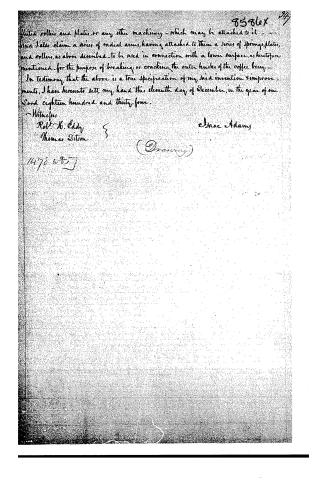
8386x 247
fluted rollers and plates, or any other machinery — which may be attached to it — and I also claim a series of radial arms, having attached to them a series of springs, plates, and rollers, as above described — to be used in connection with a lower surface, as heretofore mentioned — for the purpose of breaking or cracking the outer husks of the coffee berry.
In testimony that the above is a true specification of my said invention & improvements, I have hereunto set my hand this eleventh day of December, in the year of our Lord eighteen hundred and thirty-four.
Witnesses
Roll: H. Eddy
Thomas Ditton
Isaac Adams
(Drawing)
1478 w757
Published accounts: journal notice
Notice in the monthly list of patents, with remarks
Journal of the Franklin Institute, new ser., vol. 16 (1835), p. 91 · View the page
24. For machinery for Breaking the Husk of the Coffee Berry; Isaac Adams, Boston, Massachusetts, January 13.
Remarks. This machinery consists of two horizontal plates of cast iron, the upper of which has an eye through it, and is surmounted by a hopper. These plates are to be furrowed, so as to break the husks with the greater certainty. The distance between the plates may be varied, in order to adapt them to berries of different sizes. The upper plate is made to revolve, motion being communicated to it by a shaft passing through the lower plate. Another modification of the apparatus is mentioned and represented, in which, instead of the upper revolving disk, a wheel with arms, carrying conical rollers sustained upon springs, is made to revolve, so that the rollers shall bear upon and crush the husks, without breaking the berries. We should suppose that common stones, and some of the hulling machines consisting of similar disks, furnished with asperities, would answer the purpose equally well with the first described apparatus. There are, in fact, machines so much like it, as to leave for it but little claim to originality, excepting as applied to coffee berries.
About this record
- Patentee
- DATAMP
- Date
- the Name and Date index of patents, DATAMP, USPTO records
- Invention
- DATAMP
- Listed in
- the Name and Date index of patents, DATAMP, USPTO records, Jim Shaw's X-patent list, the Journal of the Franklin Institute, Burke's List of Patents (1847)
- Burke's 1847 Patent Office list gives the same patent.