

Drawings and documents
National Archives restored drawings: drawing
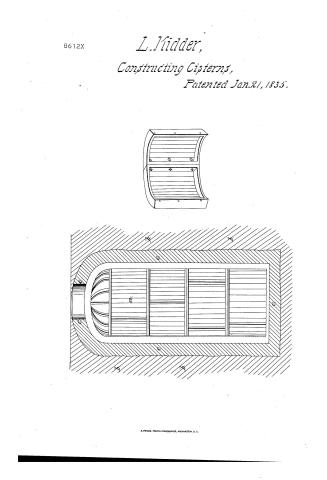
L. Kidder's Patent Drawing for a Method of Constructing Cisterns

National Archives, Restored Patent Drawings (Record Group 241) · Full-size scan at the National Archives · Catalog record
Show the text on the drawing Hide (66 words)
Words on the drawing as machine-read by the National Archives; not checked. Useful mainly for searching.
72. MASONRY. / [51] Cisterns. / $1 / L.KIDDER / CLASSIFICATION / Patented 21 In /835 / 8612-X 8612 - X / Constructing Cislerns / DIVISION. / Restored patents / a. Would / b. Natural earth / C. Puddling / Detail of Sections of Mould / Patent Office ach 731.1842 / Made under the direction of the commissiouer of / Patents in conformity with ach of 3 3 ᵈ March 1837 / Strickland Del / Commysious of Patents
USPTO scan
The patent as scanned by the USPTO
-
 Page 1
-
 Page 2
-
 Page 3
-
 Page 4


U.S. Patent and Trademark Office · Google Patents
Show the transcription Hide (1,138 words)
Machine transcription (LightOnOCR) of the pages as scanned by the USPTO, most of them the handwritten copies made when the records were restored after the 1836 fire. Not checked; it can misread handwriting, so compare it with the scan.
Page 1.
8612X
L. Kidder,
Constructing Cisterns,
Patented Jan. 21, 1835.

Page 2.
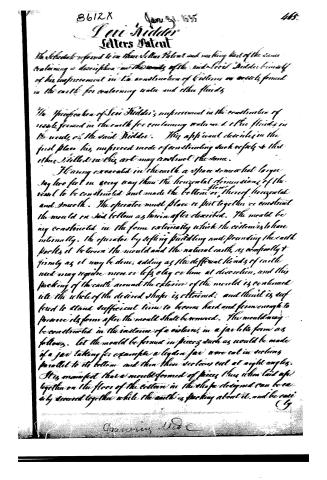
8612X Jan. 21. 1835 465
Levi Hiddler
Letters Patent
The Subscriber referred to in these Letters Patent and making part of the same containing a description in the words of the said Levi Hiddler himself of his improvement in the construction of cisterns or vessels formed in the earth for containing water and other fluids.
The Specification of Levi Hiddler’s improvement in the construction of vessels formed in the earth for containing water and other fluids in the words of the said Hiddler. This applicant describes in the first place his improved mode of constructing such vessels, & that others skilled in this art may construct the same.
Having excavated in the earth a space somewhat larger say two feet in every way than the horizontal dimensions of the vessel to be constructed and made the bottom of thereof horizontal and smooth. The operator must place or put together or construct the mould on said bottom as herein after described. The mould being constructed in the form externally which the cistern is to have internally. The operator by stifling puddling and pounding the earth packs it between the mould and the natural earth as compactly & firmly as it may be done, adding as the different kinds of earth used may require more or less clay or lime at discretion, and this packing of the earth around the exterior of the mould is continued until the whole of the desired shape is obtained, and then it is suffered to stand sufficient time to become hard and firm enough to preserve its form after the mould shall be removed. The mould may be constructed in the instance of a cistern, in a jar like form as follows. Let the mould be formed in pieces such as would be made of a jar taking for example a wooden jar were cut in sections parallel to its bottom and then these sections cut at right angles. It is manifest that a mould formed of pieces thus when laid up together on the floor of the cistern in the shape designed can be easily secured together while the earth is packing about it, and be easily
G. W. H.
Page 3.
8612X
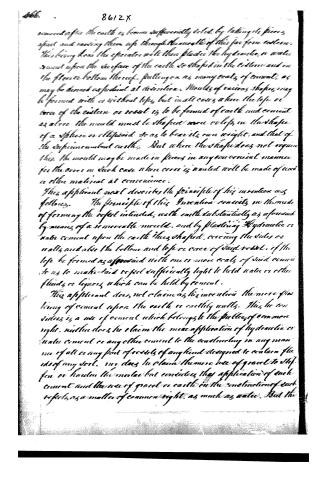
announced within the earth as common insufficiently tested by taking its pieces, spread and mixing them up through the mould of this jar from within. This having done the operator will then plaster the hydraulic or water cement upon the surface of the earth so shaped in the bottom and on the floor or bottom the roof, putting on as many coats of cement, as may be deemed sufficient at discretion. Moulds of various shapes may be formed with or without help, but in all cases where the top or cover of the cistern or vessel is to be formed of earth and cement as above the mould must be shaped more or less in the shape of a sphere or ellipsoid so as to bear its own weight, and that of the superincumbent earth. But where the shape does not require this, the mould may be made in pieces in any convenient manner for the cover in such case where cover is wanted will be made of wood or other material at convenience.
This applicant next describes the principle of his invention as follows. The principle of this invention consists in the mode of forming the vessel intended, with earth substantially as aforesaid by means of a removable mould, and by plastering Hydraulic or water cement upon the earth thus shaped, covering the sides or walls, and also the bottom and top or cover of said vessel, if the top be formed as aforesaid with one or more coats of said cement so as to make said vessel sufficiently light to hold water or other fluids or liquors which can be held by cement.
This applicant does not claim as his invention the mere plastering of cement upon the earth or earthy walls. This, he considers, is a use of cement which belongs to the public of common right, neither does he claim the mere application of hydraulic or water cement or any other cement to the constructing in any manner of all or any part of vessels of any kind designed to contain fluids of any sort. Nor does he claim the mere use of gravel to stiffen or harden the mortar but considers the application of such cement and the use of gravel or earth in the construction of such vessels as a matter of common right as much as water. But the
Page 4.
8612X
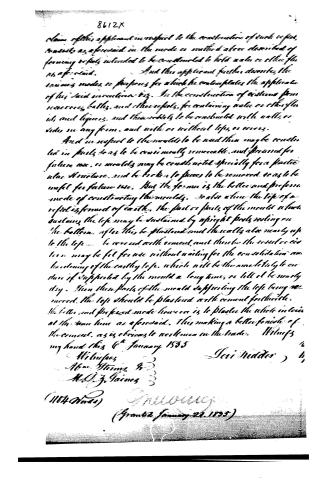
claim of this applicant in respect to the construction of earth vessels, consists as aforesaid in the mode or method above described of forming vessels intended to be constructed to hold water or other fluids aforesaid. And this applicant further describes the various modes or purposes for which he contemplates the application of his said invention viz. In the construction of cisterns, furnaces, baths, and other vessels, for containing water or other fluids, and liquors, and these vessels to be constructed with walls or sides in any form, and with or without tops or covers.
And in respect to the moulds to be used there may be constructed in parts so as to be conveniently removable and preserved for future use, or moulds may be constructed specially for a particular structure, and be broken to pieces to be removed so as to be useful for future use. But the former is the better and preferred mode of constructing the moulds. So also when the top of a vessel is formed of earth, the part or parts of the mould which sustain the top may be sustained by upright posts resting on the bottom, after this, be plastered and the walls also nearly up to the top — be covered with cement, and thereby the vessel or cistern may be fit for use without waiting for the consolidation and hardening of the earthy top, which will be the most likely to endure if supported by the mould a long time, or till it be nearly dry. Then these parts of the mould supporting the top being removed, the top should be plastered with cement forthwith. The better and preferred mode however is to plaster the whole interior at the same time as aforesaid. This making a better finish of the cement, as is obvious to workmen in the trade. Witness my hand this 6th January 1835
Witnesses
Abn. Stimson, Jr.
M. J. Gaines
Jeri Rudder
(1104 Words)
Granted January 21, 1835
Published accounts: journal notice
Notice in the monthly list of patents, with remarks
Journal of the Franklin Institute, new ser., vol. 16 (1835), p. 99 · View the page
45. For an improvement in the construction of Water Cisterns; Levi Kidder, city of New York, January 21.
Remarks. The specification of this patent is made with all due attention to form, but this will not communicate value to that which is not intrinsically good, and such, we think, is the case with the invention before us. Where a cistern is to be made, we are directed to dig out an opening therefor in the ground, somewhat larger than it is designed eventually to be, say two feet in the horizontal dimensions. A mould of wood is then to be made of the intended size of the cistern; this should be formed in sections, so that it can eventually be removed; it may be in the form of a jar, lessening at top. The earth taken out is then to be sifted, puddled, and pounded, and closely packed in all round the mould, adding clay or lime at discretion. This is to stand a sufficient length of time to become hard and firm; the mould is then to be removed, and the inside plastered with hydraulic cement. The patentee does not claim the plastering with cement upon the earthy walls, or the use of gravel to harden the mortar. "But the claim of this applicant in respect to the construction of such vessels, consists, as aforesaid, in the mode or method above described, of forming vessels intended to be constructed to hold water, or other fluid, as aforesaid." Which claim falls very short of distinguishing the plan of the patentee from that of others. Where the earth is compact, a better cistern would be made by merely excavating and plastering, and, in any situation, a wall of brick, well lined with cement, would be far better than one of earth, and it would be quite as cheap as that proposed.
About this record
- Patentee
- DATAMP
- Date
- the Name and Date index of patents, DATAMP, USPTO records
- Invention
- DATAMP
- Listed in
- the Name and Date index of patents, DATAMP, USPTO records, Jim Shaw's X-patent list, the Journal of the Franklin Institute