

Drawings and documents
National Archives restored drawings: drawing
H. Pepper's Patent Drawing for a Machine for Sawing Staves and Other Kinds of Cylindrical Work

National Archives, Restored Patent Drawings (Record Group 241) · Full-size scan at the National Archives · Catalog record
Show the text on the drawing Hide (82 words)
Words on the drawing as machine-read by the National Archives; not checked. Useful mainly for searching.
$1 / 143. / W.OOD-SAWING. / Saw-Teeth. / Batented Feby. 5. 1835 / IDATION / 8624+ / DIV ISION. / H o PEPPER / Sawing staves & other kinds opoytindrical Work / Manner in which Teeth are attached / Patented 5th Feb 1835 / to Cylinder / E' / A Frame / B.Horizontal shaft / C. Cylindrical saw / E'. When or Pulley 07' / Patent office aug 13th 180 / Strickland Del / Made under the direction of the commissioner / hatents in conformity with acty 3 March 1837- / ManyL / Commisponer of Maty
USPTO scan
The patent as scanned by the USPTO
-
 Page 1
-
 Page 2


U.S. Patent and Trademark Office · Google Patents
Show the transcription Hide (416 words)
Machine transcription (LightOnOCR) of the pages as scanned by the USPTO, most of them the handwritten copies made when the records were restored after the 1836 fire. Not checked; it can misread handwriting, so compare it with the scan.
Page 1.
8624X
H. Pepper,
Saw Teeth.
Patented Feb. 5, 1895.

AM. PHOTO-LITHO. CO. N.Y. (OSBORNE'S PROCESS)
Page 2.
UNITED STATES PATENT OFFICE
8624X
HART PEPPER, OF SOUTHWICK, MASSACHUSETTS.
IMPROVEMENT IN THE MODE OF SAWING STAVES.
Specification forming part of Letters Patent dated February 5, 1835.
To all whom it may concern:
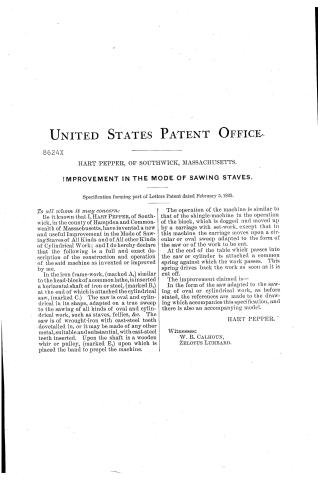
Be it known that I, HART PEPPER, of Southwick, in the county of Hampden and Commonwealth of Massachusetts, have invented a new and useful Improvement in the Mode of Sawing Staves of All Kinds and of All other Kinds of Cylindrical Work; and I do hereby declare that the following is a full and exact description of the construction and operation of the said machine as invented or improved by me.
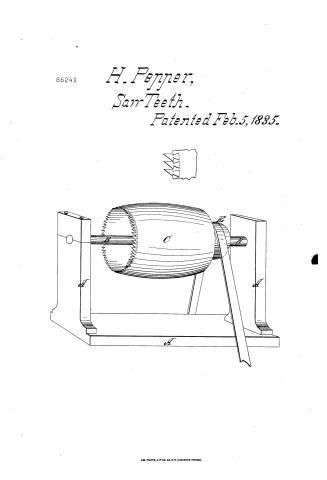
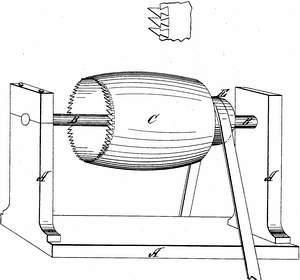
In the iron frame-work, (marked A,) similar to the head-block of a common lathe, is inserted a horizontal shaft of iron or steel, (marked B,) at the end of which is attached the cylindrical saw, (marked C.) The saw is oval and cylindrical in its shape, adapted on a true sweep to the sawing of all kinds of oval and cylindrical work, such as staves, fellies, &c. The saw is of wrought-iron with cast-steel teeth dovetailed in, or it may be made of any other metal, suitable and substantial, with cast-steel teeth inserted. Upon the shaft is a wooden whir or pulley, (marked E,) upon which is placed the band to propel the machine.
The operation of the machine is similar to that of the shingle-machine in the operation of the block, which is dogged and moved up by a carriage with set-work, except that in this machine the carriage moves upon a circular or oval sweep adapted to the form of the saw or of the work to be cut.
At the end of the table which passes into the saw or cylinder is attached a common spring against which the work passes. This spring drives back the work as soon as it is cut off.
The improvement claimed is—
In the form of the saw adapted to the sawing of oval or cylindrical work, as before stated, the references are made to the drawing which accompanies this specification, and there is also an accompanying model.
HART PEPPER.
Witnesses:
W. B. CALHOUN,
ZELOTUS LUMBARD.
Published accounts: journal notice
Notice in the monthly list of patents, with remarks
Journal of the Franklin Institute, new ser., vol. 16 (1835), p. 158 · View the page
2. For a Machine for Sawing Staves, and other cylindrical work; Hart Pepper, Southwick, Hampden county, Massachusetts, February 5.
Remarks. This machine consists of a mandrel, mounted in the manner of a collar and mandrel lathe, and carrying a saw, which is represented as barrel shaped, and which must, of necessity, be of the dimensions of the vessels which the staves are intended to form; the saw, we are told, may be made of wrought iron, with cast steel teeth inserted in the cutting edge. The stuff is to be fixed upon a suitable carriage, furnished with guides of the proper form, to bring it up against the saw. There is not any claim made, nor are there any directions given more definite than those above indicated. Saws very similar to the foregoing have been long in use, but it would be a formidable task to make one, the body of which should be sufficiently true, whilst its dimensions were equal to that of a pipe, or hogshead.
DATAMP: illustration
Illustrations from DATAMP

DATAMP (Directory of American Tool and Machinery Patents), via the Internet Archive · Archived DATAMP page
About this record
- Patentee
- DATAMP
- Date
- the Name and Date index of patents, DATAMP, USPTO records
- Invention
- DATAMP
- Listed in
- the Name and Date index of patents, DATAMP, USPTO records, Jim Shaw's X-patent list, the Journal of the Franklin Institute, Burke's List of Patents (1847)
- Burke's 1847 Patent Office list gives the same patent.