

Drawings and documents
USPTO scan
The patent as scanned by the USPTO
-
 Page 1
-
 Page 2
-
 Page 3


U.S. Patent and Trademark Office · Google Patents
Show the transcription Hide (619 words)
Machine transcription (LightOnOCR) of the pages as scanned by the USPTO, most of them the handwritten copies made when the records were restored after the 1836 fire. Not checked; it can misread handwriting, so compare it with the scan.
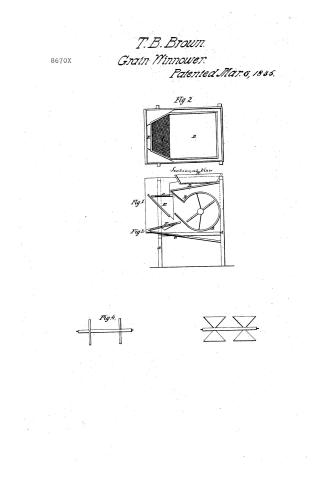
Page 1.
8670X
T. B. Brown.
Grain Winnowers.
Patented Mar. 6, 1835.
Fig. 2.

Sectional View
Fig. 1.

Fig. 3.

Fig. 4.

Page 2.
8670X Mar. 6, 1835 March 6, 1835
Townman B. Bown of Locke, New York
Letters Patent.
The Schedule referred to in these Letters Patent and making part of this same containing a description in the word of the said Townman B. Bown himself of his improvement in the Winnowing Mill.
To all to whom these Presents shall come:
Know that I, Townman B. Bown of the Town of Locke in the County of Cayuga and State of New York, have invented a new and useful improvement in the Winnowing Mill for cleaning Grain, and that the following is a full and exact description of the construction and operation of the said Machine as invented and improved by me.
1st. The Body of the mill is made with a frame of timber 2 inches square, one each side on two posts 3 feet 8 inches high. The frame is 2 feet 8 inches wide, connected by 2 girts, one at the top, the other 16 inches from the bottom. To this frame the boards for the sides are fastened on the inside of the frame covering it from top to bottom, and projecting at the far end of the mill (the end at which the clean stuff and chaff leave the mill) 6 inches beyond the frame. These sides are set up 26 inches apart, 17 inches from the top and 11 from the back end of the Mill. In the center of a cylinder 18 inches in diameter on the inside extending across the mill, having an opening towards the far end of the mill 6 1/2 inches wide, adjoining this is a passage inclining the air upwards at an angle of 43 degrees. The opening at the top of which is 10 inches long, 23 inches wide at the hind end and 9 inches wide at the far end. At the bottom of this passage is an opening 3 inches wide next to the cylinder, through which the grain passes on the screen.
2nd. A Shoe placed under the hopper with a drop of 2 inches when the current of air comes into contact with the grain, so as to meet it in a broken condition 5 inches from the cylinder. This shoe has a coarse screen a little wider than the top of the passage rising at the far end.
3rd. The first screen below the passage is so constructed as to convey the grain to the upper end of the lower screen, after it has passed through the first. Thus getting the whole use of the lower and most important screen.
4th. A Wheel or blower consisting of a shaft with 2 arms framed through it each of which is 5 inches from the inside of the mill. To each of these arms are attached two wings, crossing each other in the middle at right angles at the shaft, of such a length as to leave a space of 4 inches vacant at the middle of the shaft. The parts of the above described mill which are claimed as newly invented and as improvements for which a Patent is requested are the parts described in the 2nd, 3rd, 4th & 5th numbers above specified. The shaking of the screens and manner
Page 3.
316. 8676X
of operation of the mill in other respects is the same as in the winnowing Mills in common use
Exps. Witnesses
Nylb Augustus Sperrill
Select. J. Kelley.
Shuman. O. Brown
(Patented March 6, 1835) (594 words)
Drawing made
Published accounts: journal notice
Notice in the monthly list of patents, with remarks
Journal of the Franklin Institute, new ser., vol. 16 (1835), p. 232 · View the page
11. For a Winnowing Machine; Truman B. Brown, Locke, Cayuga county, New York, March 6.
Remarks. What are called improvements in this apparatus, appear to us of so trifling a character, as not to demand the time and space which would be required to make them known.
About this record
- Patentee
- DATAMP
- Date
- the Name and Date index of patents, DATAMP, USPTO records
- Invention
- DATAMP
- Listed in
- the Name and Date index of patents, DATAMP, USPTO records, Jim Shaw's X-patent list, the Journal of the Franklin Institute, Burke's List of Patents (1847)
- Burke's 1847 Patent Office list gives the same patent.