

Drawings and documents
USPTO scan
The patent as scanned by the USPTO
-
 Page 1
-
 Page 2
-
 Page 3
-
 Page 4
-
 Page 5


U.S. Patent and Trademark Office · Google Patents
Show the transcription Hide (1,383 words)
Machine transcription (LightOnOCR) of the pages as scanned by the USPTO, most of them the handwritten copies made when the records were restored after the 1836 fire. Not checked; it can misread handwriting, so compare it with the scan.
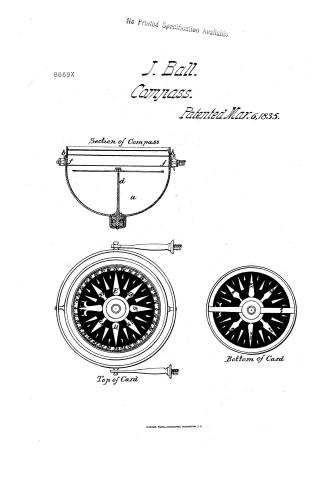
Page 1.
No Printed Specification Available
8669X
J. Ball.
Compass.
Patented Mar. 6, 1835.
Section of Compass

Top of Card

Bottom of Card

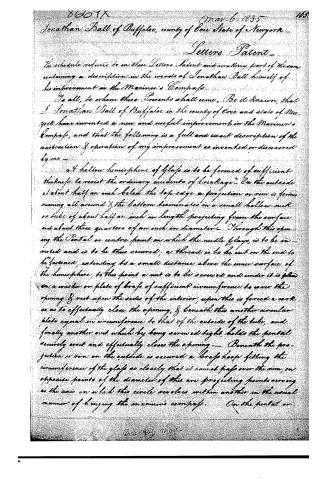
Page 2.
8667X
Mar. 6, 1835
Jonathan Ball of Buffalo, county of Erie State of New York—
Letters Patent—
The schedule referred to in these Letters Patent and making part of this one containing a description in the words of Jonathan Ball himself of his improvement in the Mariner’s Compass.
To all, to whom these Presents shall come. Be it known, that I Jonathan Ball of Buffalo in the county of Erie and state of New York have invented a new and useful improvement in the Mariner’s Compass, and that the following is a full and exact description of the construction & operation of my improvement as invented or discovered by me—
A hollow hemisphere of glass is to be formed of sufficient thickness to resist the ordinary accidents of breakage. On the outside at about half an inch below the top edge a projection or rim is formed running all around & the bottom terminates in a small hollow neck or tube of about half an inch in length projecting from the surface and about three quarters of an inch in diameter. Through this opening the Pental or centre point on which the needle plays, is to be inserted and is to be thus secured; a thread is to be cut on the end to be fastened, extending to a small distance above the inner surface of the hemisphere, to this point a nut is to be screwed and under it is placed on a washer or plate of brass of sufficient circumference to cover the opening & rest upon the sides of the interior, upon this is forced a cork so as to effectively close the opening, & beneath this another circular plate equal in circumference to that of the outside of the tube, and finally another nut which by being screwed tight, holds the pental securely over and effectively closes the opening— Beneath the projection or rim on the outside is secured a brass hoop filling the circumference of the glass so closely that it cannot pass over the rim, on opposite points of the diameter of this are projecting points serving as the axis on which this circle revolves within another in the usual manner of hanging the mariner’s compass. On the pental or
Witness More
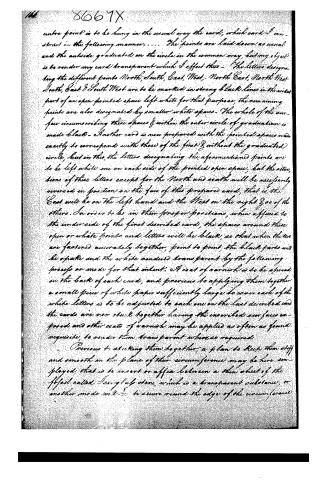
Page 3.
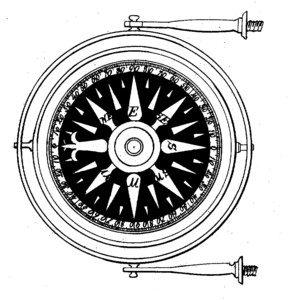
centre point is to be hung in the usual way the card, which card I construct in the following manner. . . . . The points are laid down as usual and the outside graduated on the circle in the common way, but my object is to render my card transparent which I effect thus—The letters designating the different points North, South, East, West, North East, North West, South, East & South West are to be marked in strong black lines in the wider part of an open pointed space left white for that purpose, the remaining points are also designated by smaller white spaces. The whole of the surface circumscribing these spaces & within the outer circle of graduation is made black. Another card is now prepared with the pointed spaces made exactly to correspond with those of the first & without the graduated circle, but in this, the letters designating the aforementioned points are to be left white one on each side of the pointed open space, but the situations of these letters except for the North and south will be necessarily reversed in position on the face of this prepared card, that is the East will be on the left hand and the West on the right & so of the others. In order to be in their proper positions, when affixed to the underside of the first described card, the spaces around these open or white points and letters will be black, so that when the two are fastened accurately together, point to point, the black parts will be opaque and the white rendered transparent by the following process or mode for that intent. A coat of varnish is to be spread on the back of each card, and previous to applying them together a small piece of white paper sufficiently large to cover each of the white letters is to be adjusted to each one on the last described and the cards are now stuck together having the inscribed surfaces exposed and other coats of varnish may be applied as often as found requisite, to render them transparent where so required.
Previous to sticking them together, a plan to keep them stiff and smooth in the plane of their circumference may be here employed, that is to insert or affix between a thin sheet of the foil called King of stone, which is a transparent substance, or another mode will be, to secure round the edge of the circumference.
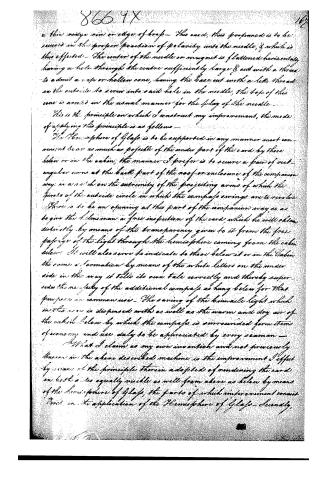
Page 4.
866 9X
a thin ridge, rim or edge of glass. This card, thus prepared is to be secured in the proper position of polarity into the needle, & which is thus effected. The center of the needle or magnet is flattened horizontally having a hole through the center sufficiently large & cut with a thread to admit a cap or hollow cone, having the base cut with a little thread on the outside to screw into said hole in the needle, the top of this cone is armed in the usual manner for the play of the needle.
This is the principle on which I construct my improvement, the mode of applying this principle is as follows—
The Hemisphere of Glass is to be supported in any manner most convenient to as as much as possible of the under part of the card by those below or in the cabin, the manner I prefer is to secure a pair of rectangular arms at the back part of the roof or enclosure of the companion way, in a such on the extremity of the projecting arms of which the pivots of the outside circle in which the compass swings are to revolve. There is to be an opening at this part of the companion way so as to give the Seaman a free inspection of the card, which he will obtain distinctly by means of the transparency given to it from the free passage of the light through the hemisphere coming from the cabin below. It will also serve to indicate to those below it or in the Cabin the correct information by means of the white letters on the under side in this way it tells its own tale correctly and thereby supercedes the necessity of the additional compass as hung below for that purpose in common use. The saving of the binacle light which in this way is dispensed with as well as the warm and dry air of the cabin below by which the compass is surrounded form items of economy and use duly to be appreciated by every seaman—
What I claim as my own invention and not previously known in the above described machine is the improvement I effect by means of the principle therein adopted of rendering the card on both sides equally visible as well from above as below by means of the Hemisphere of Glass, the parts of which improvement consist first in the application of the Hemisphere of Glass—Secondly,
Page 5.
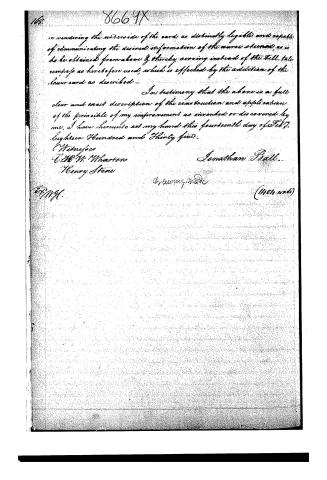
in rendering the underside of the card as distinctly legible and capable of communicating the desired information of the course steered, as is to be obtained from above, & thereby serving instead of the tell tale compass as heretofore used, which is effected by the addition of the lower card as described.
In testimony that the above is a full clear and exact description of the construction and application of the principle of my improvement as invented or discovered by me, I have hereunto set my hand this fourteenth day of Feb. 1837.
Witnesses
C.H. W. Wharton
Henry Stone
Jonathan Ball.
By authority made
(1404 words)
Published accounts: journal notice
Notice in the monthly list of patents, with remarks
Journal of the Franklin Institute, new ser., vol. 16 (1835), p. 234 · View the page
17. For an improvement in the Mariners' Compass; Jonathan Ball, Buffaloe, Erie county, New York, March 6.
Remarks. The patentee concludes his specification with the following claims: "Rendering the card on both sides equally visible, as well from above as below, by means of the hemisphere of glass." This glass hemisphere is to take the place of the brass hemisphere, within which the compass card ordinarily plays. There is to be an opening through the deck, under the binnacle, that the steersman may see the card by the light in the cabin, whilst it is visible in that apartment also. In the second volume of the new series of this journal, p. 129, there is the specification of an improvement in the mariners' compass, combining all the essential features of that now patented, with the addition of perfect security to the instrument against injury by cannon shot, from its being contained within the thickness of the deck. The patentee in that specification says, "The compass box is made with a glass bottom, so that the card can be seen as perfectly in the cabin as upon deck; I also make the compass card translucent, in consequence of which it may be lighted from below; the compass is defended at top by a very thick piece of glass; the lower side of the box is also glazed, and I contemplate sometimes the making the sides of the box, of glass." The foregoing quotation from the patent of 1798 will show, clearly, the identity of the two contrivances; and, if report be true, the same thing had been in use on board of some British national vessels previously to the above date.
DATAMP: illustration
Illustrations from DATAMP
DATAMP (Directory of American Tool and Machinery Patents), via the Internet Archive · Archived DATAMP page
About this record
- Patentee
- DATAMP
- Date
- the Name and Date index of patents, DATAMP, USPTO records
- Invention
- DATAMP
- Listed in
- the Name and Date index of patents, DATAMP, USPTO records, Jim Shaw's X-patent list, the Journal of the Franklin Institute, Burke's List of Patents (1847)
- Burke's 1847 Patent Office list gives the same patent.