

Drawings and documents
USPTO scan
The patent as scanned by the USPTO
-
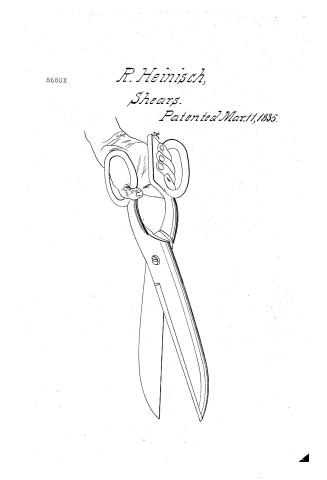 Page 1
-
 Page 2


U.S. Patent and Trademark Office · Google Patents
Show the transcription Hide (518 words)
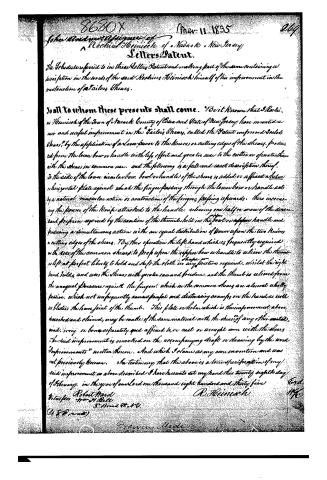
Machine transcription (LightOnOCR) of the pages as scanned by the USPTO, most of them the handwritten copies made when the records were restored after the 1836 fire. Not checked; it can misread handwriting, so compare it with the scan.
Page 1.
8680X
R. Heinisch,
Shears.
Patented Mar. 11, 1835.
Page 2.
8680X
Mar 11, 1835
John Andrew Wagoner of
Rochester, New York
Letters Patent.
The Schedule referred to in these Letters Patent and making part of the same containing a description in the words of the said Rochius Heinisch himself of his improvement in the construction of Tailors Shears.
To all to whom these presents shall come. Be it known that Rochius Heinisch of the Town of Tivoli, County of Essex and State of New Jersey have invented a new and useful improvement in the "Tailor's Shears," called the Patent improved Tailor's Shears, by the application of a lever, power to the knives or cutting edges of the shears, produced from the lower bow or handle with less effort and greater ease to the cutter or operator than with the shears in common use, and the following is a full and exact description thereof.
To the side of the lower circular bow, bowl or handle of the shears is added or affixed a helical or horizontal plate against which the finger passing through the lower bow or handle acts by a natural muscular action or contraction of the fingers, pressing upwards, thus increasing the power of the knife attached to the handle, relieving one half or more of the downward pressure required by the exertion of the thumb held in the bowl or upper handle and producing a simultaneous action with an equal distribution of power upon the two knives or cutting edges of the shears. By this operation the left hand which is frequently required in the use of the common shears to press upon the upper bow or handle to relieve the thumb is left at perfect liberty to hold and shape the cloth in any position required, whilst the right hand holds and uses the shears with greater ease and freedom, and the thumb is relieved from the unequal pressure against the fingers which in the common shears are almost wholly passive, which not unfrequently causes painful and distressing cramps in the hand, as well as affects the lower joint of the thumb. This plate or helix which is the improvement above described and claimed, may be made of the same material with the shears or of any other metal, wood, ivory or bone, separately and affixed to, or cast or wrought in with the shears. The said improvement is marked on the accompanying draft or drawing by the word "Improvements" written thereon. And which I claim as my own invention and was not previously known. In testimony that the above is a true specification of my said improvement as above described I have hereunto set my hand this twenty eighth day of February, in the year of our Lord one thousand eight hundred and thirty five.
Robert Ward
Witness
R. Heinisch
(4 & 5 words)
Drawers Made
Published accounts: journal notice
Notice in the monthly list of patents, with remarks
Journal of the Franklin Institute, new ser., vol. 16 (1835), p. 237 · View the page
Shears; John Andrews, assignee of Rockus Heinisch, city of New York, March 11.
Remarks. The upper side of the lower bow, or ring, of the shears is to be made flat, or widened out, so that the fingers which press upon it in the act of cutting, may exert their power without the inconvenience experienced in the uses of shears as ordinarily made. The claim is simply to the widening out this part, as described.
DATAMP: illustration
Illustrations from DATAMP
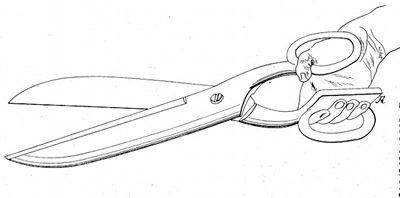
DATAMP (Directory of American Tool and Machinery Patents), via the Internet Archive · Archived DATAMP page
About this record
- Patentee
- DATAMP
- Date
- the Name and Date index of patents, DATAMP, USPTO records
- Invention
- DATAMP
- Listed in
- the Name and Date index of patents, DATAMP, USPTO records, Jim Shaw's X-patent list, the Journal of the Franklin Institute, Burke's List of Patents (1847)
- Burke's 1847 Patent Office list gives the same patent.