

Drawings and documents
USPTO scan
The patent as scanned by the USPTO
-
 Page 1
-
 Page 2
-
 Page 3
-
 Page 4
-
 Page 5
-
 Page 6


U.S. Patent and Trademark Office · Google Patents
Show the transcription Hide (1,887 words)
Machine transcription (LightOnOCR) of the pages as scanned by the USPTO, most of them the handwritten copies made when the records were restored after the 1836 fire. Not checked; it can misread handwriting, so compare it with the scan.
Page 1.
8681X
Caton & Rives.
Registering App's for Printing Press.
No.
Patented Mar. 11, 1835.

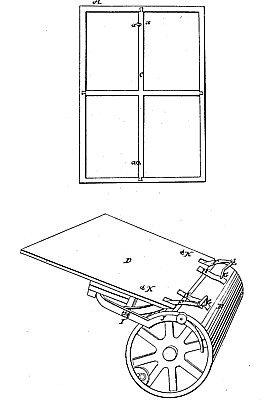
Sideview
Endview
Page 2.
8681 X Mar 11, 1835 1
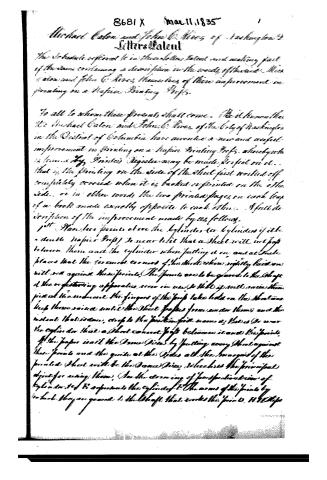
Michael Eaton and John C. Rives of Washington D.
Letters Patent
The Schedule referred to in these Letters Patent and constituting part
of the same containing a description in the words of the said Eaton
and John C. Rives, the nature of their improvement in
printing on a Napier Printing Press.
To all to whom these presents shall come. We do know that
the Michael Eaton and John C. Rives of the City of Washington
in the District of Columbia have invented a new and useful
improvement in printing on a Napier Printing Press, which
is hereinafter described, may be made perfect on it.
That is, the printing on the side of the sheet first rolled off
completely covered when it is backed or printed on the other
side, or in other words the two printed pages on each leaf
of a book made exactly opposite to each other. A full description of the improvement made by us follows.
1st. Napier’s points are on the cylinder (or cylinders if it be
a double Napier Press) so near to it that a sheet will not pass
between them and the cylinder when putting it on and at such
places that the foremost corners of the sheets when rightly laid on
will not against those points. The points are to be placed to the shaft
of the registering apparatus now in use so that it will raise them
just at the moment the fingers of the press take hold on the sheets and
keep them raised until the sheet passes from under them; and the
instant that is done, drop to the position first named; that is, near
the cylinder that a sheet cannot pass between it and the points.
If the paper is all the same size by putting away sheets against
those points and the guide at the sides all the margins of the
printed sheet will be the same size, which is the principal
object for using them. In the drawing of perspective view of
cylinder it is supposed the cylinder is the arms of the points by
which they are guided to the shaft that works the press. H. H. H. H.
Page 3.
of the other, so from A which the points set off. The end of the shaft being the arms of the points one yard. 2. Make two Stems, and on the head of each the letter c, just as it is on a type, and about the size of large printer's stem these put into one of the cross bars of the clamp on the three lines. It will be just as high as the type, locked up on it, so at such places that they will make an impression upon the printed sheet about ten inches from each edge of it. In working off the first Side, these stems will make impressions on any sheet that may be seen distinctly when the paper is turned to work off the Second Side. The Cylinders of a double Napier Press fall a little when passing over the cross bar in working a form on it; therefore the heads of the Stems should not be quite so high as the type, because if they are they will frequently make a hole through the paper which should not be done. The stems should be so regulated that their heads will make about the same impressions as are made by the types. (See drawing of... chase) and size of the stems. To represent the cross bars of the chase and c.c. the stems.
3. Place on the inclined board, upon which the Sheet is laid to be torn off by the fingers of the press. Two movable points just the distance apart as the Stems in the chase are. These points should rise about one fourth of an inch above the board. In working off the Second Side put the centre of the c. made on the paper by the Stems on the chase in working off the first Side, exactly over these points and more than whichever may maybe moving under the press will make register on the Sheet when it is taken off by the fingers of the press. It will require a boy on each Side of the press to lay on the Sheet when working off the Second Side.
These or three movable points will enable two boys to lay on 25 sheets a minute, which are as many as can be worked off within that time by a single Cylinder. In working off the Second Side the points that bear are fast which have been for no duration maybe used instead of those above mentioned, when the points that rise and fall are used they should be stuck through the Sheet in the centre of the c. made
Page 4.
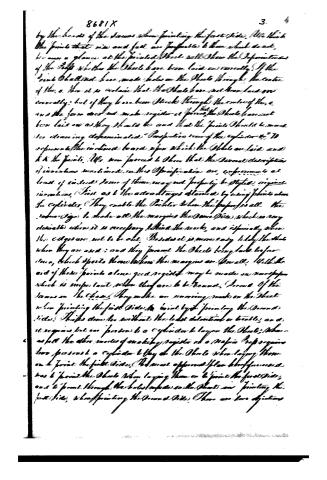
by the boards of the frames when printing the first side. We think the points that are and fast are preferable to those which do not, because a glance at the printed sheet will show the Superintendence of the Pulp whether the Sheets have been laid on correctly. If the Pulp should not have made holes in the Sheets through the centre of the o. then it is certain that the Sheets have not been laid on correctly; but if they have been struck through the centre of the o. and the form does not make register it follows that the Sheets have not been laid on as they should be and that the points should be made the drawing determined. "Perfection true of the cylinder is" is separate the inclined board upon which the Sheets are laid and X X the points. We now proceed to show that the General description of invention mentioned in this Specification are, improvements at least if indeed some of them may not properly be styled, original inventions. First as to the advantages obtained by using points above for cylinders. They enable the Printer when the paper is all the same size to make all the margins the same size, which is very desirable when it is necessary to bind the work, and especially when the edges are not to be cut. Besides it is more easy to lay the sheets when they are used; and they prevent the Sheets being laid too far down, which spoils them when the margins are small. With the aid of these points alone good register may be made on war paper which is important when they are to be bound. Some of the frames on the Chart they make an uneven mark on the Sheet when printing the first side to be used by printing the Second side. This is done too without the least detriment or trouble, as it requires but one person to a cylinder to lay the Sheets; whereas all the other modes of making register at a Mapin Press require two persons to a cylinder to lay the Sheets when laying them on to print the first side. And must appear if one hand is used to print the Sheets when laying them on to print the first side, and to print through the holes made on the Sheets on printing the first side, when printing the Second side. There are two objections
Page 5.
8681X
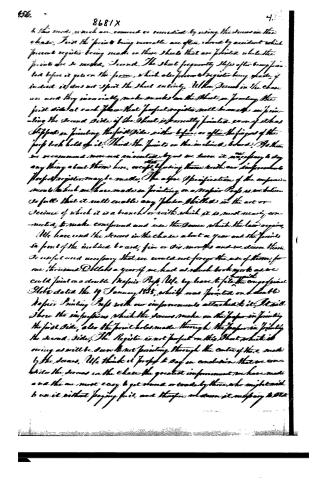
In this manner, we much are removed as recommended by using the screws in the chase. First, the "points" being movable are often struck by accident which prevents register being made on those sheets that are printed while the points are so moved. Second, The sheet frequently slips after being printed before it gets on the form, which also prevents register being made, if indeed it does not spoil the sheet entirely. When screws in the chase are used they invariably make marks on the sheet on printing the first side at each place that "perfect register" will be made on printing the second side if the sheet is perfectly printed soon after has slipped on printing the first side either before or after the finger of the press took hold of it. Third, the points on the inclined boards. As these we recommend more not evocated by us we know it necessary to say anything about them here, except by using them with our improvements perfect register may be made. The above Specification of the improvements which we have made in printing on a Repair Press as we believe so full that it will enable any "person skilled" in the art or science of which it is a branch or with which it is most nearly connected, to make compound and use the same which the law requires. We have used the screws in the chase about a year and the points in front of the inclined board, five or six months and we deem them so useful and necessary that we would not forego the use of them, for one thousand Dollars a year if we had as much book work as we could print on a double Repair Press. We by leave to file the original Note dated the 19 January 1835, which was printed on a double Repair Printing Press with our improvements attached to it. It will show the impressions which the screws make on the paper in printing the first side, also the print holes made through the paper in printing the second side. The Register is not perfect on this sheet which is owing as will be seen to not printing through the centre of the c. made by the screws. We think it proper to say in conclusion that we consider the screws in the chase the greatest improvement we have made and the one most easy to get round or evade by those who might wish to use it without paying for it, and therefore we deem it necessary to file
Page 6.
8681X
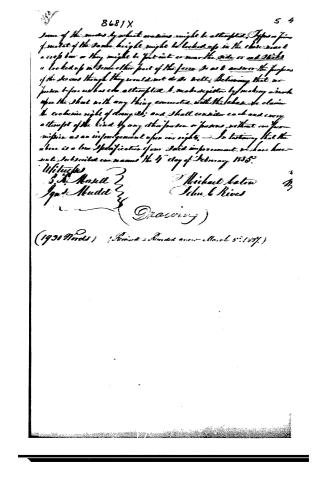
Some of the modes by which evasions might be attempted. If a fence of posts of the same height might be locked up in the close near a crop bar or they might be put out or near the side or end sticks a locked up in some other part of the farm so as to answer the purpose of the fences though they would not do so well. Believing that no person before us has ever attempted to make a registration by making a break upon the shot with any thing connected with the close, we claim the exclusive right of doing so; and shall consider each and every attempt of the kind by any other person or persons without our permission as an infringement upon our rights. In testimony that the above is a true specification of our said improvement, we have hereunto subscribed our names the 4th day of February 1835.
Witnesses
J. B. Russell
John Mudd
Michael Bates
John L. Rives
(Drawing)
(1930 Words) (Record & Record annexed March 5th 1837.)
Published accounts: journal notice
Notice in the monthly list of patents, with remarks
Journal of the Franklin Institute, new ser., vol. 16 (1835), p. 236 · View the page
21. For an improvement on the Napier Printing Press; Michael Caton, and John C. Rives, city of Washington, D. C., March 11.
Remarks. The improvement to which the foregoing title refers, is intended to make a more perfect register than has hitherto been done on the cylinder press. It would require too much space to give a full description of the improvement referred to,for, although it is in itself simple, it is connected with a machine of much complexity, and not generally understood. Two points are to be placed above the cylinder, and so near to it that a sheet will not pass between them and the cylinder when being put on, and in such places that the foremost corners of the sheet will rest against them. These points are to be geared to the shaft of the registering apparatus now in use, [Newton's,] so that it will raise them just at the moment the fingers of the press take hold of the sheet, and keep them raised until the sheet passes from under them, when they must instantly drop to their first position. By putting every sheet against these points, they will, if of the same size, have all their margins equal. Two screws, each having on their heads the letter o, about the size of a long primer o, are to be screwed into one of the cross-bars of the chase, and these must be so regulated that the heads are exactly even with the type locked up in it, and at such place that they will make an impression upon the printed sheet about an inch from each edge of it. The impression made on each sheet in working off the first side, may be distinctly seen when the paper is turned to work off the second side. On the inclined board on which the sheets are laid, to be taken off by the fingers of the press, two movable points are to be placed at the same distance apart with the screws in the chase, and the centre of the o made by the first working is to be placed exactly over these points, adjusting them so as to make register. A boy will be required on each side to lay on the sheets correctly, which habit will soon render easy.
DATAMP: illustration
Illustrations from DATAMP
DATAMP (Directory of American Tool and Machinery Patents), via the Internet Archive · Archived DATAMP page
About this record
- Patentee
- DATAMP
- Date
- the Name and Date index of patents, DATAMP, USPTO records
- Invention
- DATAMP
- Listed in
- the Name and Date index of patents, DATAMP, USPTO records, Jim Shaw's X-patent list, the Journal of the Franklin Institute, Burke's List of Patents (1847)
- Burke's 1847 Patent Office list gives the same patent.