

Drawings and documents
USPTO scan
The patent as scanned by the USPTO
-
 Page 1
-
 Page 2
-
 Page 3
-
 Page 4
-
 Page 5


U.S. Patent and Trademark Office · Google Patents
Show the transcription Hide (1,059 words)
Machine transcription (LightOnOCR) of the pages as scanned by the USPTO, most of them the handwritten copies made when the records were restored after the 1836 fire. Not checked; it can misread handwriting, so compare it with the scan.
Page 2.
United States Patent
Patent No.: X8693
William Wallace Gray of Richmond Virginia
Letters Patent dated March 18, 1835.
The Schedule referred to in these Letters Patent and making part of the same containing a description in the words of the said William Wallace Gray himself of his improvement in an instrument for the cure of many internal diseases.
To all whom these presents shall come. Be it known that I William Wallace Gray of the City of Richmond in the County of Henrico and State of Virginia have invented a new and useful improvement in an instrument for the cure of many internal diseases viz. Ulcers, Swellings, Ulcers of long standing, Tumors, Eruptions, Burns & scalds, old and fresh wounds, Calves and glandular swellings &c. and that the following is a full and exact description of the construction and operation of said instrument as invented or improved by me.
Receipt and mode of preparing the Ointment.
One Gallon Cotton seed Oil; one Gallon Linseed oil; one quart of Sweet oil pure; One quart Canada Balsam or oil of Fir two pounds of Mutton tallow; one pound Bees wax and five pounds Sugar of Lead. The cotton seed and linseed oils to be put into an iron kettle sufficiently large to hold 14 or 15 gallons. The kettle to be swung on a frame over a fire of charcoal in a composition or other furnace the heat of which may be regulated by heating or shutting down the stove. The oils should be slowly boiled or simmered for five or six hours, but never so much heated as to burn or destroy the gummy substances. Previous to introducing the sugar of lead however, the heat of the oils should be considerably increased until it will scorch and blacken the feathers or parchment until the smell of a common goose quill is very quickly. In this stage of the oil the lead may be introduced after being first ground in a mortar of some kind as fine as flour if possible, and then passed through a fine sieve. One person should stir the oils while another should throw in the lead in small quantities through a tube or made like a pepper.
Page 3.
United States Patent
Patent No.: X8693
Page 4.
United States Patent
Patent No.: X8693
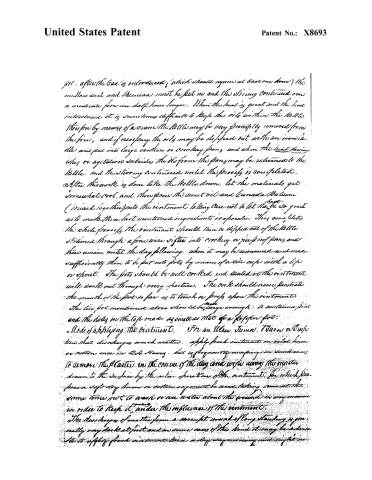
order to expedite the work of cleansing as well as to subdue the inflammation and promote mortification. When the affected part is thoroughly drained, a disposition to heal is generally manifested by a discharge of white healthy matter, the edges becoming flat and white and the center filling up with small red pinpoints of sound flesh. In this stage of the wound apply the ointment once in 48 hours and cleanse once in 24 as above directed. In ulcers produced by mercury the Venapfaiella tincture should also be used in order to create a free discharge of the poisonous matter. This tincture can be procured of the druggists generally. For inflammation, swelling, fresh wounds, sprains, or burns, once in 24 hours will be often enough to apply the ointment. If applied to the arm breast of a female it can be rendered more mild if necessary by spreading a small quantity of mutton fat on each plaster and mixing it well by heating. The materials being of the purest kind no injury whatever can arise from the use of this ointment; nor can there be the least liability to cold at any season. In relation to long standing and deeply concealed sores of any kind I particularly recommend that the plasters be spread large enough to cover the whole inflamed part, in fact should the wound be situated about the middle of the leg then wrap the same ointment from the knee to the foot until the inflammation be completely subdued, and should mortification be apprehended let the plasters be made warm in order that its effect may be rendered more active and powerful. For the snake bite this cause is honorably urged taking care first to searify the neighborhood of the part bitten. The spider bite if not easily treated will extend to the bone form a core and sometimes produce deep ulcerations. For sores of about the breast spread a plaster large enough to cover the whole chest also apply one between the shoulders. The ointment is an excellent dressing to follow a blister in order to create a suppuration and thereby more effectively relieve the part affected by pain particularly in cases of Ulcerating some cases of Ulcer and Sorefula tumors will require the ointment for months perhaps before a thorough cleansing can be effected. Therefore patience and perseverance must be exercised with great regularity in the dressing while strict attention should be paid to diet in order to prevent the system from
Page 5.
United States Patent
Patent No.: X8693
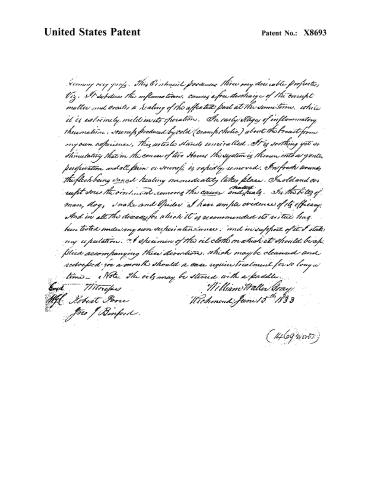
Economy very great. This Ointment possesses three very desirable properties, viz. It subdues the inflammation, causes a free discharge of the concretions matter and creates a healing of the affected part at the same time, while it is extremely mild in its operation. In early stages of inflammatory rheumatism, sores produced by cold (ampelostic) about the breast from my own experience, this article stands unrivalled. It is something yet so stimulating that in the course of two hours the system is thrown into a gentle perspiration and all pain or sores is rapidly removed. In fresh wounds the flesh being sound healing immediately takes place. In old and carious sores the ointment removes the cause and heals. In the bites of man, dog, snake and Spider I have ample evidence of its efficacy. And in all the diseases for which it is recommended its virtues have been tested under my own supervision and in support of it I state my reputation. A specimen of the oil cloth on which it should be applied accompanying these directions, which maybe cleaned and re-used for a month should a case require treatment for so long a time — Note. The oils may be stained with a pencil.
End — Nitropeus
William Walter Gray
Richmond June 15th 1833
M.C. Robert Bore
Jno. J. Binford.
(1469 words)
Published accounts: journal notice
Notice in the monthly list of patents, with remarks
Journal of the Franklin Institute, new ser., vol. 16 (1835), p. 242 · View the page
38. For an Ointment for the Cure of many External Diseases; William Allen Gray, city of Richmond, Henrico county, Virginia, March 18.
Remarks. "White swellings, ulcers of long standing, tumours, eruptions, burns and scalds, old and fresh wounds, callous and glandular swellings, &c. &c.," are among the affections which this ointment is to remove. The following is the recipe for preparing it. "One gallon cotton seed oil; one gallon linseed oil; one quart sweet oil; one quart Canada balsam, or oil of fir; two pounds of mutton suet; one pound bees-wax; and five pounds sugar of lead." We shall not add the directions for incorporating the ingredients composing this ointment, although they are given at large in the specification, nor shall we attempt an epitome of its virtues; the patentee stakes his reputation on its success in the cure of the bites of spiders, serpents, and mad dogs. Notwithstanding this weighty pledge, we are very apprehensive that the patentee would feel that he had something more at stake, maugre his ointment, were he bitten by a rattlesnake, or a mad dog. The virtues of this composition are dependent upon the sugar of lead, and those who require its use may obtain sugar of lead ointment ready prepared at the apothecaries'. It is useful in burns and ulcers, but for most of the purposes mentioned in the foregoing list it would be worse than worthless, as a dependence upon it would prevent the adoption of the proper remedies.
About this record
- Patentee
- DATAMP
- Date
- the Name and Date index of patents, DATAMP, USPTO records
- Invention
- DATAMP
- Listed in
- the Name and Date index of patents, DATAMP, USPTO records, Jim Shaw's X-patent list, the Journal of the Franklin Institute, Burke's List of Patents (1847)
- Burke's 1847 Patent Office list gives the same patent.