

Drawings and documents
USPTO scan
The patent as scanned by the USPTO
-
 Page 1
-
 Page 2
-
 Page 3
-
 Page 4


U.S. Patent and Trademark Office · Google Patents
Show the transcription Hide (891 words)
Machine transcription (LightOnOCR) of the pages as scanned by the USPTO, most of them the handwritten copies made when the records were restored after the 1836 fire. Not checked; it can misread handwriting, so compare it with the scan.
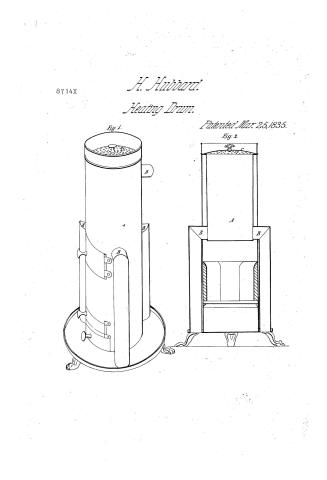
Page 1.
8714X
H. Hubbard.
Heating Drum.
Patented Mar. 25, 1835.
Fig. 1.
Fig. 2.
Page 2.
8714X
3/25/1835 4/1
May 25, 1835
D. Harvey Hubbard, Berlin, Conn.
Solely Patent
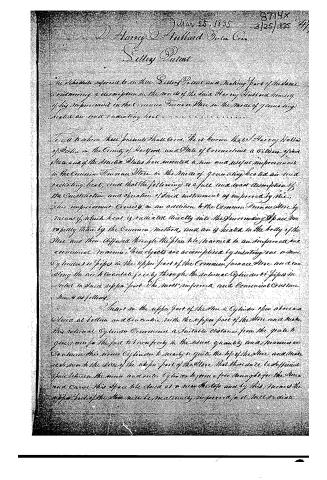
The schedule referred to in the Letters Patent and making part of this issue containing a description in the words of the said Harvey Hubbard himself of his improvement in the Common Furnace Stove in the mode of generating heated air and radiating heat.
To all to whom these presents shall come, Be it known that I, Harvey Hubbard of Berlin in the County of Hartford and State of Connecticut a citizen of the United States have invented a new and useful improvement in the Common Furnace Stove in the mode of generating heated air and radiating heat, and that the following is a full and exact description of the construction and operation of said instrument as improved by me.
This improvement consists in an addition to the Common Furnace Stove by means of which heat is radiated directly into the surrounding space more rapidly than by the common method, and air is heated in the body of the Stove and then diffused through the plan to be warmed in an improved and economical manner. These objects are accomplished by inserting one or more cylindrical or pipes in the upper part of the Common furnace Stove and conducting the air to several places through the interior of these pipes in which in said upper part the most improved and convenient construction is as follows:
Insert in the upper part of the Stove a Cylinder open above and closed at bottom and Constrict with the upper part of the Stove and make this interior Cylinder Commence a suitable distance from the grate to give room for the fuel to burn freely in the usual quantity and manner and Continue this inner Cylinder to nearly or quite the top of the Stove and make it as near to the size of the upper part of the Stove that there will be sufficient space between the inner and outer Cylinder to form a free draught for the Stove and cause this space to be closed at a near the top and by this means the upper part of the Stove will be materially improved for it will radiate
Page 3.
heat more rapidly than a stove with a common upper part or top if the upper part of the stove is twice as wide as the inner cylinder may be about one and one half inches or two inches in diameter making a distance of about one and one half inches or one inch more or less between the cylinders and in the same proportion for smaller or larger stoves.
To generate heated air in the body of the stove and diffuse the same through the space between the cylinders I may openings day three or more as near as practicable to the bottom of the inner cylinder. These openings may be made by pipes commencing on the inside of the inner cylinder and extending horizontally through the adjoining space and through the inside of the stove and carefully fitted in and thus making a free communication between the external air and the inside of the inner cylinder. Leading pipes may be inserted in these openings extending downwardly by the inside of the stove and terminating at any convenient point above or below or at the bottom of the stove. Such leading pipes are not essential to the improvement but useful to take the air to be heated from the lower part of the stove adjoining space and to give the air good circulation. For a 2 inch stove three pipes of about three inches in diameter each will be found suitable but the stove may be used as now convenient for stoves of other sizes the same proportions can be observed.
The material used may be sheet or cast iron or other suitable metal. A perforated cover may be placed on the top of the inner cylinder when at pleasure and such ornaments used as may vary they desire.
What I claim as my improvement and for which I take a Patent is the addition of the inner cylinder in the upper part of the stove with openings into said cylinder at the bottom thus communicating with the external air in the manner above described and thus increasing the quantity of heat radiated from the upper part of the stove and at the same time generating heated air in the body of the stove and diffusing it through the adjoining space in a convenient and economical manner. I claim no other part or parts of the instrument than those above described and I do not claim any rights to radiate heat or generate heated air in one or more cylinders separated from the body.
Page 4.
of the above as a true and correct Patent Drawing. In testimony that the above and foregoing is a true Specification of my said improvement I hereunto set my hand and seal at New Haven this twenty fifth day of February 1836.
Witness: Samuel S. Hitchcock
Edwin Hitchcock
Harry Hubbard
924 1836
(Patented March 25, 1836)
(Drawing)
Published accounts: journal notice
Notice in the monthly list of patents
Journal of the Franklin Institute, new ser., vol. 16 (1835), p. 248 · View the page
52. For an improvement in the common Furnace Stove; Harvey Hubbard, Berlin, Hartford county, Connecticut, March 25.
About this record
- Patentee
- DATAMP
- Date
- the Name and Date index of patents, DATAMP, USPTO records
- Invention
- DATAMP
- Listed in
- the Name and Date index of patents, DATAMP, USPTO records, Jim Shaw's X-patent list, the Journal of the Franklin Institute, Burke's List of Patents (1847)
- Burke's 1847 Patent Office list gives the same patent.