

Drawings and documents
USPTO scan
The patent as scanned by the USPTO
-
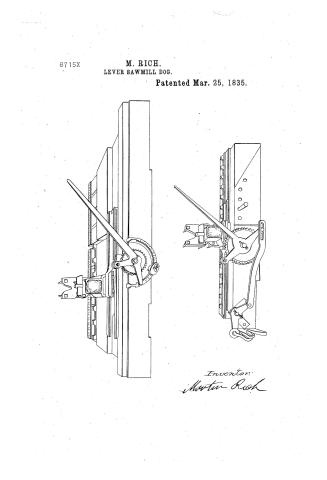 Page 1
-
 Page 2
-
 Page 3
-
 Page 4


U.S. Patent and Trademark Office · Google Patents
Show the transcription Hide (957 words)
Machine transcription (LightOnOCR) of the pages as scanned by the USPTO, most of them the handwritten copies made when the records were restored after the 1836 fire. Not checked; it can misread handwriting, so compare it with the scan.
Page 1.
8715X
M. RICH.
LEVER SAWMILL DOG.
Patented Mar. 25, 1835.
Inventor:
Martin Rich
Page 2.
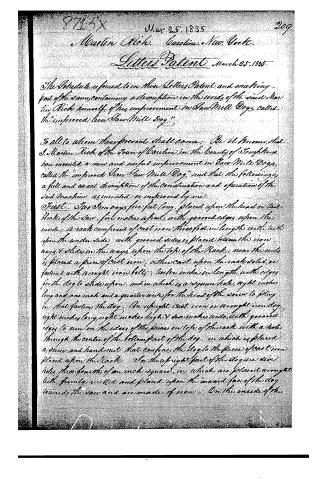
Mar 25, 1835
Martin Aick. Caroline, New York.
Letters Patent March 25, 1835.
The Schedule referred to in these Letters Patent and making part of the same, containing a description in the words of the said Martin Aick himself of his improvement in Saw Mill Dogs, called the "improved Iron Saw Mill Dog."
To all to whom these presents shall come: Be it known, that I, Martin Aick, of the Town of Caroline, in the County of Tompkins, have invented a new and useful improvement in Saw Mill Dogs, called the "improved Iron Saw Mill Dog," and that the following is a full and exact description of the construction and operation of the said machine as invented or improved by me.
First. Two Iron ways five feet long, placed upon the head or tail blocks of the saw, five inches apart, with grooved edges upon the inside; a rack composed of cast iron three feet in length with teeth upon the under side, with grooved sides, is placed between the iron ways & slides in the ways upon the top of the blocks; near the ends is placed a piece of cast iron (either cast upon the rack solid, or fastened with wrought iron bolts) twelve inches in length with edges for the dog to slide upon, and in which is a square hole, eight inches long and one inch and a quarter wide, for the head of the screw to play in that fastens the dog. An upright cast iron or wrought iron dog, eight inches long, eight inches high & six inches wide, with grooved edges to run on the sides of the piece on top of the rack with a hole through the center of the bottom part of the dog, in which is placed a screw and handnut that confines the dog to the piece of cast iron placed upon the blocks. In the upright part of the dog are six holes three fourths of an inch square, in which are placed wrought teeth, firmly riveted and placed upon the inward face of the dog towards the saw and are made of iron. On the inside of the
Page 3.
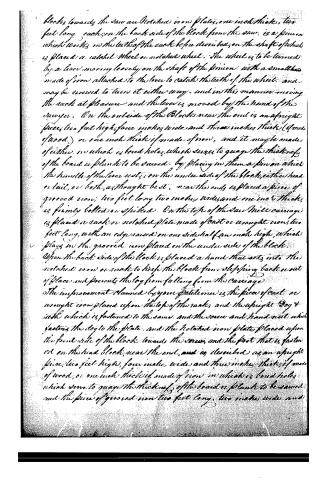
blocks towards the saw are Notched in one plate, one inch thick, two feet long, each; on the back side of the block from the saw, is a pin on which works in the teeth of the rack before described, on the shaft of which is placed a ratchet wheel or notched wheel. The wheel is to be turned by a lever moving loosely on the shaft of the pinion, with a small head made of iron attached to the lever to catch the teeth of the wheel, and may be reversed to turn it either way, and in this manner moving the rack at pleasure, and the lever is moved by the hand of the Sawyer. On the outside of the blocks near the end is an upright piece, two feet high, four inches wide and three inches thick (if made of wood,) or one inch thick if made of iron, and it may be made of either, in which is bored holes, which serves to gauge the thickness of the board or plank to be sawed, by placing in them a pin on which the handle of the lever rests; on the under side of the block, either head or tail, or both, as thought best, near the end, is placed a piece of grooved iron, two feet long, two inches wide, and one inch thick, is firmly bolted or spiked. On the top of the saw mill carriage is placed a rack or notched plate made of cast or wrought iron, two feet long, with an edge raised on one side half an inch high, which plays in the grooved iron placed on the under side of the block. Upon the back side of the block is placed a hand that sets into the notched iron or rack to keep the block from slipping back or out of place, and prevents the log from falling from the carriage.
The improvement claimed by your petitioner is the piece of cast or wrought iron placed upon the top of the rack, and the upright Dog & teeth which is fastened to the same, and the screw and hand nut which fastens the dog to the plate, and the Notched iron plate, placed upon the front side of the block towards the saw, and the foot that is fastened on the head block, near the end, and is described as an upright piece, two feet high, four inches wide and three inches thick, if made of wood, or one inch thick if made of iron, in which is bored holes which serve to gauge the thickness of the board or plank to be sawed, and the piece of grooved iron two feet long, two inches wide and
Page 4.
one inch thick, described as firmly bolted to the head or tail block, and also the rack described as placed upon the top of the saw mill carriage, and called a rack or notched plate, and the hand on the back side of the block that plays or sets into the notched plate or rack. — In Witness whereof I have hereto set my hand and name this twenty third day of February 1835.
Witnesses
John Stephens
Frederick G. Stanley
Martin Rich
(Drawing restored Jany. 6. 1840)
966 words) 8¢ only
Published accounts: journal notice
Notice in the monthly list of patents, with remarks
Journal of the Franklin Institute, new ser., vol. 16 (1835), p. 252 · View the page
59. For an improvement in Saw Mill Dogs; Martin Rich, Caroline, Tompkins county, New York, March 25.
Remarks. Mr. Rich had, previously to this date, obtained at least four patents for sawmill dogs, and we see by the list that a fifth is to follow in a day or two; we hope that the breed is sufficiently in demand to pay something more than the expenses of accouchement. The racks, pinions, teeth, levers, and other appurtenances, which are combined together to effect the purposes intended, can be understood only by the drawing, which we do not think it necessary to give.
Published accounts: journal notice
Notice in the monthly list of patents, with remarks
Journal of the Franklin Institute, new ser., vol. 16 (1835), p. 254 · View the page
67. For Saw Mill Dogs; Martin Rich, Caroline, Tompkins county, New York, March 27.
Remarks. These are called gauge dogs, as they are intended to regulate the thickness of the stuff to be sawed, which they do by means of screws moving the log on the head and tail blocks. They are so constructed that, if desired, the log can be cut completely through, leaving no stub-shot. There is no claim made, and as gauge dogs have been previously constructed, and operated upon by means of screws, it would have been proper for the patentee to have pointed out the specific difference between the present and former plans; the law, indeed, requires that this should be done.
DATAMP: illustration
Illustrations from DATAMP
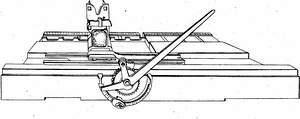
DATAMP (Directory of American Tool and Machinery Patents), via the Internet Archive · Archived DATAMP page
About this record
- Patentee
- DATAMP
- Date
- the Name and Date index of patents, DATAMP, USPTO records
- Invention
- DATAMP
- Listed in
- the Name and Date index of patents, DATAMP, USPTO records, Jim Shaw's X-patent list, the Journal of the Franklin Institute, Burke's List of Patents (1847)
- Burke's 1847 Patent Office list gives the same patent.