

Drawings and documents
USPTO scan
The patent as scanned by the USPTO
-
 Page 1
-
 Page 2
-
 Page 3
-
 Page 4
-
 Page 5
-
 Page 6


U.S. Patent and Trademark Office · Google Patents
Show the transcription Hide (1,500 words)
Machine transcription (LightOnOCR) of the pages as scanned by the USPTO, most of them the handwritten copies made when the records were restored after the 1836 fire. Not checked; it can misread handwriting, so compare it with the scan.
Page 1.
8736X
D. HARRINGTON.
Galvanic Apparatus.
Patented March 31, 1835.
Fig. 1.

Page 2.
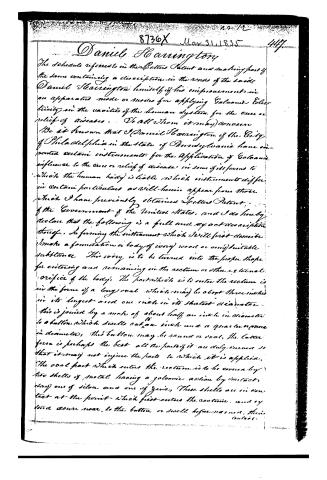
Daniel Scarrington
The schedule referred to in this Letters Patent and making part of the same containing a description in the words of the said Daniel Scarrington himself of his improvements in an apparatus made or modes for applying Galvanic Electricity in the cavities of the human system for the cure or relief of diseases. To all whom it may concern
Be it known that I Daniel Scarrington of the City of Philadelphia in the state of Pennsylvania have invented certain instruments for the Application of Galvanic influence to the cure or relief of disease in some of its forms to which the human body is liable which instruments differ in certain particulars as will herein appear from those which I have previously obtained Letters Patent of the Government of the United States, and I do hereby declare that the following is a full and exact description thereof.
In forming the instrument which I will first describe I make a foundation or body of ivory wood or any suitable substance. This ivory is to be turned into the proper shape for entering and remaining in the rectum or other external orifice of the body. The part which is to enter the rectum is in the form of a long oval which may be about three inches in its longest and one inch in its shortest diameter. This is joined by a neck of about half an inch in diameter to a button which swells out an inch and a quarter or more in diameter. This button may be round or oval, the latter form is perhaps the best all the parts of it are duly curved so that it may not injure the parts to which it is applied. The oval part which enters the rectum is to be covered by two shells of metal having a galvanic action by contact, say one of silver and one of zinc. These shells are in contact at the point which first enters the rectum and extend down near to the button or swell before named. This contact
Page 3.
contact may be produced by passing the wires through the two shells from side to side. Through the axis of this instrument a hole is drilled sufficiently large to hold a catgut or string through the same for a fine pore to be presently described. Figure 1. in the accompanying drawing represents the instrument of the form and size described. A & B. being the shells of silver (and zinc) and C. the button which bears against the rectum. When the instrument is inserted, by which and the action of the sphincter on neck D, it is retained in its place and may be worn for hours without interfering with the action of the body in sitting, walking or riding in a carriage. The dotted lines show the perforation through the axis of the instrument, the object of which I will describe. It is desirable to stimulate the intestines to a greater height than can be reached by the instrument as described (or by any other inflexible form that can be devised it is believed) with this view I make a number of metallic forms which may round, oval or cylindrical, one half of them of silver and the other of zinc, they may be about half an inch or they may be more or less in their diameter. These I string alternately, the zinc (and the silver, when a cat gut or other suitable cord or string which is secured immovably in the extreme form round or oval and the other end of the cord I pass through the perforation in the ivory leaving the end of the cord to extend a few inches beyond the button. These forms or balls as perforated and arranged upon their cord are shown at E, E, E, In this way a flexible part of any required length may be formed which when passed into the rectum will follow the conditions of the intestines more readily than a bougie. By drawing the string loose through the ivory instrument they may be by the aid of both hands very readily entered the cavity as their pressure together will give to them a requisite stiffness for
Page 4.
for the purpose. A flexible part might also be made by other means, as for example, by winding spirally upon a mandrel a wide or narrow flat strip of silver and another of zinc, but this mode of forming a flexible it is thought would have no advantage over the one first described as to its power and would be found more difficult to keep clean and more liable to injury in its correct spiral form from using. One object in using the wire within the metallic shells is to give lightness to the instrument as its operation would be as powerful if the parts indicated were made of solid metals but the weight in some cases might be found inconvenient to the wearer. In some cases it might be found advantageous to use the flexible arrangement as shown at E, E, E, without the first described instrument, in which case the means of securing it in its place by the aid of a strap or other wire will be sufficiently obvious. When from any cause it may be difficult to introduce the instrument first described on account of its form I make it in two parts divided longitudinally, but in this case it is most convenient to make it wholly of zinc as to its body & plate one of the halves so far as it is intended to enter a cavity merely one side whole surface with silver. The corners where the two halves fit together are to be rounded off and one half is to be inserted after the other as by so doing the parts will be less disturbed than with the instrument first described. Either this or the first instrument may be confined or held in place by a strap passing below the occiput & around the Pelvic bone. The end of the strap to be attached to a belt above the hips or to the clothes, this however will not often be found requisite when the instrument is used in the rectum, but when used in the vagina it may not infrequently be found necessary particularly in cases where a portion of the uterus would tend to eject it. Although
Page 5.
50 8736X
instruments of the kind described herein produce continued action which perhaps may not be found to tend in many cases to such immediate renovating effect as some of those formerly patented by me in which the action is intermittent, yet as they require but little attention on the part of those who use them, may be kept in their places in most instances by the action of the parts in consequence of the form given to them and compensate by the length of time which they may be allowed to remain for a more brief and powerful action they will be frequently preferred. When these instruments are used in the vagina or in cases of suffused sinuses or for any other purpose such alteration in their form and size may be made as the particular circumstances of the case will require. For example, the inelasticity of the parts in certain cases may be such as to render the small part of the instrument which connects the button with the main or large part inconvenient to the user, unless it were made of flexible or elastic material, a flexible connecting portion between the two ends of the instrument may be made of wire bent into spiral form and the same spiral may be flattened to a necessary extent and its inner part filled with any flexible substance that could be saturated with gum elastic sizing (and thereby prevent its imbibing excrementitious matter and becoming offensive). I have already indicated the principle difference between these instruments and such as have an intermittent action as described in my former specifications, and they differ also from those in which the two different metals are applied to different parts of the body & connected by a wire or other conductor, neither of which is now claimed, but nothing more than an instrument or instruments such as I have herein described (subject to proper variations or modifications necessary to adapt them to
Page 6.
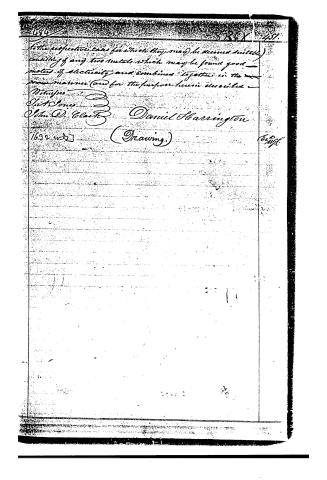
to the respective cases for which they may be deemed suitable)
conductivity of any two metals which may be found good—
metals of electricity and combined together in the most
proper manner (and for the purpose herein described—
Witness
John O. Clark Daniel Harrington
1632 w32 (Drawing.) (Expt.)
Published accounts: journal notice
Notice in the monthly list of patents
Journal of the Franklin Institute, new ser., vol. 16 (1835), p. 257 · View the page
75. For Galvanic Apparatus, applied to Cavities of the Human System; Daniel Harrington, city of Philadelphia, March 31.
About this record
- Patentee
- DATAMP
- Date
- the Name and Date index of patents, DATAMP, USPTO records
- Invention
- DATAMP
- Listed in
- the Name and Date index of patents, DATAMP, USPTO records, Jim Shaw's X-patent list, the Journal of the Franklin Institute, Burke's List of Patents (1847)
- Burke's 1847 Patent Office list gives the same patent.
Shaw: also: Carman, L. 8736.8 1835-04-02; also: Deakyne, J. 8736.2 1835-04-02; also: Hale, Aron 8736.9 1835-04-02; also: Harrington, D. 1835-03-31; lists Mack, O. here as 8736½