

Drawings and documents
USPTO scan
The patent as scanned by the USPTO
-
 Page 1
-
 Page 2
-
 Page 3
-
 Page 4
-
 Page 5


U.S. Patent and Trademark Office · Google Patents
Show the transcription Hide (1,502 words)
Machine transcription (LightOnOCR) of the pages as scanned by the USPTO, most of them the handwritten copies made when the records were restored after the 1836 fire. Not checked; it can misread handwriting, so compare it with the scan.
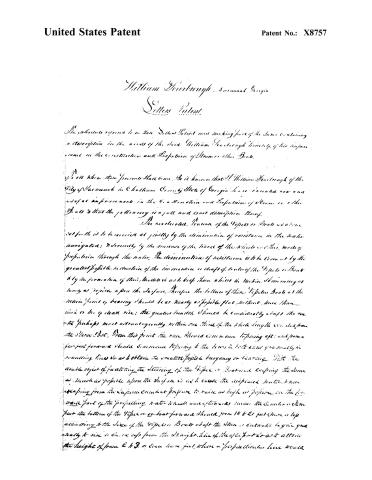
Page 2.
United States Patent
Patent No.: X8757
William Heartrough, Savannah, Georgia
Letters Patent
The subscriber refers to his said Patent and making part of the same containing a description in the words of the said William Heartrough himself of his improvement in the construction and Propulsion of Steam or other Boats.
To all whom these presents shall come, Be it known that I William Heartrough of the City of Savannah in Chatham County State of Georgia have invented new and useful improvements in the Construction and Propulsion of Steam or other Boats and that the following is a full and exact description thereof.
The accelerated Progress of the Vessels or Boats as above set forth is to be carried at justly by the diminution of resistance in the water navigation; Secondly by the increase of the force of the wheels or other mode of propulsion through the water. The diminution of resistance is to be done as by the greatest possible reduction of the immersion or draft of loading of the Vessel or Boat & by the formation of their Models so as to keep them when in motion skimming as nearly as possible upon the Surface. Therefore the bottom of their Vessel or Boats at the main point of bearing should be as nearly as possible flat without more than inch or two of clear rise; the greater breadth should be considerably above the same — the perhaps most advantageously within one third of the whole length counted from the Stern Port. From this point the side should commence tapering aft; and from far-pest forward should commence tapering to the bow in both cases gradually in resulting lines so as to obtain the greatest possible buoyancy or bearing. With the double object of facilitating the Steering of the Vessel or Boat and keeping the same as much as possible upon the Surface so as to cause the displaced water when escaping from the superincumbent pressure to raise as high as possible on the forward part of the propelling water wheel and afterwards under the Center of the Boat the bottom of the Vessel or Boat forward should from 15 to 20 feet from a leg according to the size of the Vessel or Boat about the Stern or center be gradually to rise or curve up from the straight line of the after part so as to attain the height of from 2 to 3 or even more feet, where a perpendicular line would
Page 3.
United States Patent
Patent No.: X8757
fall from said Stone or Car. Water. The Shape of the paddle wheel should be placed a right over the aft end of the greater breadth of the Vessel or Boat whereby the displaced water will more readily escape & a very slight yet horizontal inclination of the buckets of the paddle wheel from a direct right angle from the face of the boat will not only carry the displacing water under the bottom and aid the force of the rudder but will tend to lighten the pressure of the dead water on the said Buckets and the force of the displaced water in the act of regaining its level must use matter of course urge the boat or Vessel forward. Secondly in regard to the increase of the travelling of the water that in other mode of propulsion as no steam or other engine of any considerable length of stroke could keep in advantageous motion wheels of any great diameter with the length of buckets or paddles now generally in use where any considerable resistance was opposed at more than 15 to 20 revolutions in a minute, increased velocity could only be seen at piston engines by the power of giving the effect of which would be a material encroachment on the power of the Engine and attended with considerable risk of breakage.
The object is then to find a remedy for such inconvenience the difficulties or disadvantages in proportion to the reduction of the diameter of a wheel so will be the diminution of the force of its propelling thus the revolution of a 20-foot diameter wheel would give but a little over 16 yards whilst the revolution of one of 20 feet diameter would propel a distance more than 20 yards. Hence the four boats plying on the Hudson Delaware or Chesapeake the diameters of the paddle wheels have been enlarged to the extent the capacity of the Boats and the power of the Engines would admit; one we have, to the evidence that Mr. Brother could only traverse their velocity principally by the augmented diameter of his paddle wheel; he could not have done it on his experimental raft of 75 feet in length. The difficulties & disadvantages which have been suggested in regard to gearing upon the Engine to obtain increased velocity of motion and the enlargement of the diameter of the paddle wheels to augment the travel may however safely and easily be surmounted by shortening the length of the buckets or paddles in a proportionate degree. For example if we place on a wheel 16 feet in diameter arms that extend in a straight line near the periphery Buckets 6 feet in
Page 4.
United States Patent
Patent No.: X8757
lengths and 2 feet in width the 16 multiplied into each other would exhibit a surface of 32 feet square, on a 2 feet wheel with arms at the same distance apart if Buckets only four feet in length were placed they would be 2 in number which multiplied as above would give a surface of 16 square feet. Thus although the reduction in the length of the Bucket is equal to 3/4 of feet or 1/2 the whole surface of immersion in the revolution is reduced only 2/3 or 1/3, which there is a clear saving of 3/4 of feet or 1/2 of the surface of the wheel in each revolution. This saving is not one that any ordinary observer may readily perceive, though generally in the large boats of this country the whole length of the Buckets or paddles have been divided into two or even more parts. We have thus seen that by the formation of the model so as to diminish the resistance of the water by shortening the paddles or Buckets the work or labor of the engine has been so much reduced that much of the risk of breakage in the event of gearing whether by wheels, Bands or otherwise has been superseded. The consequent increase of velocity, not by any means to be attained with the same corresponding loss or diminution of power which the general rule might seem to indicate for when the surface or immersion has been once given the angular speed of the Boat or Vessel will more than compensate the Engine for its first expense of power.
The stability or solidity of the construction if it may be gained is of primary importance to the correct working of the machinery especially in the case of giving it is further proposed as the means of attaining it that the paddle wheel because any part of the boat or vessel between or beyond them where the purpose is great should be sustained or supported from the inside of the boat or vessel by the use of projecting timbers or bars resting directly under the beams or on String pieces thereunder connecting two or more of them and against the ceiling or sides of the boat or vessel but not permanently affixed to the same so that the Paddles or Belting acting in the manner of a Key Stone or key Stone to the arch, the purpose near the quarter or on the upper part of the Boat or Vessel will be transferred to the Paddles or Belting and they in return if necessary will find a corresponding adequate abutment from the equality of pressure at the other side or on the end of the arch there. But exclusively of this it is considered that such
Page 5.
United States Patent
Patent No.: X8757
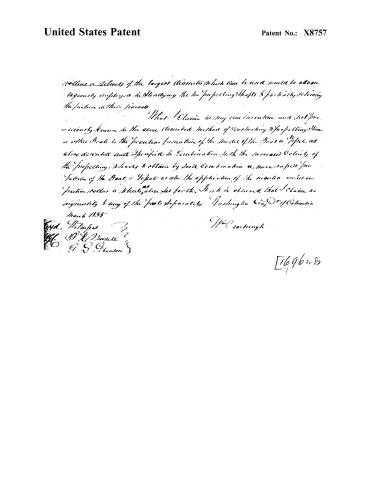
rollers or deflects of the longest diameter which can be used, would be advantageously employed in steadying the two propelling shafts & partially relieving the friction in their journals.
What I Claim is any one invention, and not previously known in the above described method of constructing propelling steam or other boats is the peculiar formation of the model of the Boat or Yacht as above described, and specifically in Combination, with the increased velocity of the propelling rollers to obtain by said Combination a, more rapid propulsion of the Boat or Yacht as also the application of the inverted roller on friction rollers or wheels, above set forth. It is to be observed that I claim no originality to any of the parts separately. Washington City, Oct. 27, 1835
End.
*H. H. H.
D. H. H.
G. S. H. H.*
1696 w8
Published accounts: journal notice
Notice in the monthly list of patents, with remarks
Journal of the Franklin Institute, new ser., vol. 16 (1835), p. 320 · View the page
C a a we This contrivance is to operate very much upon the principles of the bent lever balance, as will be seen by the sketch in the margin, where a is a grooved wheel working eccentrically upon a pivot at b, and carrying an index c, the cord d, sustaining the weight and the scale; a further description deem unnecessary. The claim is to "the application of the principle to any of the purposes for which scales or balances are used." When accurate weighing is required, this plan of a beam working on pivots, and subject to other disadvantages, will not supersede the ordinary mode of weighing, to which it is immeasurably inferior. 41. For Cleaning and Polishing Rice; M. Scarborough, Savannah, Georgia, April 8.
Remarks. The claim under this patent "is the application of stone by itself, or with wood, or with any other material with which it, (the stone) can act in combination, together with the due and proper admixture of the chaff, to aid and promote the friction necessary and desirable for the proposed object."
About this record
- Patentee
- DATAMP
- Date
- the Name and Date index of patents, DATAMP, USPTO records
- Invention
- DATAMP
- Listed in
- the Name and Date index of patents, DATAMP, USPTO records, Jim Shaw's X-patent list, the Journal of the Franklin Institute, Burke's List of Patents (1847)
- The Franklin Institute's journal spells the name differently.
- Burke's 1847 Patent Office list gives the same patent.