

Drawings and documents
USPTO scan
The patent as scanned by the USPTO
-
 Page 1
-
 Page 2
-
 Page 3
-
 Page 4
-
 Page 5


U.S. Patent and Trademark Office · Google Patents
Show the transcription Hide (1,701 words)
Machine transcription (LightOnOCR) of the pages as scanned by the USPTO, most of them the handwritten copies made when the records were restored after the 1836 fire. Not checked; it can misread handwriting, so compare it with the scan.
Page 2.
United States Patent
Patent No.: X8756
William Scarborough, Savannah, Georgia
Letters Patent
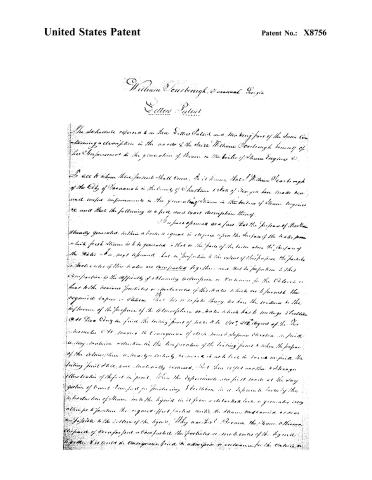
The declarant refers to these Letters Patent and the body part of the same containing a description in the words of the said William Scarborough himself of his Improvement in the generation of Steam in the boiler of Steam Engines &c.
To all to whom these presents shall come, Be it known, that I William Scarborough of the City of Savannah in the County of Chatham State of Georgia have made certain useful improvements in the generating steam in the boilers of Steam Engines &c. and that the following is a full and exact description thereof.
It is first assumed as a fact that the pressure of the steam already generated within a boiler is equal in its force upon the surface of the water, from which fresh steam is to be generated, to that on the parts of the boiler above the surface of the water. It is next assumed that in proportion to the extent of this pressure the particles or molecules of this water are compressed together; and that in proportion to this compression is the difficulty of obtaining admission or entrance for the Caloric or heat to the various particles or molecules of this water which are to furnish the required vapour or steam. That this is a false theory, we have the evidence to the influence of the pressure of the atmosphere on water which has to undergo ebullition. At Vera Cruz we find the boiling point of water to be 110°, 212 degrees of the Fahrenheit thermometer. At Mexico in consequence of its much superior elevation, we find a very insensible reduction in the temperature of the boiling point. When the pressure of the atmosphere is nearly nothing removed, it is to be found in steam unspiced the boiling point is less, more insensibly reduced. But there is yet another and stronger illustration of the fact in point. When the experiments were first made at the very garden of Mount St. Joseph for producing ebullition in a separate boiler by the introduction of steam into the liquid, in it from a detached boiler or generator, every attempt to produce the required effect failed until the steam was carried as near as possible to the bottom of the liquid. Why was this? Because the steam of steam the space of compressed or compacted the particles or molecules of the liquid together. It is clear in consequence from the admission or entrance for the Caloric to
Page 3.
United States Patent
Patent No.: X8756
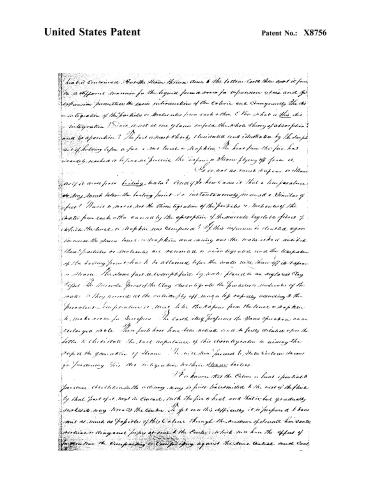
heat it contained. But the Steam thrown down to the bottom could then apart it from in a different manner for the liquid form a room for expansion above and for expansion permitted the easier introduction of the Caloric and consequently the disintegration of the particles or molecules from each other. Now what is this disintegration? Does it not at one glance suggest the whole theory of absorption and evaporation? The fact is most clearly elucidated and illustrated by the simple act of holding before a fire a wet towel or napkin. The heat from the fire has scarcely reached it before we perceive the vapors or steam flying off from it.
Is it not as much vapors or steam as if it arose from boiling water? And if so how came it that a temperature so long much below the boiling point—so instantaneously produced a similar effect? Was it not the disintegration of the particles or molecules of the water from each other caused by the absorption of the minute vegetable fibers of which the towel or napkin was composed? If this inference be tested again immerse the same towel or napkin and seeing out the water it had absorbed these particles or molecules are removed or reintegrated and the temperature of the boiling point has to be attained before the water will throw off its vapors or steam. The same fact is exemplified by water placed in an unglazed clay vessel. The minute pores of the clay disintegrate the particles or molecules of the water and they amount at the outside fly off more or less rapidly according to the prevalent temperature or heat like the vapors from the towel or napkin to make room for successors. The earth clay performs the same operation on an enlarged scale. These facts have been noticed and so fully elucidated upon the letter to elucidate the vast importance of this disintegration in aiding the rapid generation of steam. We will now proceed to state certain means for producing this disintegration within steam boilers.
It is known that the Caloric or heat emanates from cause circulation in the ordinary way is first transmitted to the rest of the fluid by that part of it next in contact with the fire or heat and that it but gradually makes its way toward the center. To get over this difficulty it is proposed to have put as much as possible of this Caloric through the means of small horizontal vertical or diagonal pipes as near to the center, which will have the effect of preventing the compacting or compressing against the same central and cool
Page 4.
United States Patent
Patent No.: X8756
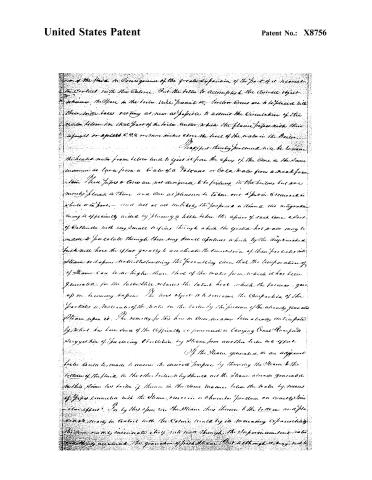
of the flame in consequence of the greater expansion of the part of it nearest the Contact with the Calorie. But the kettle to accomplish the desired object, the Space in the boiler will permit it, bottom Orms are to be placed with their wide bases resting as near as possible to admit the Circulation of the water below in that part of the boiler under which the flame passes with their upper or apexes 2.5.4 or more inches above the level of the water in the boiler.
It appears thereby intended will be to raise the heated water from below and to eject it from the apex of the Orms in the same manner as lava from a Crater of a Volcano or Cola Water from a crack from a lava. These pipes or Orms are not designed to be fixed in the boilers but are merely placed in them and can at pleasure be taken out & put in & removed in whole or in part. — And not at all unlikely, the proposed or claimed this integration may be efficiently aided by placing a little below the apexes of each Orm a sort of Collar with any small Orifices through which the ejected hot water may be made to percolate through these any small apertures while by the superheated fluid will have the effect greatly to accelerate the conversion of their particles into steam or vapor notwithstanding the preceding idea that the temperature of steam can be no higher than that of the water from which it has been generated, for the latter still retains the latent heat which the former gave up on becoming vapor. The next object is to overcome the Compaction of the Particles or Molecules of the water in the boiler by the pressure of the already generated Steam upon it. The remedy for this has in some measure been already anticipated by what has been done of the difficulty is pronounced in Carrying Coal Pumps & Suggestion of producing Elevation by Steam from another boiler not effect.
If the Steam generated in an adjacent boiler Orms be made to convey the desired purpose by throwing the Steam to the bottom of the fluid in the other boiler, it by hence, not the Steam already generated in this boiler but boiler if thrown in the same manner below the water by means of pipes connected with the Steam receiver or chamber produce an exactly the same effect. So by this operation the Steam thus thrown to the bottom of the boiler nearly in Contact with the Calorie would by its increasing expansibility the same readily insinuate itself into and through the Superincumbent water thereby accelerate the generation of fresh Steam. But although it may not be
Page 5.
United States Patent
Patent No.: X8756
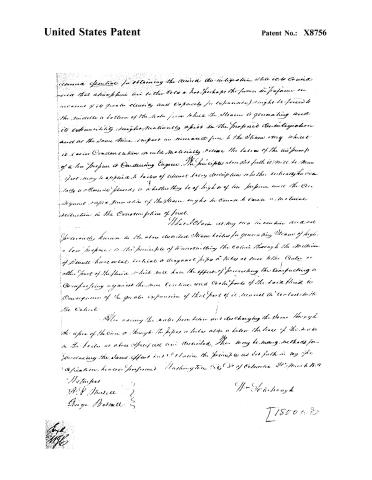
seemingly essential for obtaining the desired desintegration. This is to be caused when that atmospheric air (either cold or hot, perhaps the former in preference on account of its greater density and capacity for expansion) might be forced to the middle or bottom of the water from which the steam is generating and its expansibility might be materially affected in the proposed desintegration and at the same time impart an increased force to the steam, thus which is easier condensation would materially relieve the labor of the air pump of a low pressure condensing engine. The principles above set forth it will be seen that may be applied to boilers of almost every description whether vertically or horizontally placed, or whether they be of high or low pressure and the consequent rapid generation of the steam ought to cause a material reduction in the consumption of fuel.
That I claim as my own invention and not previously known in the art, the described steam boilers for generating steam of high or low pressure; is the principle of transmitting the color through the medium of small horizontal, vertical or diagonal pipes or tubes at once to the center or other part of the fluid which will have the effect of preventing the congealing or congealing against the more extreme and color parts of the boiler fluid in consequence of the greater expansion of that part of it nearest in contact with the color.
Also raising the water from below and discharging the same through the upper of the cone or through the pipes or tubes at once below the level of the water in the boiler as above specified and described. There may be many methods for producing the same effect but I claim the principle as set forth in my specification, however performed.
Washington City, Oct. 28, 1858
Witnesses
W. B. Moseley
George Boswell
Wm. H. Hough
$\boxed{1800}$
Published accounts: journal notice
Notice in the monthly list of patents, with remarks
Journal of the Franklin Institute, new ser., vol. 16 (1835), p. 319 · View the page
The cones named are situated, and to operate, something like the circulators of Mr. Perkins. 39. For the Construction and Propulsion of Steam or other Boats; William Scarborough, Savannah, Georgia, April 8.
Remarks. What is claimed under this patent "in the described method of constructing and propelling steam or other boats, is the peculiar formation of the mode of the boats, or vessels, in combination with the increased celerity of the propelling wheels, to obtain by said combination a more rapid propulsion of the boat, or vessel, through the water; as also the application of the inverted tubes, and friction rollers, or wheels, as set forth. It is to be observed that I claim no originality to any of the parts separately." It is no easy task to tell for what this patent is taken, as the description is rather discursive, and the individual things mentioned are confessedly not new. It seems necessary that when a patentee depends upon a new combination of known things, this combination should give a peculiar and well marked character to the thing as a whole; otherwise, although the fact may be disclaimed, the individual parts are depended upon to sustain the claim. We are told that to decrease the resistance to the motion of a boat, the immersion must be reduced as much as possible, so that it may skim over the surface of the water; that the bottom, therefore, should be, as nearly as possible, flat; that the greatest breadth should be considerably abaft the centre, &c. The shaft of the paddle wheel, it is said, should be placed right over the abaft end of the greatest breadth of the vessel. The size and velocity of the paddle wheel, and also the length of the buckets are discussed; and the conclusion arrived at is that it will be advantageous to increase the velocity of the wheel, and to shorten the buckets in a proportionate degree. The inverted arches are curved timbers which support the paddle wheel beams, and rest at their lower end against the keelson. The friction rollers are to be run under the wheel shafts.
About this record
- Patentee
- DATAMP
- Date
- the Name and Date index of patents, DATAMP, USPTO records
- Invention
- DATAMP
- Listed in
- the Name and Date index of patents, DATAMP, USPTO records, Jim Shaw's X-patent list, the Journal of the Franklin Institute, Burke's List of Patents (1847)
- Burke's 1847 Patent Office list gives the same patent.