

Drawings and documents
USPTO scan
The patent as scanned by the USPTO
-
 Page 1
-
 Page 2
-
 Page 3


U.S. Patent and Trademark Office · Google Patents
Show the transcription Hide (774 words)
Machine transcription (LightOnOCR) of the pages as scanned by the USPTO, most of them the handwritten copies made when the records were restored after the 1836 fire. Not checked; it can misread handwriting, so compare it with the scan.
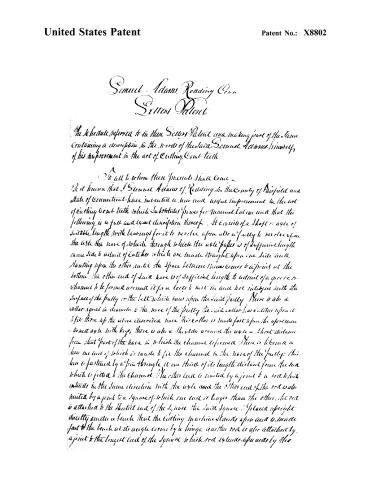
Page 2.
United States Patent
Patent No.: X8802
Samuel Adams, Reading, Conn.
Letters Patent
The schedule referred to in the Letters Patent and making part of the same containing a description in the words of the said Samuel Adams himself, of his improvement in the art of Cutting Count-tails.
To all to whom these presents shall come—
Be it known that I Samuel Adams of Reading in the County of Fairfield and State of Connecticut have invented a new and useful improvement in the art of Cutting Count-tails which substitutes power for manual labor and that the following is a full and exact description thereof. It consists of a Shaft or axle of suitable length with bearings for it to revolve upon also a Pulley to revolve upon the axle the name of which through which the axle passes is of sufficient length on one side to admit of Catcher which are made straight upon one side and slanting upon the other until the space between them comes to a point at the bottom. The other end of said name is of sufficient length to admit of a groove or channel to be formed around it for a belt to rest in and not interfere with the surface of the pulley or the belt which runs upon the said pulley. There is also a collar equal in diameter to the name of the pulley the said collar has a slot upon it to fit there up the above described name this collar is made fast upon the aforementioned axle with keys; there is also a shoulder around the axle a short distance from that part of the name in which the channel is formed. There is likewise a lever one end of which is made to fit the channel in the name of the pulley; this lever is fastened by a pin through it one third of its length distance from the end which is fitted to the channel. The other end is united by a joint to a rod which extends in the same direction with the axle and the other end of the rod is also united by a joint to a Square of which one end is longer than the other. The rod is attached to the shortest end of the Square the said Square is placed upright directly under a handle that the cutting machine stands upon and is made fast to the bench at its angle corner by a hinge another rod is also attached by a joint to the longest end of the Square which rod extends upwards by the
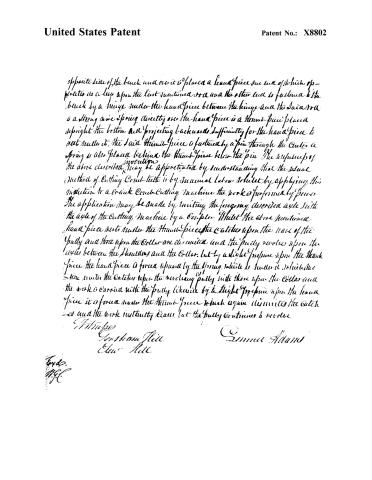
Page 3.
United States Patent
Patent No.: X8802
opposite side of the block and over it is placed a hand piece one end of which op-
poses to a lever upon the last mentioned rod and the other end is fastened to the
block by a hinge under the hand piece between the hinge and the said rod
is a strong wire spring directly over the hand piece is a thumb piece placed
upright the bottom end projecting backwards sufficiently for the hand piece to
rest under it. The said thumb piece is fastened by a pin through the center a
spring is also placed behind the thumb piece below the pin. The usefulness of
the above described invention may be appreciated by understanding that the usual
method of cutting comb teeth is by manual labor. Subject by applying this
invention to a crank comb cutting machine the work is performed by power.
The application may be made by uniting the foregoing described axle with
the axle of the cutting machine by a couple. While the above mentioned
hand piece rests under the thumb piece the catches upon the face of the
pully and there upon the collar are dismuted and the pully revolves upon the
axles between the shoulders and the collar. but by a slight pressure upon the thumb
piece the hand piece is forced upward by the spring which is under it. while the
same moves the catches upon the revolving pully with there upon the collar and
the work is carried with the pully likewise by a slight pressure upon the hand
piece it is forced under the thumb piece which again dismutes the catch
es and the work instantly ceases but the pully continues to revolve
Witnesses
Joshua Hill
Elou Hill
Simuel Adams
To do.
M.C.
Published accounts: journal notice
Notice in the monthly list of patents
Journal of the Franklin Institute, new ser., vol. 16 (1835), p. 70 · View the page
259. Comb teeth, cutting.-Lemuel Adams, Reading, Fairfield county, Conn. 2 List of American Patents for May, 1835.
Published accounts: journal notice
Notice in the monthly list of patents, with remarks
Journal of the Franklin Institute, new ser., vol. 16 (1835), p. 388 · View the page
9. For Cutting Comb Teeth; Samuel Adams, Redding, Fairfield county, Connecticut, May 2.
Remarks. An apparatus is described by means of which the teeth of combs are to be cut by applying power, instead of manual labour. The apparatus presented we can understand, so far as it goes, but as the mode of applying it to the cutting of comb teeth, or of any thing else, does not appear, we are really in the dark upon the main point, and, therefore, have nothing to communicate.
About this record
- Patentee
- DATAMP
- Date
- the Name and Date index of patents, DATAMP, USPTO records
- Invention
- DATAMP
- Listed in
- the Name and Date index of patents, DATAMP, USPTO records, Jim Shaw's X-patent list, the Journal of the Franklin Institute, Burke's List of Patents (1847)
- Burke's 1847 Patent Office list gives the same patent.