

Drawings and documents
USPTO scan
The patent as scanned by the USPTO
-
 Page 1
-
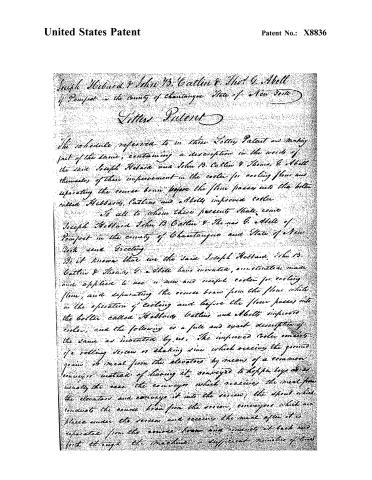 Page 2
-
 Page 3
-
 Page 4
-
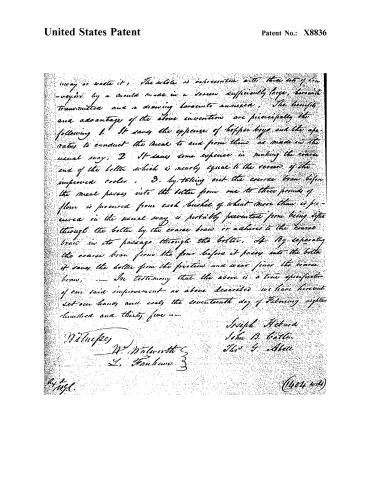 Page 5


U.S. Patent and Trademark Office · Google Patents
Show the transcription Hide (1,326 words)
Machine transcription (LightOnOCR) of the pages as scanned by the USPTO, most of them the handwritten copies made when the records were restored after the 1836 fire. Not checked; it can misread handwriting, so compare it with the scan.
Page 2.
United States Patent
Patent No.: X8836
Joseph Hubbard & John B. Catlin & Thos. G. Abell
of Pomfret in the County of Chautauqua State of New York
Letters Patent
The schedule referred to in these Letters Patent and making part of the same, containing a description in the words of the said Joseph Hubbard and John B. Catlin & Thomas G. Abell themselves, of their improvement in the cooler for cooling flour and separating the coarse bran before the flour passes into the better called Hubbard, Catlin and Abell improved cooler.
To all to whom these presents shall come
Joseph Hubbard John B. Catlin & Thomas G. Abell of Pomfret in the county of Chautauqua and State of New York send Greeting
Be it known that we the said Joseph Hubbard, John B. Catlin & Thomas G. Abell have invented, constructed, made and applied to use a new and useful cooler for cooling flour, and separating the coarse bran from the flour while in the operation of cooling and before the flour passes into the better called Hubbard, Catlin and Abell improved cooler, and the following is a full and exact description of the same as invented by us. The improved cooler consists of a rolling screen or shaking sieve which receives the ground grain or meal from the elevators by means of a common conveyor instead of having it conveyed to hopper boys as is usually the case the conveyor which receives the meal from the elevators and convey it into the screen, the spout which conducts the coarse bran from the screen, conveyors which are placed under the screen and receive the meal after it is separated from the coarse bran and conduct it back and forth through the machine a sufficient number of times
Page 3.
United States Patent
Patent No.: X8836
to cool it (in the one now in use once only), a spout which receives the meal from the end of the last conveyor, & through which it falls into the better, and a case which covers the whole except the first conveyor, with standing sides to direct the meal which falls, or is sifted through the screen into the last conveyor 1. The screen is made after the manner of a common better with slip sides and is composed of or covered with iron wire of a proper texture to attain the course bran, and to permit the rest of the meal to pass or be sifted through it. The screen rolls with the shaft to which it is attached and which according to the above description comprises a part of the machine which we call the screen, on one end of the shaft is a common conveyor which receives the meal from the elevator, and by its rotary motion conducts it within the screen whenever by the same motion it is sifted through the screen, except the course bran which is carried through the whole length of the screen and discharged into a spout at the opposite end from that into which it was received. The screen now used by us is eight feet long and twenty slip inches in diameter and made of or covered with iron wire, but the length and diameter may be varied according to circumstances, and it may also be made of or covered with any other suitable material than iron wire though we now know of nothing better. 2. The conveyor which receives the meal from the elevator and which is the end of the shaft on which the screen turns, runs in an appropriate spout or case and is about three feet long but its length may be varied according to circumstances. It must be sufficiently long to reach from the elevator into the screen and deposit the meal there. The said screen and conveyor are placed nearly, longitudinally having a sufficient inclination to give proper to the meal which is received into one end of the screen.
Page 4.
United States Patent
Patent No.: X8836
from the conveyor, and to discharge the coarse bran into a spout at the opposite end as common billy operates—
39. Directly under the screen is another conveyor made in the common form of the same length of the screen, into which the meal which is sifted through the screen falls, being directed by two boards of the same length and of proper width, placed longitudinally and parallel to each other, the lower edges of which meet and are worked so as to make a trough for it to direct or guide all the meal through the conveyor, and the upper edges of which are far enough apart to receive all the meal which is sifted through the screen. From the lower end of this conveyor the meal falls into a screen having an opposite direction & made in the same manner, and from the inclined end of this it falls into a third, having an opposite inclination to the last and made in the same manner; and from the inclined end of this third conveyor is a spout which receives the meal and conducts it into the bottle. The meal after being separated from the coarse bran (which is done while warm) is thus carried through the whole length of the machine by the three sets of conveyors for the purpose of rendering it perfectly cool before entering the bottle. Any number of conveyors may be used as may be necessary and convenient. In ordinary mills one is sufficient and the length of the screen and conveyor underneath may be increased so as to have one conveyor sufficiently cool the flour in all cases. Those who in use have one conveyor under the screen only and from six to eight feet in length as above mentioned, or the size and length with one conveyor underneath only as sufficient for two rows of stones. Attention is given to the screen and conveyors by such kinds of gearing or machinery as the constructor shall prefer, or as is commonly used in such cases. If the screen and conveyor or conveyors underneath are covered with or included in a case, (with sufficient opening to admit the air) to screen the meal, from the dust and filth of a stone, and from any current of wind that might blow it
Page 5.
United States Patent
Patent No.: X8836
way or waste it. The whole is actuated with three sets of con-
veyors by a double curve in a screen sufficiently large, herein
transmitted and a drawing board to answer. The benefits
and advantages of the above invention are principally the
following 1. It saves the expense of hopper boys and the ap-
paratus to conduct the meal to and from them as made in the
usual way. 2. It saves some expense in making the coarse
end of the bolt which is nearly equal to the screen of the
improved cooler. 3. By taking out the coarse bran before
the meal passes into the bolt from one to three pounds of
flour is procured from each bushel of wheat more than is pro-
cured in the usual way is probably prevented from being sifted
through the bolt by the coarse bran or adheres to the coarse
bran in its passage through the bolt. 4. By separating
the coarse bran from the flour before it passes into the bolt
it saves the bolt from the friction and wear finer the coarse
bran. — In testimony that the above is a true specification
of our said improvement as above described we have hereunto
set our hands and seals the seventeenth day of February eighteen
hundred and thirty five.
Witnesses
W. Walworth
L. Frankham
Joseph Hebard
John B. Cottin
Thos. S. Abell
(1404 w.d.)
Published accounts: journal notice
Notice in the monthly list of patents
Journal of the Franklin Institute, new ser., vol. 16 (1835), p. 71 · View the page
288. Flour cooler, &c. -Hebart, Catlin, and Abeel, Pomfret, New York,
Published accounts: journal notice
Notice in the monthly list of patents, with remarks
Journal of the Franklin Institute, new ser., vol. 16 (1835), p. 399 · View the page
38. For a Cooler for Flour; Joseph Hebard, John B. Catlin, and Thomas G. Abell, Pomfret, Chautauque county, New York, May 22.
Remarks. "The improved cooler consists of a rolling screen, or shaking sieve, which receives the ground grain, or meal, from the elevators. by means of a common conveyer, instead of having it conveyed to hopper boys, as is usually the case. The conveyer which receives the meal from the elevator, and conveys it into the screen. The spout which conducts the coarse bran from the screen. Conveyers which are placed under the screen, and receive the meal after it is separated from the coarse bran, and conduct it back and forth through the machine a sufficient number of times to cool it. A spout which receives the meal from the last conveyer, and through which it falls into the bolter; and a case which covers the whole, excepting the first conveyer, with slanting sides, to direct the meal which falls, or is sifted through the screen, into the last conveyer." The drawing represents three conveyers below the rolling screen, which successively receive the meal, and convey it back and forth, and the specification enlarges upon the advantages derived from the use of this apparatus, which is simple in its principle, compact, and, we have no doubt, efficient. There is no claim made, but it is obvious that the general arrangement is the subject of the patent, the individual parts being spoken of as familiarly known.
About this record
- Patentee
- DATAMP
- Date
- the Name and Date index of patents, DATAMP, USPTO records
- Invention
- DATAMP
- Listed in
- the Name and Date index of patents, DATAMP, USPTO records, Jim Shaw's X-patent list, the Journal of the Franklin Institute, Burke's List of Patents (1847)
- Burke's 1847 Patent Office list gives the same patent.