

Drawings and documents
USPTO scan
The patent as scanned by the USPTO
-
 Page 1
-
 Page 2
-
 Page 3


U.S. Patent and Trademark Office · Google Patents
Show the transcription Hide (743 words)
Machine transcription (LightOnOCR) of the pages as scanned by the USPTO, most of them the handwritten copies made when the records were restored after the 1836 fire. Not checked; it can misread handwriting, so compare it with the scan.
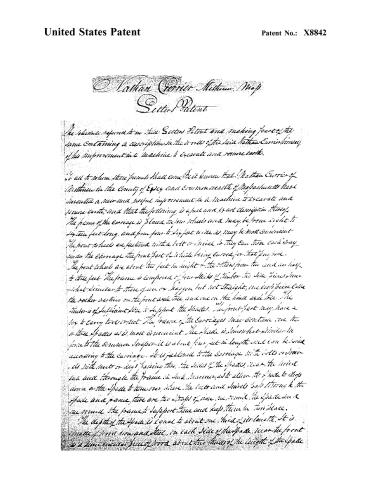
Page 2.
United States Patent
Patent No.: X8842
Nathan Carrier Medium Map
Letters Patent
The above referred to in this Letters Patent and making part of the same containing a description in the words of the said Nathan Carrier, his improvement in a machine to excavate and remove earth.
To all to whom these presents shall come, Be it known that Nathan Carrier of Natick in the County of Essex and Commonwealth of Massachusetts have invented a new and useful improvement in a machine to excavate and remove earth; and that the following is a full and exact description thereof.
The frame of the carriage is placed on four wheels and may be from eight to sixteen feet long, and from four to six feet wide as may be most convenient. The front wheels are fastened with a bolt or rivet so they can turn each way under the carriage, the front part of which being curved for that purpose. The front wheels are about two feet in height — the others from two and a half to three feet. The frame is composed of four sticks of timber, the side pieces being somewhat similar to those of an ox wagon but not straight, one end piece being the rocker resting on the front axle tree and one on the hind axle tree. The timber is of sufficient size to support the spades. The front part may have a key to carry tools or not. The frame of the carriage may contain one to three spaces as is most convenient. The blade is somewhat similar in form to the common scraper — it is about four feet in length and can be varied according to the carriage. It is fastened to the carriage with bolts or rivets with nuts or keys passing thru the sides of the spade near the hind end and through the frame in such manner as to allow the blade to drop down or the spade to turn over when the tools and shovels are thrown through the spade and pane, there are two studs of iron on front the spade and around the frame to support them and keep them in turn place.
The depth of the spade is equal to about one third its length. It is made of iron and steel, in each side of the spade near the front is a semicircular piece of wood, about two thirds of the length of the spade.
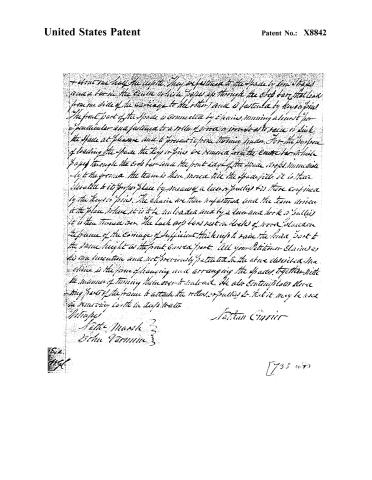
Page 3.
United States Patent
Patent No.: X8842
+ about one half the depth. They are fastened to the frame by iron straps and a bar in the center which passes up through the cross bar that leads from one side of the carriage to the other, and is fastened by key or pins. The front part of the space is connected by chains, running almost perpendicularly and fastened to a roller of iron or wood, so as to raise or sink the space at pleasure and to prevent it from turning under. For the purpose of loading the space, the key or pins are removed from the center bar, which passes through the cross bar and the front edge of the space drops immediately to the ground. The team is then moved till the space fills. It is then elevated to its proper place by means of a lever or pulley, and is then confined by the key or pins. The chains are then unfastened and the team driven to the place where it is to be unloaded, and by a lever and lock or pulley it is then turned over. The back end has just as much of iron or wood, placed on the frame of the carriage of sufficient thickness to raise the load, just to the same height as the front, curved part. All your Petitioner claims as his own invention and not previously patented in the above described. The choice is the form of hanging and arranging the spaces, together with the manner of turning them over to unload. He also contemplates leaving any part of the frame to attach the rollers or pulleys so that it may be used in moving carts in deep water.
Witnesses:
Nathaniel Marsh 3
John Varmine 3
Nathan Carrier
[735 1870]
Published accounts: journal notice
Notice in the monthly list of patents
Journal of the Franklin Institute, new ser., vol. 16 (1835), p. 71 · View the page
299. Excavating machine.-Nathan Currier, Methuen, Essex county, Mass.
Published accounts: journal notice
Notice in the monthly list of patents, with remarks
Journal of the Franklin Institute, new ser., vol. 16 (1835), p. 403 · View the page
49. For a Machine to Excavate and Remove Earth; Nathan Currier, Methuen, Essex county, Massachusetts, May 29.
Remarks. One, two, or three spades, made in the form of the common scraper used for excavating, are to be hung upon a carriage running upon wheels. There are windlasses and chains for raising or lowering the cutting edges of the spades, and for turning them over when the load is to be discharged. All that is claimed, is, "the form of hanging and arranging the spades, together with the manner of turning them over to unload."
About this record
- Patentee
- DATAMP
- Date
- the Name and Date index of patents, DATAMP, USPTO records
- Invention
- DATAMP
- Listed in
- the Name and Date index of patents, DATAMP, USPTO records, Jim Shaw's X-patent list, the Journal of the Franklin Institute, Burke's List of Patents (1847)
- Burke's 1847 Patent Office list gives the same patent.