

Drawings and documents
USPTO scan
The patent as scanned by the USPTO
-
 Page 1
-
 Page 2
-
 Page 3


U.S. Patent and Trademark Office · Google Patents
Show the transcription Hide (968 words)
Machine transcription (LightOnOCR) of the pages as scanned by the USPTO, most of them the handwritten copies made when the records were restored after the 1836 fire. Not checked; it can misread handwriting, so compare it with the scan.
Page 1.
8858X
A & S Chichester.
Blocking & Stretching Hats.
Patented May 29, 1835.

Page 2.
8858X
May 29, 1835
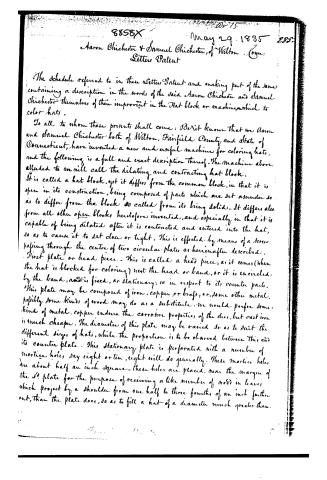
Aaron Chichester & Samuel Chichester, of Wilton, Conn.
Letter Patent
The schedule referred to in these Letter Patent and making part of the same containing a description in the words of the said Aaron Chichester and Samuel Chichester themselves of their improvement in the Hat block or machine which to color hats.
To all to whom these presents shall come: Be it known that we Aaron and Samuel Chichester both of Wilton, Fairfield County and State of Connecticut, have invented a new and useful machine for coloring hats, and the following is a full and exact description thereof. The machine above alluded to we will call the dilating and contracting hat block.
It is called a hat block, yet it differs from the common block, in that it is open in its construction, being composed of parts which are set asunder so as to differ from the block so called from its being solid. It differs also from all other open blocks heretofore invented, and especially in that it is capable of being dilated after it is contracted and entered into the hat, so as to cause it to set close or tight. This is effected by means of a screw passing through the centre of two circular plates as hereinafter described.
First plate or head piece. This is called a head piece, as it comes (when the hat is blocked for coloring) next the head or band, or it is encircled by the band, and is fixed, or stationary; so in respect to its counter part. This plate may be composed of iron, copper, or brass, or some other metal, possibly some kinds of wood may do as a substitute. We would prefer some kind of metal. Copper endure the corrosive properties of the dyes, but cast iron is much cheaper. The diameter of this plate may be varied so as to suit the different sizes of hats, while the proportion is to be observed between this and its counter plate. This stationary plate is perforated with a number of mortice holes, say eight or ten, eight will do generally. These mortice holes are about half an inch square. These holes are placed near the margin of the said plate for the purpose of receiving a like number of wood in leaves which project by a shoulder from one half to three fourths of an inch further out, than the plate does, so as to fill a hat of a diameter much greater than.
Page 3.
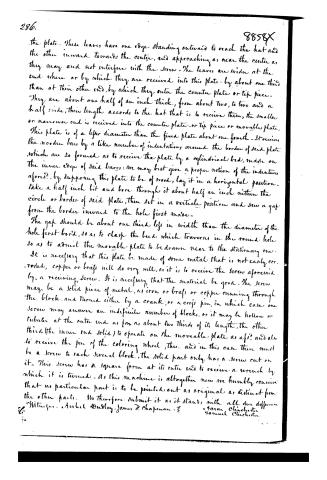
the plate. These leaves have one edge standing outward to reach the hat and the other inward towards the center, and approaching as near the center as they may and not interfere with the screw. The leaves are wider at the end where or by which they are received into this plate, by about one third than at their other end, by which they enter the counter plate or tip piece. They are about one half of an inch thick, from about two, to two and a half wide, their length accords to the hat that is to receive them, the smaller or narrower end is received into the counter plate or tip piece or movable plate. This plate is of a lesser diameter than the fixed plate about one fourth. It receives the wooden bars by a like number of indentations around the border of said plate, which are so formed as to receive the plate by a cylindrical bed, made on the inner edge of said bars: we may best give a proper notion of the indentations aforesaid, by supposing this plate to be of wood, lay it in a horizontal position, take a half inch bit and bore through it about half an inch within the circle or border of said plate, then set in a vertical position and saw a gap from the border inward to the hole first made.
The gap should be about one third less in width than the diameter of the hole first bored, so as to clasp the bed which traverses in the round hole so as to admit the movable plate to be drawn near to the stationary one.
It is necessary that this plate be made of some metal that is not easily corroded, copper or brass will do very well, as it is to receive the screw aforesaid by a receiving screw. It is necessary that the material be good. The screw may be a solid piece of metal, as iron or brass or copper running through the block and turned either by a crank, or a croft pin, in which case one screw may answer an indefinite number of blocks, or it may be hollow or tubular at the outer end as far as about two thirds of its length, the other third (the inner end solid) to operate on the moveable plate as aforesaid and also to receive the pin of the coloring wheel, then and in this case there must be a screw to each several block, the solid part only has a screw cut on it. This screw has a square form at its outer end to receive a wrench by which it is turned. As this machine is altogether new we humbly conceive that no particular part is to be pointed out as original as distinct from the other parts. We therefore submit it as it stands, with all due deference.
Witness: Asahel Dudley, James F. Chapman.
Samuel Chichester
Published accounts: journal notice
Notice in the monthly list of patents
Journal of the Franklin Institute, new ser., vol. 16 (1835), p. 71 · View the page
303. Hat block.-A. and S. Chichester, Wilton, Fairfield county, Conn.
Published accounts: journal notice
Notice in the monthly list of patents, with remarks
Journal of the Franklin Institute, new ser., vol. 16 (1835), p. 404 · View the page
53. For a Hat Block; Aaron and Samuel Chichester, Wilton, Fairfield county, Connecticut, May 29.
Remarks. This hat block is intended to be used in the colouring of hats, and is of the open kind which allows the colouring liquid to come freely into contact with the interior of the article, in the process of dying. It differs from those open blocks which have preceded it, by being so made as to dilate after being inserted into the crown of the hat, so as to cause it to set close, or tight, thereto. A piece of metal, of suitable size, is to be made circular, and is to be perforated, near its edge, by eight, or any other convenient number of mortises, which are to receive the ends of eight slats, or pieces, of wood, which are to form the sides of the open block. This round piece of metal may be called the fixed head. A smaller disk of metal fits within the slats, passing in at the lower end, and having its edge notched to receive the inner edges of the slats, the latter being made sloping, so that this movable head, as it is forced in, will cause them to recede from each other. A screw passes from the centre of the fixed to the centre of the movable head, by which the latter is forced in, and the effect intended produced. The contrivance being deemed essentially new, no particular claim is made.
About this record
- Patentee
- DATAMP
- Date
- the Name and Date index of patents, DATAMP, USPTO records
- Invention
- DATAMP
- Listed in
- the Name and Date index of patents, DATAMP, USPTO records, Jim Shaw's X-patent list, the Journal of the Franklin Institute, Burke's List of Patents (1847)
- Burke's 1847 Patent Office list gives the same patent.