

Drawings and documents
National Archives restored drawings: drawing
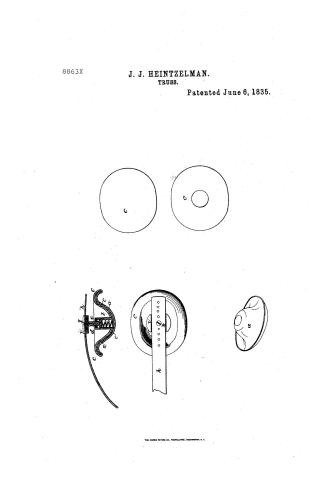
John J. Heintzelman's Patent Drawing for a Truss Pad

National Archives, Restored Patent Drawings (Record Group 241) · Full-size scan at the National Archives · Catalog record
Show the text on the drawing Hide (105 words)
Words on the drawing as machine-read by the National Archives; not checked. Useful mainly for searching.
156] / SURGERY. Trusses, russio - sury / #150 / CLASSIFICATION / John. I Huntzdman / 8863+ / Truss Pad. / Hapa / DIVISION / Patented June 6. 1835. / Vol. 22 ps.509. / Section of the pad. / Preferences. / a.bircular disk of metale. / 6. metal cylinder. / C.C oval pieces of coontchone / A circular head. / e pin with a head. / of spiral spring. / C.C. coontchouce ovals. / of verew. / h. bow. / i button. / Top view of Pad. / Metal disk. a. / Patent office June 28 1842 / And under the dinction of the Commisioner / of Patents in conformity with act of 3ʳᵈ march 1837 / Mungh Eumorth / Commition of Patents / batren / thren / Sorps
USPTO scan
The patent as scanned by the USPTO
-
 Page 1
-
 Page 2
-
 Page 3
-
 Page 4


U.S. Patent and Trademark Office · Google Patents
Show the transcription Hide (1,056 words)
Machine transcription (LightOnOCR) of the pages as scanned by the USPTO, most of them the handwritten copies made when the records were restored after the 1836 fire. Not checked; it can misread handwriting, so compare it with the scan.
Page 1.
8863X
J. J. HEINTZELMAN.
TRUSS.
Patented June 6, 1835.

THE SCOTT PETERS CO., PHOTO-LITHO., WASHINGTON, D. C.
Page 2.
June 6, 1835
John S. Heintzelman
Letter Patent
The schedule referred to in these Letters Patent and making part of the same containing a description in the words of the said John S. Heintzelman himself of his improvement in the Truss for the cure of Hernia.
I will to whom these presents shall come: Be it known that I John S. Heintzelman of the City and County of Philadelphia in the State of Pennsylvania have invented a new and useful improvement in a Truss for the cure of hernia for which Letters Patent were granted to me on the 20th day of July 1831, and which I style Heintzelman's improved Truss Pad and that the following is a full and exact description of the construction and operation of the same as invented or improved by me.
My improvement consists in the construction of the pad which is as follows: A metal or a metal disk is made of strong tin, sheet copper, brass or other material possessing the same elasticity and firmness of say 2 inches diameter, a portion of the surface at the center, about equal in diameter to half the diameter of the disk, is by means of dies, punches or any other convenient means punched up or raised so as to form a spherical or conical convexity towards the front, so that the side of the disk which is to lie next to the patient, and a corresponding concavity on the other side or back, the remaining circular surface or ring is punched in a similar manner, concave on the front side and convex on the back. These inflexions may all be made at one operation by dies such as are in ordinary use.
To the center of the cavity in the back is secured by soldering a small hollow brass or metal cylinder say 3/4 of an inch in diameter and 1/2 of an inch long more or less, this cylinder is intended to receive the attachment which secure the pad to the bow or spring of the truss as hereinafter described. The metal disk being thus formed I may take two circular or oval, or the same may be pieces of sheet metal to have in general shape sufficient after being conformed with the concavity.
Page 3.
concepts of the disk, to encircle around on the outer circumference of the latter an opening being also cut in the back piece for the protrusion of the cylinder, the disk being now placed between these sheets they are pressed closely in a pair of dies with cavities and concepts nearly corresponding with the inflexions of the disk (except a deep groove for the cylinder) and sufficiently larger to receive the additional thickness of the sheets and to mould a full concave edge or ring beyond the circular cavity of the front of the pad the air having been previously heated to a proper degree, by which means in a few minutes the edges of the gum elastic sheets are firmly united together and the pad retaining the figure and impress given by the dies, is ready for attaching to the bow, which is done in the following manner. The cylinder hereinbefore mentioned is closed by a circular head or plate having a hole in its centre and furnished with a screw thread at its circumference which screws or takes into a corresponding thread in the upper part of the cylinder. A strong metallic pin or shaft passes through the hole in this plate, the part within the cylinder having a broad circular head nearly of equal diameter with the cylinder which rests or bears on a spiral steel spring disposed closely in to the cylinder, the other end of the pin projecting about 1/8 of an inch beyond the plate with a screw hole in its centre to receive the screw which attaches the bow or spring of the legs as follows. The end of the bow or spring which may be 1/2 an inch broad and thin as the required degree of strength will permit being introduced into a slot or groove made in an oblong button or piece of brass, a screw is passed through the button and spring which takes in the end of the pin above mentioned, and confines the whole together, the length of the slot allowing a slight lateral motion to the bow, which in connection with the action of the spiral spring upon which the head of the pin bears, forms a sort of universal joint, and admits of an easy rolling motion of the bow or pad without the latter being in the least displaced or its pressure altered. In the pad for femoral cases the attachment is the same & only differs from the above in that the pad in common use (stuffed with wool) by being formed of dies as herein described of a metal
Page 4.
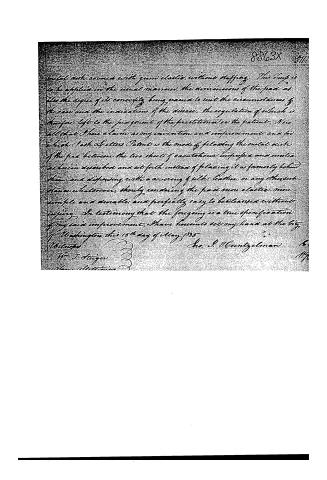
metal disk covered with gum elastic, without stuffing. This band is to be applied in the usual manner, the dimensions of the pad as also the degree of its convexity being varied to suit the circumstances of the case and the indications of the disease, the regulation of which is therefore left to the judgment of the practitioner or the patient. Now all that I have claimed as my invention and improvement and for which I ask Letters Patent is the mode of placing the metal disk of the pad between the two sheets of caoutchouc in prefix and metal as herein described and set forth instead of placing it as formerly behind them, and disposing with a covering of silk, leather, or any other substance whatsoever, thereby rendering the pad more elastic, more simple and durable, and perfectly easy to be cleaned without injury. In testimony that the foregoing is a true specification of my said improvement, I have hereunto set my hand at the City of Washington this 15th day of May 1835.
Wm. S. Steiger
Jno. S. Heintzelman
Wm. S. Steiger
Jno. S. Heintzelman
8863X 3/11
Published accounts: journal notice
Notice in the monthly list of patents
Journal of the Franklin Institute, new ser., vol. 16 (1835), p. 142 · View the page
315. Truss for hernia. -John Heintzelman, city of Philadelpnia,
Published accounts: journal notice
Notice in the monthly list of patents, with remarks
Journal of the Franklin Institute, new ser., vol. 17 (1836), p. 39 · View the page
We think that the making of a vessel or box in the form of a coffin, out of a material of which various vessels have been previously made, will neither be viewed as an invention or improvement in the eye of the law, nor do we perceive how such an invention could employ the powers of three individuals. 5. For an improvement in the Truss for Hernia; John L. Heintzelman, city of Philadelphia, June 6.
Remarks. "Now all that I claim as my invention and improvement, and for which I ask letters patent, is the mode of placing the metal disk of the pad between the two sheets of caoutchouc, impressed and united as herein described and set forth, instead of placing it, as formerly, behind them, and dispensing with a covering of silk, leather, or any other substance whatsoever; thereby rendering the pad more elastic, more simple and durable, and perfectly easy to be cleansed without difficulty." The caoutchouc pad is formed by pressing two sheets of caoutchouc, cut to a suitable size and shape, between heated metallic dies, by which the edges of the substance are united, and a proper form given to each side of the pad, the brass plate being enclosed between them, with a suitable tube projecting from the back of the pad, by which to attach it to the spring.
About this record
- Patentee
- DATAMP
- Date
- the Name and Date index of patents, DATAMP, USPTO records
- Invention
- DATAMP
- Listed in
- the Name and Date index of patents, DATAMP, USPTO records, Jim Shaw's X-patent list, the Journal of the Franklin Institute, Burke's List of Patents (1847)
- Burke's 1847 Patent Office list gives the same patent.