

Drawings and documents
USPTO scan
The patent as scanned by the USPTO
-
 Page 1
-
 Page 2
-
 Page 3
-
 Page 4
-
 Page 5


U.S. Patent and Trademark Office · Google Patents
Show the transcription Hide (990 words)
Machine transcription (LightOnOCR) of the pages as scanned by the USPTO, most of them the handwritten copies made when the records were restored after the 1836 fire. Not checked; it can misread handwriting, so compare it with the scan.
Page 1.
BEST AVAILABLE COPY
E. Shinner,
Cook Stove.
8,889x
Patented June 12, 1835.


H. PETER, PHOTO-LITHOGRAPHER, WASHINGTON, D. C.
Page 2.
8889X June 12 1835 No 15 197
Elijah Skinner
Letters Patent
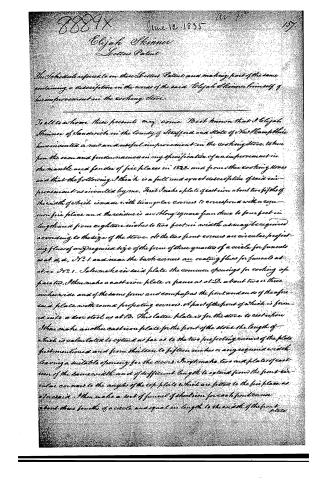
This Schedule referred to in these Letters Patent and making part of the same containing a description in the words of the said Elijah Skinner himself of his improvement in the cooking stove.
To all to whom these presents may come. Be it known that I Elijah Skinner of Sandwich in the County of Stafford and State of New Hampshire have invented a new and useful improvement in the cooking stove, taken from the oven and fender named in my specification of an improvement in the mantle and fender of fire places in 1822, and from other cooking stoves and that the following I think is a full and exact description of said improvement as invented by me. First I make a plate of cast iron about two fifths of the width of which is made with triangular corners to correspond with a common fire place and the residue is an oblong square from three to four feet in length and from eighteen inches to two feet in width as may be required according to the size of the stove. At the two front corners are circular projecting flues of any required size of the form of three quarters of a circle for funnels as at a, a, Fig. 1 and near the back corners are ovaling flues for funnels as at b, b, Fig. 1. I then make in said plate the common openings for cooking apparatus. I then make a cast iron plate or frame as at D, about two or three inches wide and of the same form and compass as the front and one of the afore said plate with round projecting corners. A part of the front of which is formed into a door stool as at D. This latter plate is for the stove to rest upon. I then make another cast iron plate for the front of the stove the length of which is calculated to extend as far as to the two projecting corners of the plate first mentioned and from thirteen to fifteen inches or any required width leaving a suitable opening for the doors. I next make two cast plates of cast iron of the same width and of different length to extend from the front circular corners to the angles of the top plate which are fitted to the fire place as aforesaid. I then make a sort of funnel of sheet iron for each front corner about three fourths of a circle and equal in length to the width of the front plate.
Page 3.
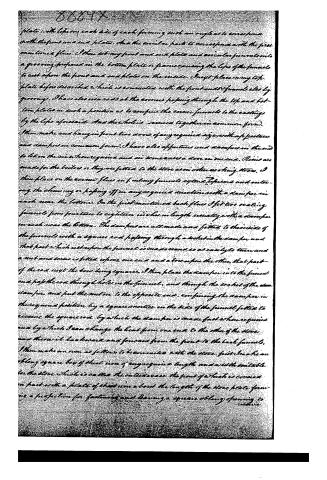
plate with lips on each side of each forming such an angle as to correspond with the front and end plates, and the circular parts to correspond with the first mentioned flue. I then set my front and end plates and circular funnels into a groove prepared in the bottom plate or frame causing the lips of the funnels to rest upon the front and end plates on the inside. I next place on my top plate before described which is connected with the front and end funnels also by grooves. I have also provided at the corners passing through the top and bottom plates in such a position as to confine the corner funnels to the castings by the lips of said. And this whole is secured together in common form.
I then make and hang in front two doors of any required size with a fastener and damper in common form. I have also affixed to the end to let on the air when required and in some cases a door on one end. Airs are made for the boiler or they are fitted to the stove as in other cooking stoves. I then place on the corner flues in front my funnels extending beyond and entering the chimney or passing off in any required direction with a damper in each near the bottom. On the first mentioned back flue I fit two ovaling funnels from fourteen to eighteen inches in length usually with a damper on each near the bottom. The dampers are all made and fitted to the inside of the funnels with a square rod passing through a socket in the damper and that part which rests upon the funnel is made so as to easily turn and a nut and screw is fitted upon one end and a bow upon the other, that part of the rod next the bow being square. I then place the damper into the funnel and pass the rod through holes in the funnel, and through the socket of the damper, and put the nut on to the opposite end, confining the damper in the required position by a square notch on the side of the funnel fitted to receive the square rod by which the damper is made fast when required and by which I can change the heat from one end to the other of the stove and throw it backward and forward from the front to the back funnels.
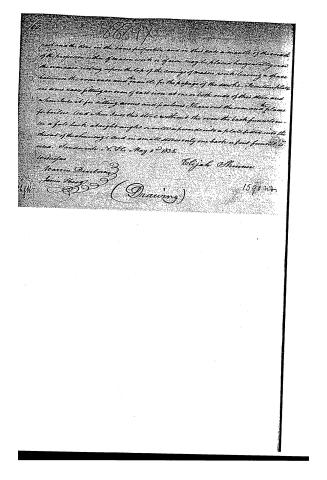
I then make an iron as follows to be connected with the stove, first I make an oblong square box of that iron of any required length and width suitable for the stove which is called the outside case. The front of such is covered in part with a plate of that iron about the length of the stove plate forming a projection for fastening and leaving a square oblong opening to receive
Published accounts: journal notice
Notice in the monthly list of patents
Journal of the Franklin Institute, new ser., vol. 16 (1835), p. 142 · View the page
320. Cooking stove.-Elijah Skinner, Sandwich, N. H.
Published accounts: journal notice
Notice in the monthly list of patents, with remarks
Journal of the Franklin Institute, new ser., vol. 17 (1836), p. 41 · View the page
10. For a Cooking Stove; Elijah Skinner, Sandwich, Strafford county, New Hampshire, June 12.
Remarks. This stove is to be set in a common open fireplace, and differs so little in its general arrangements from some others, as not to require or to admit of special description. The claim is to " the particular arrangement and effect of the flues, funnels, damper and oven, and the appendages for letting off the steam; and the application of the whole to the common open fireplace, as before described."
About this record
- Patentee
- DATAMP
- Date
- the Name and Date index of patents, DATAMP, USPTO records
- Invention
- DATAMP
- Listed in
- the Name and Date index of patents, DATAMP, USPTO records, Jim Shaw's X-patent list, the Journal of the Franklin Institute, Burke's List of Patents (1847)
- Burke's 1847 Patent Office list gives the same patent.