

Drawings and documents
National Archives restored drawings: drawing
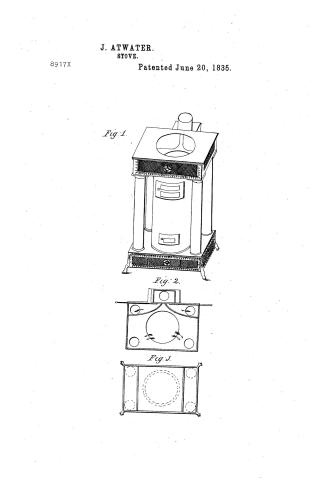
J. Atwater's Patent Drawing for a Stove

National Archives, Restored Patent Drawings (Record Group 241) · Full-size scan at the National Archives · Catalog record
Show the text on the drawing Hide (42 words)
Words on the drawing as machine-read by the National Archives; not checked. Useful mainly for searching.
126. STOVES & FURNACES ab stone / [154] Heating Stoves. V / 12 / J O .ITWATER / CLASSIFICATION / 8917- X / ST OVE o / Patented 20th June 1835 / DIVISION. / Fig 1. / asso / seese / Fig 2 / Fg3.
USPTO scan
The patent as scanned by the USPTO
-
 Page 1
-
 Page 2
-
 Page 3
-
 Page 4
-
 Page 5


U.S. Patent and Trademark Office · Google Patents
Show the transcription Hide (1,462 words)
Machine transcription (LightOnOCR) of the pages as scanned by the USPTO, most of them the handwritten copies made when the records were restored after the 1836 fire. Not checked; it can misread handwriting, so compare it with the scan.
Page 1.
J. ATWATER.
STOVE.
8917X
Patented June 20, 1835.
Fig. 1.
Fig. 2.
Fig. 3.
Page 2.
June 20, 1835
James Atwater
Letters Patent
The schedule referred to in these Letters Patent and making part of the same containing a description in the words of the said James Atwater himself of his improvement in the common furnace stove used for burning hard coal.
Know all men by these Presents
That I James Atwater of New Haven in the County of New Haven and State of Connecticut and a citizen of said State and of the United States have invented a new and useful improvement in the common furnace stove used for burning hard coal and that the following is a full and exact description of the construction and operation of said machine as invented or improved by me. This improvement consists in certain alterations of and additions to a common furnace stove used to burn hard coal for the purpose of retaining and diffusing the heat of the fuel burned therein in a convenient and economical manner. These additions and alterations comprise a base with a chamber in each of two sides thereof an entablature with two divisions therein and two columns connecting the base and entablature. This base and entablature are substituted for the usual top and bottom of the stove. The cylinder of the stove, the base, entablature and columns may be formed of cast iron or other suitable metallic substance or apart from each, but I have found sheet iron for the cylinder and columns, and cast iron for the base and entablature answer a good purpose, but the whole can be made of cast iron if preferred. The base and entablature may be of any suitable shape but I have made them in the shape of an elongated cake with six plates or sides. The cylinder which contains the grates, the doors and any other usual apparatus of a common furnace stove is made to fit onto a lip formed around an opening in the base and entablature of the size of the cylinder nearly and the columns are made to fit on to lips which surround the above named openings (viz) one in the upper plate of the base and one in the lower plate of the entablature. Which lips will correspond in number and
Page 3.
and position with column and base nearly of the same size. The opening for the cylinder being in the centre of the base and entablature and if four columns are used the openings for them being at or near the four corners of the base and entablature. The length of the base and entablature may be about twice the diameter of the cylinder and the breadth may a little exceed the said diameter so that the front of the cylinder and column when fitted on will be in a line and set back of the front of the base and entablature so as to make a suitable projection and give a finished appearance to the whole. The base by two partitions proceeding from front to rear, is divided into three parts, the middle part being about three fifths and the two parts or side chambers being each about one fifth of the length of the base. The entablature is also divided by two partitions into three parts which partitions are placed in the rear of the entablature and made slightly curving and each one commences a little in front of the opening for the two back columns and terminates very near the middle of the back plate of the entablature so that each of the back columns opens into a separate chamber divided off from the residue of the entablature. On the rear plate of the entablature are two openings one in each of the chambers last mentioned of any convenient size and shape to correspond with the size of the columns which openings communicate with a short flattened pipe or head fitted to and projecting from the rear plate of the entablature on the upper side of which head is placed or fitted a pipe to conduct off smoke gas &c or this pipe may be placed in any other convenient position. Each of the openings through the back plate of the entablature leading from the two small chambers thereof has a slide or stopper fitted to it by which the opening is partially or wholly opened and shut and which slides are drawn out or shoved in by means of a handle to each which passes out at the respective ends, and near the rear of the entablature. The base has an opening in the front plate about the length of one diameter of the cylinder which receives a cast iron in the usual way. On the top plate of the entablature I have found it best to form an opening about the size of the cylinder and fit a round plate to shut over the same, and which can be taken
Page 4.
8917X
of with ease when required. In the bottom plate of the base and on the side chambers are two small openings with stoppers or slides to shut also and open for the removal of dust or other substances. The hole should be supported by feet or otherwise raising the base a suitable distance from the floor or ground. The whole being fitted together may be made firm by rods passing from the upper plate of the entablature through the columns and down through the lower plate of the base and fastened at each end in the usual way. When the slides or stoppers are drawn out and the fire kindled, the smoke heated air will pass up into all portions of the entablature except the two small chambers therein, thence down the two front columns, thence through the two side divisions or chambers of the base thence upward through the two back columns thence into the two small divisions or chambers of the entablature, thence through the spaces left open by the sides or stoppers, into the head or rear of the entablature and off through the pipe attached thereto in the usual way.
Thus the heated air or draught passing through the whole of the entablature and about two fifths of the base and through the columns, the heat is transmitted by an extensive radiating surface and but little of it lost. By shutting one of the slides, one half of the columns only may be used in connection with their chambers, and the draught increased or diminished. By closing both slides the fire will be extinguished. By observing a due proportion of the parts these stoves may be made of any size or shape, and may be plain or ornamental. In the stove which I have used I have found that when the cylinder was ten inches in diameter, the columns might be 3 to 3 1/4 inches in diameter but a slight variation would be immaterial. I claim none of the above described parts of the improved stove separately taken, but I do claim the combination and arrangement of the base, the entablature, the columns & the slides or stoppers so as to be used in connection with the body or cylinder or furnace stove of the usual or of any form by means of which combination and arrangement the heat of the fuel can be brought into contact with the whole of the entablature, the whole of the columns and the side chambers of the base and diffuse through a large radiating surface or can be so regulated.
Page 5.
regulate us to pass through and radiate from only one half of the columns and base, if less heat is required. In this stove the draught is circuitous only. But I do not claim that a non-circuitous draught is new, nor that the diffusion of heat by radiation through metallic plates or columns is my invention, but that the above described combination and arrangement is a new and useful improvement to accomplish the above mentioned purposes. The annexed drawings exhibit the improved stove. Figure I. shows a front view, with the plate to cover the opening in the upper plate of the entablature removed. Figure II. shows a horizontal section of the entablature. Figure III. shows a horizontal section of the base. In testimony that the foregoing is a true and full specification of my said improvement I have hereunto set my hand at I was Haver this nineteenth day of May A.D. 1835.
Witnesses
Samuel S. Hitchcock
David Kimberly
James Atwater
(Drawing)
12430 x 8
Published accounts: journal notice
Notice in the monthly list of patents
Journal of the Franklin Institute, new ser., vol. 16 (1835), p. 143 · View the page
368. Stove. James Atwater, New Haven, Conn.
Published accounts: journal notice
Notice in the monthly list of patents, with remarks
Journal of the Franklin Institute, new ser., vol. 17 (1836), p. 54 · View the page
58. For a Stove; James Atwater, New Haven, Connecticut, June 20.
Remarks. We are told by the patentee that "this improvement consists in certain alterations of, and additions to, a common furnace stove used to burn hard coal, for the purpose of retaining and diffusing the heat of the fuel burned therein in a convenient and economical manner." Those who are acquainted with the construction of Spoor's parlour stove, (see vol. 16, p. 81,) will easily understand Mr. Atwater's, as it is precisely the same thing, changed only in form. The furnace part is the common cylindrical stove, with the four flues of Spoor's stove, forming four separate columns, the stove and columns extending from a quadrangular base containing the ash pit, and side flues, to a quadrangular cap, or entablature properly divided, and supplied with slides or dampers to cause the heat to circulate down the front and up the back columns, or to admit it directly to the escape pipe. The patentee disclaims the invention of the individual parts, but claims as new "the above described combination and arrangement to accomplish the above mentioned purposes."
About this record
- Patentee
- DATAMP
- Date
- the Name and Date index of patents, DATAMP, USPTO records
- Invention
- DATAMP
- Listed in
- the Name and Date index of patents, DATAMP, USPTO records, Jim Shaw's X-patent list, the Journal of the Franklin Institute, Burke's List of Patents (1847)
- Burke's 1847 Patent Office list gives the same patent.