

Drawings and documents
USPTO scan
The patent as scanned by the USPTO
-
 Page 1
-
 Page 2
-
 Page 3
-
 Page 4
-
 Page 5


U.S. Patent and Trademark Office · Google Patents
Show the transcription Hide (1,354 words)
Machine transcription (LightOnOCR) of the pages as scanned by the USPTO, most of them the handwritten copies made when the records were restored after the 1836 fire. Not checked; it can misread handwriting, so compare it with the scan.
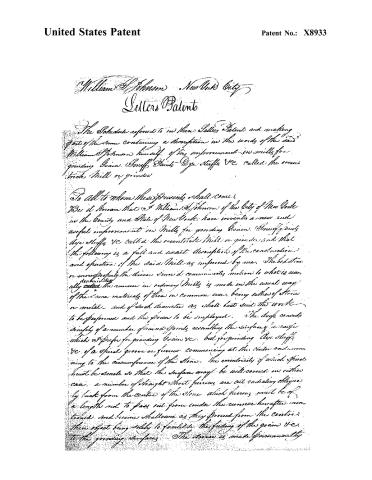
Page 2.
United States Patent
Patent No.: X8933
William Johnson — New York City
Letters Patent
The Schedule referred to in these Letters Patent and making part of the same containing a description in the words of the said William Johnson himself of his improvement in mills for grinding Grain, Flour, Paints, Dye Stuffs &c called the eccentric brake Mill or grinder.
To all to whom these presents shall come.
Be it known that I William Johnson of the City of New York in the County and State of New York have invented a new and useful improvement in Mills for grinding Grain, Flour, Paints, Dye Stuffs &c called the eccentric brake Mill or grinder and that the following is a full and exact description of the construction and operation of the said Mill as improved by me. The bedstone or more properly the drive since it conveniently motion to what is usually called the runner in ordinary Mills is made in the usual way of the same materials of those in common use, being either of Stone or metal and of such diameter as shall best suit the work to be performed and the power to be employed. The drive consists simply of a number of grooved points resembling the surface of a rasp which is proper for grinding Grain &c. but for grinding Dye Stuffs &c of a spiral groove or furrow commencing at the centre and running to the circumference of the Stone. The eccentricity of which points must be small so that the surface may be well covered in either case. a number of straight short furrows are cut radiating obliquely back from the centre of the Stone which furrows must be of a length not to pass out from under the runner hereafter mentioned and become shallower as they proceed from the centre their object being solely to facilitate the feeding of the grain &c. to the grinding surfaces. The drive is made permanently
Page 3.
United States Patent
Patent No.: X8933
fast upon the projecting end of a horizontal shaft which has a double bearing and turns in appropriate boxes so that the motion of the driver may be steady and true. The shaft receiving its motion from the moving frame by a strap or cog gearing as may be preferred. It is also mounted or turned small at its bearings so as to admit of a lateral movement by which the distance of the driver from the runner can be regulated and the mill be made to grind coarse or fine. This movement may be effected by a timber screw, spring, weighted lever, or by any of the means used for similar purposes. The top stone or runner is made of the same material as the driver. The stress being similar, except that it is reversed, it has a circular opening or eye at the center which I have found in practice should be about 2 inches in diameter for grain &c. or about 4 for clay stuffs &c. when the diameter of the driver is 2½ feet, but this must of course be varied to suit circumstances. From the back of the runner which is hollowed out so as to bring the attachment as near the face of the stone as may be for strength. A short hollow shaft rises, the bore of which forms a continuation of the eye of the stone and which when metal is used may be cast solid with the runner. Through which bore the substance to be ground is fed to the grinding surfaces, being enlarged at the outer extremity so as to admit the grain &c. more freely or receive the foot of the feed hopper, hereafter mentioned. A neck or wrist is also turned in the shaft (or which may also be formed by a screw ring) at the end extending from the back of the runner near the end, which projects with a square shoulder beyond the bearing of the shaft which latter is in a cylindrical box of suitable material that projects into the cavity of the back of the runner so that the neck or wrist of the shaft being slightly annular (towards its outer extremity) the bearing is chiefly upon the inner portion of the box close to the face of the runner as possible. This arrangement is intended to admit of a slight vibration to the runner when grinding that it may accommodate
Page 4.
United States Patent
Patent No.: X8933
itself to the irregularities that may take place in the feeding between the grinding surfaces. Moreover the bearing of the runner is raised above that of the driver so as to bring the lower edge of the eye on a level or a short distance above the centre of the driver making thereby the eccentricity equal to the diameter of the eye and the difference of the diameters of the stones being made equal to the eccentricity the upper part of their circumference when together coincide.
The feed hopper which is of a trumpet shape and receives the grain etc. from the shoe of an ordinary hopper into which it is first thrown is supported in an oblique position so as to afford an easy descent to the grain to by a short bracket or arm which rises from the upright bearing of the runner shaft to which it is attached its foot is diminished so as to enter the enlarged end of said shaft and fit it neatly without friction. It is prolonged by a small square bar or finger which is attached to the inner surface of the lower end of said foot and winds spirally along the cavity of the shaft until it nearly reaches the face of the runner. The office of this finger being to assist the feeding and to prevent choking from adhesion to the sides—particularly when grinding paint. The stones are surrounded with with a case of ordinary construction with a proper discharging outlet two tubes being introduced opposite the extremities of the horizontal diameter of the driver for the purpose of keeping up a constant circulation of fresh air which by the peculiar operation of the grinding surfaces is drawn in at one side and discharged at the other.
Operation. — The substance to be ground being placed on the hopper and the mill set in revolution by the combined motion of the spiral finger and the driver and runner it is fed to the grinding surfaces which reduce it rapidly to the degree of fineness for which the mill is set. Although I have only described the mill as operating with the grinding surfaces in a vertical position, I also intend to operate it horizontally by making a suitable alteration in the lower bearing or step of the driving shaft and
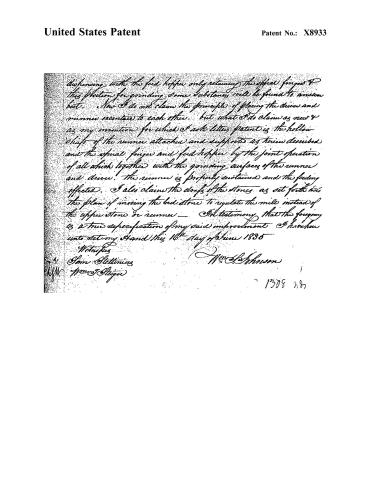
Page 5.
United States Patent
Patent No.: X8933
disposing with the feed hopper only retaining the official finger & this position for grinding, some substances will be found to answer best. Now I do not claim the principle of placing the driver and runner separate to each other, but what I do claim as new & as my invention for which I ask letter patent is the hollow shift of the runner attached and supports as herein described and the spiral finger and feed hopper by the joint operation of all which together with the grinding surfaces of the runner and driver, the runner is properly sustained and the feeding effected. I also claim the draft of the stones as set forth and the plan of moving the bed stone to regulate the mile instead of the upper stone or runner — In testimony that the foregoing is a true specification of my said improvement I have hereunto set my hand this 16th day of June 1835
Witnesses
Sam Stettinius
Wm. J. Stiger
Wm. S. Johnson
1308 28
Published accounts: journal notice
Notice in the monthly list of patents
Journal of the Franklin Institute, new ser., vol. 16 (1835), p. 214 · View the page
385. Mills for grain, &c.-William S. Johnson, city of New York,
Published accounts: journal notice
Notice in the monthly list of patents, with remarks
Journal of the Franklin Institute, new ser., vol. 17 (1836), p. 58 · View the page
75. For a Mill for Grain, &c.; William S. Johnson, City of New York, June 26.
Remarks. The patentee calls this an "eccentric mill," and proposes it as proper for grinding paints, dye stuffs, snuff, and most other articles required to be ground. A sufficient description of it may be found at p. 34, Vol. 10, as patented by James Bogardus, of the City of New York, the difference between that and the one now before us being, most manifestly, colorable only. We should think it certain that if the claim of Mr. Bogardus was well founded, the present is an invasion of it.
About this record
- Patentee
- DATAMP
- Date
- the Name and Date index of patents, DATAMP, Burke's List of Patents (1847)
- Invention
- DATAMP
- Listed in
- the Name and Date index of patents, DATAMP, USPTO records, Jim Shaw's X-patent list, the Journal of the Franklin Institute, Burke's List of Patents (1847)
- The sources give different dates; the date shown is the one most of them agree on.
- The Franklin Institute's journal confirms the date shown.
- Burke's 1847 Patent Office list gives the same patent.