

Drawings and documents
National Archives restored drawings: drawing
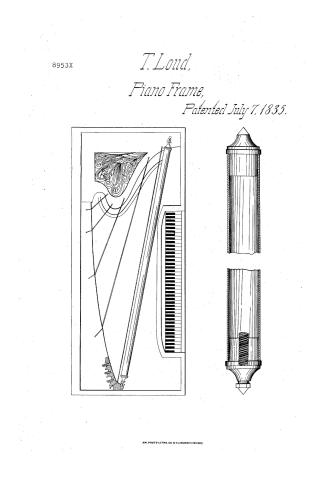
T. Loud's Patent Drawing for Compensating Tubes for Piano Fortes

National Archives, Restored Patent Drawings (Record Group 241) · Full-size scan at the National Archives · Catalog record
Show the text on the drawing Hide (59 words)
Words on the drawing as machine-read by the National Archives; not checked. Useful mainly for searching.
84. MUSIC. / Piano String Plates, / III Its / Compensaring Jules for Pans. Forles / the / 8953-1 / Palented / 1/ / Tulie / full / size / E.Strickland Den / Patent office 22'Deer 1838 / Made under the direction of the Commissioner / of Patents in conformity with act 3 March 1837 / and adjustable / Hollow / Commitioner of Patents,
USPTO scan
The patent as scanned by the USPTO
-
 Page 1
-
 Page 2
-
 Page 3


U.S. Patent and Trademark Office · Google Patents
Show the transcription Hide (610 words)
Machine transcription (LightOnOCR) of the pages as scanned by the USPTO, most of them the handwritten copies made when the records were restored after the 1836 fire. Not checked; it can misread handwriting, so compare it with the scan.
Page 1.
8953X
T. Loud,
Piano Frame,
Patented July 7, 1835.
AM. PHOTO-LITHO. CO. N.Y. (OSBORNE'S PROCESS)
Page 2.
8953X
July 7, 1835
Thomas Loud - Philadelphia, Pennsylvania
Letters Patent
The substance referred to in these Letters Patent and making part of the same containing a description in the words of the said Thomas Loud himself of his improvement on the compensating tubes of Piano Fortes.
To all whom it may concern, Be it known that I Thomas Loud of the City of Philadelphia in the State of Pennsylvania have invented an improvement in the mode of constructing and applying a compensation tube to Piano Fortes, and that the following is a full and exact description thereof. It is known to Piano Forte makers that what are called compensation tubes were applied to Piano Fortes, some years since in London. The compensation tubes are applied for the purpose of resisting the strain of the strings by supporting the blocks to which these ends are attached and also by their expansion and contraction to compensate that of the strings resulting from change of temperature. The tubes on the English instruments are made with flat ends which rested against metal plates firmly attached to the end blocks of the Piano Fortes. From the manner in which they were constructed and fixed they were liable to spring if unsupported, and to prevent this bars of wood are placed crosswise in contact with them in order to sustain them, by which arrangement the vibration of the instrument was in some degree checked and the tone impaired.
My improvement I generally use but one compensation tube. I do not intend however to limit myself in this particular, but to use two or more should I find it advantageous to do so. My claim to improvement not being dependent upon the number of tubes, but upon the manner in which they are constructed and support the strain.
When one tube only is used it must be made larger than when two or more are employed. I shall describe but one as a competent workman will be no loss in employing a greater number upon the same principle.
Page 3.
I take a tube of iron which may be about one sixteenth of an inch thick and an inch and a half in diameter, and either brighten and polish it, or cover it with a thin tube as sheet brass or other metal drawn upon it on each end of this tube I fix a cup usually of iron and having projecting points of iron or steel in their centers. One of these points is upon the projecting head of a screw tapped into the cup, these points pass into corresponding holes in ornamental cast iron blocks, one of which is usually cast in one piece with the metallic plate at one end and the other secured firmly to the block containing the rest pins at the opposite end. The particular manner of fixing them will depend upon the construction of the Piano Forte and upon the judgment of the workman. What I claim as my invention and wish to secure by Letters Patent is the employment of points or centers to sustain the pressure in compensating tubes for Piano Fortes whether constructed precisely in the manner herein set forth or in any other producing the same result by analogous means.
Witnesses
A. B. Strandbridge
Thomas Gould
Thos. C. Gould
(Patented 7 July 1835) (385 Words)
(Drawing)
Published accounts: journal notice
Notice in the monthly list of patents
Journal of the Franklin Institute, new ser., vol. 16 (1835), p. 215 · View the page
403. Piano fortes.-Thomas Loud, city of Philadelphia,
Published accounts: journal notice
Notice in the monthly list of patents, with remarks
Journal of the Franklin Institute, new ser., vol. 17 (1836), p. 123 · View the page
15. For an improvement in the Compensating Tubes for Piano Fortes; Thomas Loud, city of Philadelphia, July 7.
Remarks. (See the specification.)
About this record
- Patentee
- DATAMP, Burke's List of Patents (1847)
- Date
- the Name and Date index of patents, DATAMP, USPTO records
- Invention
- DATAMP
- Listed in
- the Name and Date index of patents, DATAMP, USPTO records, Jim Shaw's X-patent list, the Journal of the Franklin Institute, Burke's List of Patents (1847)
- The name conflict was settled by Burke's 1847 list.
- Burke's 1847 Patent Office list gives the same patent.