

Drawings and documents
National Archives restored drawings: drawing
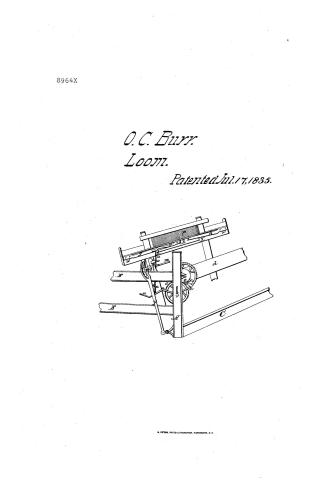
O.C. Burr's Patent Drawing for a Take-up Mechanism for Looms

National Archives, Restored Patent Drawings (Record Group 241) · Full-size scan at the National Archives · Catalog record
Show the text on the drawing Hide (104 words)
Words on the drawing as machine-read by the National Archives; not checked. Useful mainly for searching.
139. WEAVING, / Take Ups and Let Offs, / Take Ups. / (No Model.) / 0. C. BURR. / TAKE-UP MECHANISM FOR LOOMS. / CLASSIFICATION / 8964x / Patented July 17, 1835. / DIVISION. / Oliver b. Buris Imp Coom E-D / Patented sy July 1835. / P° / to / 19 / .A / Reed is supported on its lower side / in far K. which is held in place by / springs g, h. The resistance offered / by the weft to the need Causes bar / K ts more back in lay, and spring v, / acting upon the upher end of lever n / causes pin Z to engage with leven a
USPTO scan
The patent as scanned by the USPTO
-
 Page 1
-
 Page 2
-
 Page 3
-
 Page 4


U.S. Patent and Trademark Office · Google Patents
Show the transcription Hide (1,001 words)
Machine transcription (LightOnOCR) of the pages as scanned by the USPTO, most of them the handwritten copies made when the records were restored after the 1836 fire. Not checked; it can misread handwriting, so compare it with the scan.
Page 1.
8964X
O.C. Burr.
Loom.
Patented Jul. 17, 1835.

M. PETERS, PHOTO-LITHOGRAPHER, WASHINGTON, D.C.
Page 2.
8964 X
July 17, 1835
Olivier C. Burr. July 17, 1835
The Schedule referred to in these Letters Patent and making part of the same, containing a description in the words of the said Olivier C. Burr himself of his improvement in the construction of Looms.
To all people to whom these Presents shall come, Be it known that I Olivier C. Burr of Milbury in the County of Worcester and Commonwealth of Massachusetts machinist have invented constructed and applied to use a new and valuable improvement in the construction of Looms, and that the following is a full and exact description of the construction and operation of the same, as invented or improved by me. Manufacturers have experienced great inconvenience in regulating the motion of the beam in the loom upon which the cloth as it is woven is wound. Many attempts have been made to remedy this evil, & while for the most part they have totally failed of accomplishing the desired object. The few that have succeeded have been attended with so much expense, as to prevent their coming into general use. The improvement I have made is such that it can be added to the common Loom once at a very trifling cost, and completely accomplishes the object (which has so long been desired), for by my plan the cloth beam which heretofore wound up the cloth only at intervals after several threads of filling had been added, moves at each flight of the shuttle, and thus winds up the cloth as fast as it is woven. The beam winds as each single thread of filling is added. This gives the cloth a uniform thickness and effectively prevents all unevenness in the texture of it. In addition to this advantage, there is another effect (by my) improvement, which is equally important, which is that when the thread of the bobbin or spool either breaks or is out although the loom may continue in motion
Page 3.
the cloth beam is stationary, because the motion of this depends upon the filling. Explanation of the Drawing.
A.B. B.C. part of the frame of a loom. W.W. Lathe of the loom. p. Reed. g. spring one end confined to the Lathe at W. r. another spring, h. another spring also confined to the Lathe at one end at W. — h. a piece of wood extending from g. to g. and let into the Lathe beam and confined to its place by means of the springs g. and h. and in the operation of the loom is pressed outwards by the reed at each vibration of the Lathe, a distance equal to the diameter of the thread of the filling. m. m. arm or lever turning upon a pin or fulcrum at O. the upper end of which is between the unconfined ends of the spring g. and W. is moved by the piece of wood h. at the lower end of the arm or lever is a short or pin R. which touches the crooked arm a. a. a. — a. a. a. arm turning on the axis or shaft of the Wheel c. at W. c. ratchet wheel having a pinion upon its axle which moves the cog wheel b. b. cog wheel attached to the cloth beam. e. dogs or levers attached to the crooked arm a. a. a. for moving the ratchet wheel c. — y arm or sweep which vibrates the Lathe. i. the slot in the sweep to receive the end of the crank on the shaft m. m. shaft.
Operation of the machine. — When the loom is put in motion, the Lathe W.W. by means of the crank upon the axis m. moving in the irregular slot i is carried back. The thread of filling by means of the reed p. was carried back at the same time. The lower side of the reed p. being confined only by the piece of wood h. which is movable, was pressed outwards when the Lathe fell back in consequence of the addition of a thread of the filling. The pressure of the piece of wood h. outwards was very small equaling only the diameter of thread of filling. But this communicates a corresponding motion to the arm m.m. and the short or pin R.
Page 4.
8964X
resting upon the crooked arm a.a., gave motion to that also, and by means of the dogs or hands and aalek wheels, & pinion upon its axis, the cloth beam d. was moved, thus winding upon the cloth beam the very small piece of cloth made by the addition of the thread of filling. The springs g. and h. press the reed by means of k. back to its place. By changing the position of the pin or fulcrum of the arm m.m. which is at o, the texture of the cloth may be altered. It may be made thick or thin at pleasure and the warp slacked or strained according to the strength of the yarn. The motion of the arm or lever m.m. by which the cloth beam is turned, may be communicated as well from the lathe beam or screw y, as from the reed p. All I claim as my invention is the motion communicated to the cloth beam by means of the arm or lever m.m. In witness that this above is a true specification of my said improvement I have hereunto set my hand this twenty third day of May in the year of our Lord one thousand eight hundred and sixty four.
Witnesses
T. T. Harnesville
Peter Wilson
Christopher Columbus Balduzzi
Alice E. Burr (Attorney)
(Drawing)
Published accounts: journal notice
Notice in the monthly list of patents
Journal of the Franklin Institute, new ser., vol. 16 (1835), p. 215 · View the page
419. Looms.-Oliver C. Burr, Millbury, Massachusetts,
Published accounts: journal notice
Notice in the monthly list of patents, with remarks
Journal of the Franklin Institute, new ser., vol. 17 (1836), p. 127 · View the page
31. For an improvement in Looms; Oliver C. Burr, Millbury, Worcester county, Massachusetts, July 17.
Remarks. It is stated that it has been found very difficult to wind cloth upon the beam of a loom with regularity, as it is woven, and that those plans for doing it which have been successful, are too expensive. By the plan now patented, the beam is to move at each flight of the shuttle, instead of at longer intervals, and, if the thread on the spool breaks, the winding ceases. By a particular contrivance, the proper explanation of which would require the drawing, the latter is made to communicate motion to the cloth beam, through the intervention of an arm, or lever, the employment of which constitutes the claim.
About this record
- Patentee
- DATAMP
- Date
- the Name and Date index of patents, DATAMP, USPTO records
- Invention
- DATAMP
- Listed in
- the Name and Date index of patents, DATAMP, USPTO records, Jim Shaw's X-patent list, the Journal of the Franklin Institute, Burke's List of Patents (1847)
- Burke's 1847 Patent Office list gives the same patent.