

Drawings and documents
National Archives restored drawings: drawing
Freeman Wolcot's Patent Drawing for an Improvement in the Manufacture of Cloth

National Archives, Restored Patent Drawings (Record Group 241) · Full-size scan at the National Archives · Catalog record
Show the text on the drawing Hide (35 words)
Words on the drawing as machine-read by the National Archives; not checked. Useful mainly for searching.
MOTH fitil ING, / Intile / Happy / 01 / Clath - Mapping / Freman Holert / CLASSIFICATION / 8988.1 / DIVISION. / In the manufacture of cloth / Palented 1835 / of
USPTO scan
The patent as scanned by the USPTO
-
 Page 1
-
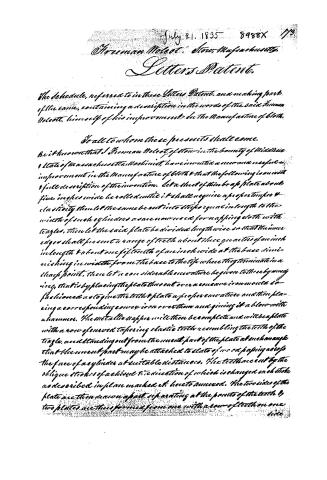 Page 2
-
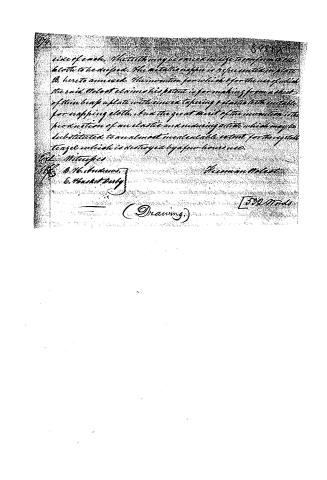 Page 3


U.S. Patent and Trademark Office · Google Patents
Show the transcription Hide (544 words)
Machine transcription (LightOnOCR) of the pages as scanned by the USPTO, most of them the handwritten copies made when the records were restored after the 1836 fire. Not checked; it can misread handwriting, so compare it with the scan.
Page 1.
CLOTH DYEING.
CLASSIFICATION
8988.X
DIVISION.
Freeman Hockett
7-21-1835
In the Manufacture of cloth
Page 2.
July 21, 1835 8988X 173
Herman Moleot. Ston, Massachusetts.
Letters Patent.
The schedule, referred to in these Letters Patent, and making part of the same, containing a description in the words of the said Herman Moleot, himself of his improvement in the Manufacture of cloth.
To all to whom these presents shall come.
Be it known that I Herman Moleot, of Ston—in the county of Middlesex & State of Massachusetts, Machinist, have invented a new and useful improvement in the Manufacture of cloth & that the following is an exact & full description of the invention. Let a sheet of thin brass plate about five inches wide be rolled until it shall acquire a proper temper & elasticity, then let the same be cut into strips of equal length to the width of such cylinders as are now used for napping cloth with tangles, then let the said plate be divided lengthwise so that the inner edges shall present a range of teeth about three quarters of an inch in length & about one fifteenth of an inch wide at the base diminishing in width from the base to the tip where they terminate in a sharp point, then let a considerable curvature be given to these edges in any way, that is by placing the plate thus cut over a concave iron mould so fashioned as to give the teeth & plate a proper curvature and then placing a corresponding convex iron over them and giving it a blow with a hammer. The metallic napper will then be complete and will be a plate with a row of curved tapering elastic teeth resembling the teeth of the tangle, and standing out from the cement part of the plate at such an angle that the cement part may be attached to slats of iron or papering across the face of a cylinder at suitable distances. The teeth are cut by the oblique strokes of a chisel in the direction of which is changed each stroke as described in plan marked at. here to annexed. The two sides of the plate are then drawn apart separating at the points of the teeth & two plates are thus formed from one with a row of teeth on one side.
Page 3.
side of each. The cloth may be then wrung to conform to the cloth to be dyed. The metallic paper is here inserted in plate B. hereto annexed. The invention for which for the use of which the said Molost claims his patent is for making from a sheet of thin leafy plate with an wax to form a plastic both suitable for wrapping cloth. And the great merit of the invention is the production of an elastic and non-drying article which may be substituted to an almost inexhaustible extent for the vegetable teazel which is destroyed by a few hours use.
Exl. Mituipes
B. H. Andrews
C. Hasket Derby
Francis Molost
(Drawing)
[502 Words]
Published accounts: journal notice
Notice in the monthly list of patents
Journal of the Franklin Institute, new ser., vol. 16 (1835), p. 215 · View the page
424. Cloth, manufacturing. Freeman Wolcot, Stow, Massachusetts,
About this record
- Patentee
- DATAMP
- Date
- the Name and Date index of patents, DATAMP, USPTO records
- Invention
- DATAMP
- Listed in
- the Name and Date index of patents, DATAMP, USPTO records, Jim Shaw's X-patent list, the Journal of the Franklin Institute, Burke's List of Patents (1847)
- The Franklin Institute's journal spells the name differently.
- Burke's 1847 Patent Office list gives the same patent.