

Drawings and documents
USPTO scan
The patent as scanned by the USPTO
-
 Page 1
-
 Page 2
-
 Page 3
-
 Page 4


U.S. Patent and Trademark Office · Google Patents
Show the transcription Hide (845 words)
Machine transcription (LightOnOCR) of the pages as scanned by the USPTO, most of them the handwritten copies made when the records were restored after the 1836 fire. Not checked; it can misread handwriting, so compare it with the scan.
Page 2.
United States Patent
Patent No.: X9011
Eli T. Benjamin
Letters Patent
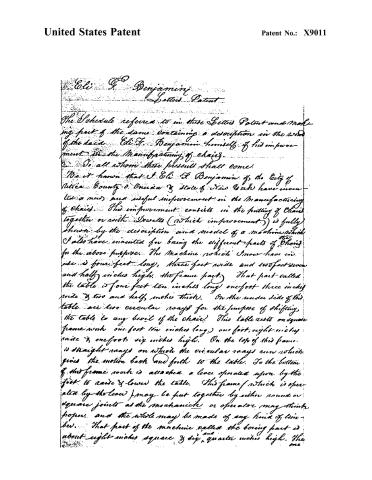
The Schedule referred to in these Letters Patent and making part of the same containing a description in the words of the said Eli T. Benjamin himself of his improvement in the Manufacturing of chairs.
To all whom these presents shall come:
Be it known that I Eli T. Benjamin of the City of Utica County of Oneida & State of New York have invented a new and useful improvement in the Manufacturing of chairs. This improvement consists in the putting of Chairs together or with Dowels (which improvement) is fully shown by the description and model of a machine which I also have invented for boring the different parts of Chairs for the above purpose. The Machine which I now have in use is four feet long, three feet wide and two feet seven and half inches high. The frame part. That part called the table is four feet ten inches long one foot three inches wide & two and half inches thick. On the under side of this table are two circular ways for the purpose of shifting the table to any level of the chair. This table rests on square frame work one foot ten inches long one foot eight inches wide & one foot six inches high. On the top of this frame is straight ways on which the circular ways run which gives the motion back and forth to the table. To the bottom of this frame work is attached a lever operated upon by the foot to raise & lower the table. This frame (which is operated by the lever) may be put together by either round or square joints as the mechanic or operator may think proper, and the whole may be made of any kind of timber. That part of the machine called the boring part is about eight inches square & six and quarter inches high. The one
Page 3.
United States Patent
Patent No.: X9011
one I have now in use has two arbors similar to turning lathe arbors with tapered holes in the end to receive the bits or augers. These two arbors are turned by another of the same kind on which the gearing is fixed for running them. The top of the table is prepared with steps & guides with screws running in long mortises or what is called slots & the timber is held to the top of the table by screws & jacks as the mechanic or operator may think proper. The edge of the table toward the boring part is prepared in the same manner. After the back and front posts of the chair are prepared & put together, the side of the chair is then set perpendicular against the edge of the table. The bottom resting on what is called a step (which is fixed to the table) the table is then turned to the right bevel of the chair by means of the circular ways which operate with nuts & screws) and now up to the bits or augers operating the lever & shifting the side of the chair until bored. That part of the machine which is separate from the table is made to fasten to the edge of the table by means of screws is made in form of the model with guides, steps & fastenings for the purpose of boring, what is called the front or slot of the chair. It is hung with hinges to a piece of timber & fastened to the edge of the table with screws having what is called a horse to raise & lower it to suit the bevel of the chair. It is made portable for convenience. It may be made fast to the table if thought proper. The whole machine may be varied or altered both in length, width & height to suit the mechanic or operator. The boring part may be made of any kind of metal or even wood & may operate with one, two, three or four bits or augers. Or there may be two boring parts attached to the same frame operating in like manner, it may also be made to operate without the lever & the whole machine may be propelled by hand, horse, steam, or water power or even air. What
Page 4.
United States Patent
Patent No.: X9011
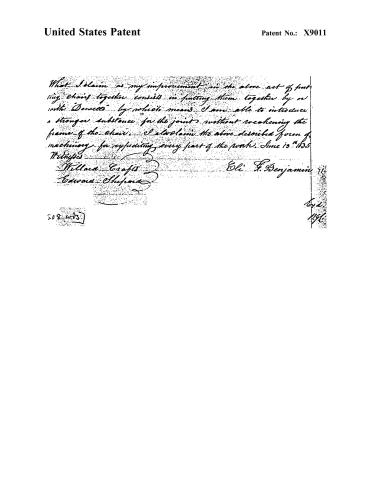
What I claim as my improvement in the above art of putting chairs together consists in putting them together by or with "Dowels" by which means I am able to introduce a stronger substance for the joint without weakening the frame of the chair. I also claim the above described form of machinery for expediting every part of the work. June 13th 1855
Witnesses:
Willard Crafts
Edward Shepard
Eli G. Benjamin
508 wts
Published accounts: journal notice
Notice in the monthly list of patents
Journal of the Franklin Institute, new ser., vol. 16 (1835), p. 286 · View the page
450. Cutting and press machine. Benjamin Morris, Oxford, N. Y. -
Published accounts: journal notice
Notice in the monthly list of patents
Journal of the Franklin Institute, new ser., vol. 16 (1835), p. 287 · View the page
489. Chairs, making.-Eli F. Benjamin, Utica, New York,
Published accounts: journal notice
Notice in the monthly list of patents, with remarks
Journal of the Franklin Institute, new ser., vol. 17 (1836), p. 196 · View the page
9. For a vertical Cutting and Press Machine for Books and Paper; Benjamin Morris, Oxford, Chenango county, New York, August 15.
Remarks. The cutting part of this machine is very similar to that of those in general use, in which a long knife is brought down vertically to cut the edges of books, or paper. The following may give some idea of the points of novelty claimed by the patentee. "I have thus shown the construction of my vertical cutting and press machine in all its principal parts, and, in so doing, have described many things which I do not claim as of my invention; but what I do claim is, first, the attaching the knife by which the cutting is to be effected, to a separate frame, as shown in the drawing, which separate frame, with the knife, may be removed from the sliding frame, and again affixed thereto by means of thumb screws and buttons, for the purpose of sharpening the knife, without altering the setting or adjustment thereof. I claim, secondly, the general combination and arrangement of the different parts of this machine, as described, for the purpose of moving the frame of the cutting knife, and also of the frame for pressing; not intending, however, by this claim, to confine myself to the precise arrangement which I have exhibited, but to vary this as I may think proper, whilst I attain the same end by means substantially similar.
Published accounts: journal notice
Notice in the monthly list of patents, with remarks
Journal of the Franklin Institute, new ser., vol. 17 (1836), p. 207 · View the page
47. For an improvement in the Manufacturing of Chairs; Eli F. Benjamin, Utica, Oneida county, New York, August 17.
Remarks. A machine is employed for the purpose of boring the different parts of the chair which are to be connected together, as all the chairs made upon the plan of the patentee are to be put together by dowells. The machine has a shifting top, upon which the pieces to be bored are secured by proper means, the movements of the top admitting of giving the proper rake in all directions; there are, attached to the frame, two spindles, running like lathe spindles, to receive the bits to be used. The claim is to "the putting chairs together by or with dowells, and the described form of machinery for expediting every part of the work." The model is referred to throughout the specification, which is a very gross error, though by no means an uncommon one. A drawing is given, but it does not furnish the details of the "described form of machinery;" to an ingenious workman, this, it is true, would be a thing of little consequence, as he could easily construct the required apparatus without trenching upon the claims of the patentee.
About this record
- Patentee
- DATAMP
- Date
- DATAMP, USPTO records, Burke's List of Patents (1847)
- Invention
- DATAMP
- Listed in
- the Name and Date index of patents, DATAMP, USPTO records, Jim Shaw's X-patent list, the Journal of the Franklin Institute, Burke's List of Patents (1847)
- The sources give different dates; the date shown is the one most of them agree on.
- The Franklin Institute's journal gives a different date.
- Burke's 1847 Patent Office list gives the same patent.