

Drawings and documents
USPTO scan
The patent as scanned by the USPTO
-
 Page 1
-
 Page 2
-
 Page 3


U.S. Patent and Trademark Office · Google Patents
Show the transcription Hide (680 words)
Machine transcription (LightOnOCR) of the pages as scanned by the USPTO, most of them the handwritten copies made when the records were restored after the 1836 fire. Not checked; it can misread handwriting, so compare it with the scan.
Page 2.
United States Patent
Patent No.: X9010
Matthias Baldwin of Philadelphia
Letters Patent
The Schedule referred to in these Letters Patent and making part of the same containing a description in the words of the said Matthias W. Baldwin himself of his improvement in the mode of fitting the boxes for guides into plummer blocks, and also the boring of the slides for Locomotive and other Steam Engines and for other purposes.
To all whom it may concern, Be it known that I, Matthias W. Baldwin, machinist of the City of the City of Philadelphia, in the State of Pennsylvania have invented a new and improved mode of fitting the boxes within which guides are to run, into plummer blocks, and also of fitting and adjusting the bearing of slides, or guides for piston Rods. Which inventions are applicable to Locomotive Engines, and also to other purposes, and I do hereby declare that the following is a full and exact description thereof. The boxes in which the guides used about Locomotive and other Steam Engines, and machinery of various kinds are received and turn have heretofore been fitted into the plummer blocks, or pedestals made to receive them by filing, or other analogous means. These cuts being made either square or angular and adapted to corresponding parts, in the plummer block or pedestal prepared to receive them.
My improved mode of fitting them consists in turning, or boring the opening or seat in the plummer block into which the boxes are to be fitted, so as to make each of the cheeks cylindrical segments. The boxes in which the guide is to run are then to be attached to each other by screws, or otherwise and turned by means of a slide rest or worked in any other manner so as to make their ends cylindrical, and to cause them to fit exactly to the cylindrical cheeks prepared for their reception in the plummer block. In constructing the slides for the pistons of Locomotive, and other Steam Engines, and
Page 3.
United States Patent
Patent No.: X9010
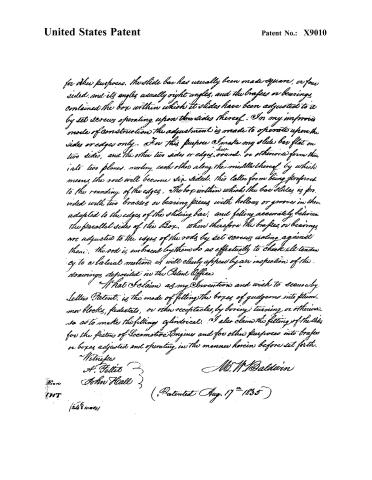
for other purposes. The slide bar has usually been made square, or four sided, and its angles usually right angles, and the braces or bearings contained the box within which it slides have been adjusted to it by set screws operating upon the sides thereof. In my improved mode of construction the adjustment is made to operate upon the sides or edges only. For this purpose I make my slide bar flat on two sides, and the other two sides or edges round, or otherwise form them into two planes, meeting each other along the middle thereof, by which means the rod will become six sided, this latter form being preferred to the rounding of the edges. The box within which the bar slides is provided with two braces or bearing pieces with hollows or grooves in them adapted to the edges of the sliding bar, and fitting accurately between the parallel sides of the box. When therefore the braces or bearings are adjusted to the edges of the rods by set screws acting against them, the rod is embraced by them so as effectively to check all tendency to a lateral motion, as will clearly appear by an inspection of the drawings deposited in the Patent Office.
What I claim as my invention and wish to secure by Letters Patent, is the mode of fitting the boxes of guides into plumb iron blocks, pedestals, or other receptacles, by boring, turning, or otherwise so as to make the fitting cylindrical. I also claim the fitting of the slide for the pistons of locomotive engines and for other purposes into braces or boxes adjusted and operating in the manner herein before set forth.
Witnesses
A. Feltet
John Hall
M. W. Baldwin
(Patented Aug. 17th 1855)
File
HT
(248 mms)
Published accounts: journal notice
Notice in the monthly list of patents
Journal of the Franklin Institute, new ser., vol. 16 (1835), p. 287 · View the page
479. Plummer blocks, &c. Matthias W. Baldwin, Philadelphia,
Published accounts: journal notice
Notice in the monthly list of patents, with remarks
Journal of the Franklin Institute, new ser., vol. 17 (1836), p. 204 · View the page
37. For a mode of Fitting the boxes for gudgeons into the plummer blocks; and also the bearing of the slides for Locomotive and other Steam Engines, and for other purposes; Matthias W. Baldwin, city of Philadelphia, August 17.
Remarks. (See Specification.) 38. For Preparing of the Oil of Harze; Christopher Preswick, and John M. Fisher, city of New York. "The object of our invention is to prepare an essential oil from the condensible matter, or overflow, which is obtained in the manufacture of carburetted hydrogen gas, from resin-wood. or bituminous coal, or a mixture of them, and the said oil may be applied to the following purposes; that is to say, in the preparation of paints, varnishes and laquers, also as a solvent caoutchouc (or gum elastic); also for furnishing light in lamps." The condensible matter is to be mixed with animal or vegetable charcoal, and then submitted to distillation, the volatile oil being condensed. The claim made is to the effecting this object, in the manner proposed. The tar, or condensible matter collected in making carburetted hydrogen from pit-coal is regularly submitted to distillation in England, and the essential oil, a species of naphtha, obtained from it is employed in dissolving caoutchouc, and for other purposes; yet this, according to the terms of the foregoing patent, appears to be one of the objects which the patentees claim as their own invention.
Published accounts: journal notice
Notice in the monthly list of patents, with remarks
Journal of the Franklin Institute, new ser., vol. 17 (1836), p. 273 · View the page
Specification of a Patent for a Mode of Fitting the Boxes for Gudgeons into the Plummer Blocks; and also the fitting of the Bearing of the Slides for Locomotive and other Steam Engines, and for other purposes. Granted to MATTHIAS W. BALDWIN, city of Philadelphia, August 17th, 1835.
Remarks. To all whom it may concern, be it known, that I, Matthias W. Baldwin, machinist, of the city of Philadelphia, in the state of Pennsylvania, have invented a new and improved mode of fitting the boxes within which gudgeons are to run, into plummer blocks, and also of fitting and adjusting the bearings of slides, or guides, for piston rods; which inventions are applicable to locomotive engines, and also to other purposes. And I do hereby declare that the following is a full and exact description thereof. The boxes in which the gudgeons used about locomotive and other steam engines, and machinery of various kinds, are received, and turn, have heretofore been fitted into the plummer blocks, or pedestals, made to receive them, by filing, or other analogous means, their ends being made either square, or angular, and adapted to corresponding parts in the plummer block, or pedestal, prepared to receive them. My improved mode of fitting them consists in turning or boring the opening, or seat in the plummer block, into which the boxes are to be fitted, so as to make each of the cheeks cylindrical segments. The boxes in which the gudgeon is to run, are then to be attached to each other by screws, or otherwise, and turned by means of a slide rest, or worked in any other manner, so as to make their ends cylindrical, and to cause them to fit exactly to the cylindrical cheeks, prepared for their reception, in the plummer block. In constructing the slides for the pistons of locomotive and other steam engines, and for other purposes, the slide bar has usually been made square, or four sided, and its angles usually right angles; and the brasses, or bearings, contained in the box within which it slides, have been adjusted to it by set screws operating upon three sides thereof. In my improved mode of construction, the adjustment is made to operate upon two sides, or edges, only. For this purpose, I make my slide bar flat on two sides, and the other two sides, or edges, half round, or otherwise form them into two planes, meeting each other along the middle thereof, by which means the rod will become six sided, this latter form being preferred to the rounding of the edges. The box within which the bar slides, is provided with two brasses, or bearing pieces, with hollows, or grooves, in them, adapted to the edges of the sliding bar, and fitting accurately between the parallel sides of the box; when, therefore, the brasses, or bearings, are adjusted to the edges of the rod by set screws acting against them, the rod is embraced by them so as effectually to check all tendency to a lateral motion, as will appear by an inspection of the drawings deposited in the Patent Office. Fig. 1 2 D D D B B B 3 A C A C GF E FG D B Figs. 1 and 2, cross sections of the box and slide bar, with angular and with circular fittings. A, slide bar. B, brasses, or bearings. C, boxes. D, adjusting screws. Fig. 3, horizontal section of a plummer block and boxes, through the centre of the gudgeon. E, gudgeon. F, box. G, cheeks of the plummer block. What I claim as my invention, and wish to secure by letters patent, is the mode of fitting the boxes of gudgeons into plummer blocks, pedestals, or other receptacles, by boring, turning, or otherwise, so as to make the fittings cylindrical. I also claim the fitting of the slides for the pistons of locomotive engines, and for other purposes, into brasses, or boxes, adjusted and operating in the manner hereinbefore set forth. MATTHIAS W. BALDWIN.
Published accounts: specification
Specification printed in the Journal of the Franklin Institute
Journal of the Franklin Institute, new ser., vol. 17 (1836), p. 273 · View the page
Text of the specification as printed in the Journal, from OCR; not proofread.
Specification of a Patent for a Mode of Fitting the Boxes for Gudgeons into the Plummer Blocks; and also the fitting of the Bearing of the Slides for Locomotive and other Steam Engines, and for other purposes. Granted to MATTHIAS W. BALDWIN, city of Philadelphia, August 17th, 1835. To all whom it may concern, be it known, that I, Matthias W. Baldwin, machinist, of the city of Philadelphia, in the state of Pennsylvania, have invented a new and improved mode of fitting the boxes within which gudgeons are to run, into plummer blocks, and also of fitting and adjusting the bearings of slides, or guides, for piston rods; which inventions are applicable to locomotive engines, and also to other purposes. And I do hereby declare that the following is a full and exact description thereof. The boxes in which the gudgeons used about locomotive and other steam engines, and machinery of various kinds, are received, and turn, have heretofore been fitted into the plummer blocks, or pedestals, made to receive them, by filing, or other analogous means, their ends being made either square, or angular, and adapted to corresponding parts in the plummer block, or pedestal, prepared to receive them. My improved mode of fitting them consists in turning or boring the opening, or seat in the plummer block, into which the boxes are to be fitted, so as to make each of the cheeks cylindrical segments. The boxes in which the gudgeon is to run, are then to be attached to each other by screws, or otherwise, and turned by means of a slide rest, or worked in any other manner, so as to make their ends cylindrical, and to cause them to fit exactly to the cylindrical cheeks, prepared for their reception, in the plummer block. In constructing the slides for the pistons of locomotive and other steam engines, and for other purposes, the slide bar has usually been made square, or four sided, and its angles usually right angles; and the brasses, or bearings, contained in the box within which it slides, have been adjusted to it by set screws operating upon three sides thereof. In my improved mode of construction, the adjustment is made to operate upon two sides, or edges, only. For this purpose, I make my slide bar flat on two sides, and the other two sides, or edges, half round, or otherwise form them into two planes, meeting each other along the middle thereof, by which means the rod will become six sided, this latter form being preferred to the rounding of the edges. The box within which the bar slides, is provided with two brasses, or bearing pieces, with hollows, or grooves, in them, adapted to the edges of the sliding bar, and fitting accurately between the parallel sides of the box; when, therefore, the brasses, or bearings, are adjusted to the edges of the rod by set screws acting against them, the rod is embraced by them so as effectually to check all tendency to a lateral motion, as will appear by an inspection of the drawings deposited in the Patent Office. Fig. 1 2 D D D B B B 3 A C A C GF E FG D B Figs. 1 and 2, cross sections of the box and slide bar, with angular and with circular fittings. A, slide bar. B, brasses, or bearings. C, boxes. D, adjusting screws. Fig. 3, horizontal section of a plummer block and boxes, through the centre of the gudgeon. E, gudgeon. F, box. G, cheeks of the plummer block. What I claim as my invention, and wish to secure by letters patent, is the mode of fitting the boxes of gudgeons into plummer blocks, pedestals, or other receptacles, by boring, turning, or otherwise, so as to make the fittings cylindrical. I also claim the fitting of the slides for the pistons of locomotive engines, and for other purposes, into brasses, or boxes, adjusted and operating in the manner hereinbefore set forth. MATTHIAS W. BALDWIN.
About this record
- Patentee
- DATAMP
- Date
- DATAMP, USPTO records, Burke's List of Patents (1847)
- Invention
- DATAMP
- Listed in
- the Name and Date index of patents, DATAMP, USPTO records, Jim Shaw's X-patent list, the Journal of the Franklin Institute, Burke's List of Patents (1847), the Journal of the Franklin Institute, Journal
- The sources give different dates; the date shown is the one most of them agree on.
- The Franklin Institute's journal confirms the date shown.
- Burke's 1847 Patent Office list gives the same patent.