

Drawings and documents
National Archives restored drawings: drawing
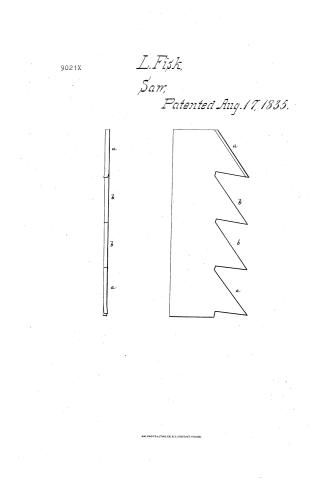
L. Fisk's Patent Drawing for a Saw-mill Saw

National Archives, Restored Patent Drawings (Record Group 241) · Full-size scan at the National Archives · Catalog record
Show the text on the drawing Hide (108 words)
Words on the drawing as machine-read by the National Archives; not checked. Useful mainly for searching.
110. - saws. / of / loot 23 page / 41- / [131] Saws. / 50.4 / Cassmith / Paterled, 19" aug. 1835 / CLASSIFICATION / 9021+ / IL. O / DIVISION. / saw-mill Saw / Patented aug 17th 1835 / a Teeth sharpened edge / b. Common Teethy / U hat keloom, Is the upper abligue / edge of saw tath, being cut to / the right and deftatheristily / and sut together as betwrist / any number of common / teeth for the purpas of sawing / moved in a smooth mames / as above described / to / ON / is / Sinchland Delty / Made under the derection of the of Patert / in componity with act g3 March 1837 / Nesemonth / in / Communication of Patents
USPTO scan
The patent as scanned by the USPTO
-
 Page 1
-
 Page 2
-
 Page 3
-
 Page 4


U.S. Patent and Trademark Office · Google Patents
Show the transcription Hide (819 words)
Machine transcription (LightOnOCR) of the pages as scanned by the USPTO, most of them the handwritten copies made when the records were restored after the 1836 fire. Not checked; it can misread handwriting, so compare it with the scan.
Page 1.
9021X
L. Fisk,
Sam,
Patented Aug. 17, 1835.

AM. PHOTO-LITHO. CO. N.Y. (USBERNE'S PROCESS)
Page 2.
Aug 17, 1835 9021X 41
Levi Fisk, Schenectady, New York.
Letters Patent.
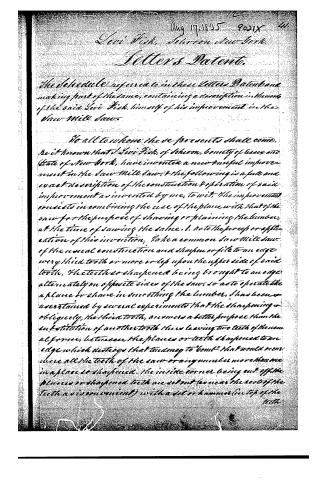
The Schedule referred to in these Letters Patent and making part of the same, containing a description in the words of the said Levi Fisk, himself of his improvement in the Saw-Mill Saw.
To all to whom these presents shall come.
Be it known that I Levi Fisk, of Schenectady, County of Essex and State of New York, have invented a new and useful improvement in the Saw-Mill Saw, and the following is a full and exact description of the construction & operation of said improvement as invented by me, to wit: The improvement consists in combining the use of the plane with that of the saw for the purpose of shaving or planing the lumber, at the time of sawing the same. 1. As to the proof or application of this invention. Take a common Saw-Mill Saw of the usual construction and sharpen or file to an edge every third tooth or more or less upon the upper side of said tooth. The teeth so sharpened being brought to an edge alternately on opposite sides of the saw, so as to operate like a plane or chaw in smoothing the lumber, I have been ascertained by several experiments that the sharpening obliquely, the third tooth, answers a better purpose than the substitution of another tooth thus leaving two teeth of the usual form, between the planes or teeth sharpened to an edge which destroys that tendency to "bond" that would occur were all the teeth of the saw or any number more than one in a plane so sharpened. The inside corner being cut off the planes or sharpened teeth are about (as near the root of the teeth as is convenient) with a set or hammer (in top of the teeth
Page 3.
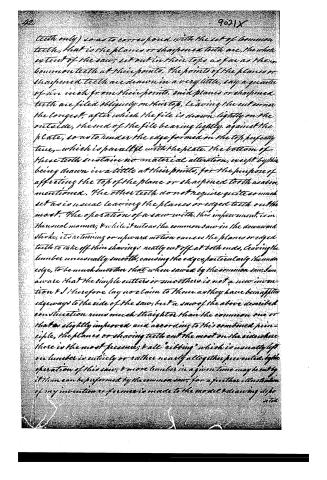
teeth only) so as to correspond with the set of common teeth, that is the planes or sharpened teeth are, the whole extent of the saw set out in their tops as far as the common teeth at their points. The points of the planes or sharpened teeth are drawn in a very little, say a quarter of an inch from their points. said planes or sharpened teeth are filed obliquely on their top, leaving the outer one the longest, after which the file is drawn lightly on the outside, the end of the file bearing lightly against the plate, so as to render the edge formed on the top perfectly true, which is parallel with the plate. The bottom of these teeth sustain no material alteration, except by being drawn in a little at their points, for the purpose of affecting the top of the plane or sharpened tooth as above mentioned. The other teeth do not require quite so much set as is usual leaving the planes or edged teeth out the most. The operation of a saw with this improvement, is in the usual manner; & while it cuts as the common saw in the downward stroke, its returning or upward motion causes the planes or edged teeth to take off thin shavings neatly cut off at both ends, leaving the lumber unequally smooth, causing the edges, particularly the under edge, to be much smoother than when sawed by the common saw. I am aware that the simple cutters or smoothers is not a new invention & I therefore lay no claim to them as they have been applied edgeways to the side of the saw, but a saw of the above described construction runs much straighter than the common one or that is slightly improved and according to this combined principle, the planes or shaving teeth cut the most on the side where there is the most pressure; & all "ribbing" which is usually left on lumber is entirely or rather nearly altogether prevented by the operation of this saw; & more lumber in a given time may be cut by it than can be performed by the common saw. for a further illustration of my invention reference is made to the model & drawing deposited
Page 4.
9621X 43
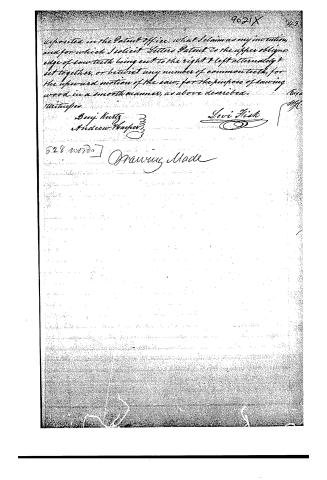
deposited in the Patent Office, what I claim as my invention, and for which I solicit Letters Patent is the upper oblique edge of saw teeth being cut to the right & left alternately & set together, or between any number of common teeth, for the upward motion of the saw, for the purpose of sawing wood in a smooth manner, as above described.
Witnesses
Benj. Kintz 3
Andrew Harper 3
Levi Hisk
528 words
Drawing Made
Published accounts: journal notice
Notice in the monthly list of patents
Journal of the Franklin Institute, new ser., vol. 16 (1835), p. 287 · View the page
485. Sawmill saw.—Levi Fisk, Schroon, Essex county, New York,
Published accounts: journal notice
Notice in the monthly list of patents, with remarks
Journal of the Franklin Institute, new ser., vol. 17 (1836), p. 206 · View the page
43. For an improvement in the Saw Mill Saw; Levi Fisk, Schroon, Essex county, New York, August 17.
Remarks. Every third tooth of a saw mill saw is to be sharpened to a cutting edge on its upper side, the teeth so sharpened being alternately on reverse sides of the saw; these teeth are then to be so set as to cause them to take a thin shaving off in their ascent, and thus to plane the sawed stuff, or to render it much smoother than is done by the common saw. It is said that experience has shown that the best effect is produced by so sharpening every third tooth, although an adherence to this number is not absolutely necessary. The claim is, to "the upper oblique edge of saw teeth being cut to the right and left alternately, and set together, or betwixt any number of common teeth, for the upward motion of the saw, for the purpose of sawing wood in a smooth manner, as above described."
DATAMP: illustration
Illustrations from DATAMP
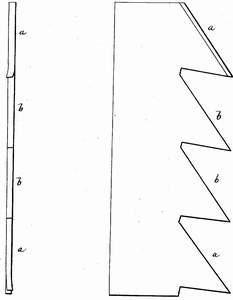

DATAMP (Directory of American Tool and Machinery Patents), via the Internet Archive · Archived DATAMP page
About this record
- Patentee
- DATAMP
- Date
- DATAMP, USPTO records
- Invention
- DATAMP
- Listed in
- the Name and Date index of patents, DATAMP, USPTO records, Jim Shaw's X-patent list, the Journal of the Franklin Institute, Burke's List of Patents (1847)
- The sources give different dates; the date shown is the one most of them agree on.
- The Franklin Institute's journal confirms the date shown.
- Burke's 1847 Patent Office list gives the same patent.