

Drawings and documents
National Archives restored drawings: drawing
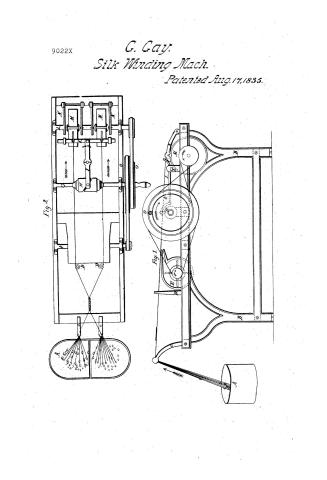
G. Gay's Patent Drawing for a Machine for Spooling Silk

National Archives, Restored Patent Drawings (Record Group 241) · Full-size scan at the National Archives · Catalog record
Show the text on the drawing Hide (40 words)
Words on the drawing as machine-read by the National Archives; not checked. Useful mainly for searching.
117-8 / 117, SILK / Septile / [140, Windin / 202 / 9022X / CLACOLITATION / DIVISION. / G.GAY / SPOOLING SILK / patented. my / pin.2. / .D / 10 D / CA / to / Fig.I. / 19 / 11118 / 3449 / It / scale g Feels
USPTO scan
The patent as scanned by the USPTO
-
 Page 1
-
 Page 2
-
 Page 3


U.S. Patent and Trademark Office · Google Patents
Show the transcription Hide (770 words)
Machine transcription (LightOnOCR) of the pages as scanned by the USPTO, most of them the handwritten copies made when the records were restored after the 1836 fire. Not checked; it can misread handwriting, so compare it with the scan.
Page 1.
9022X
G. Gay.
Silk Winding Mach.
Patented Aug. 17, 1835.
Fig. 2
Fig. 1
Page 2.
Aug 17 1835 9022 X by
Gamaliel Gay, Poughkeepsie Dutchess Co. New York.
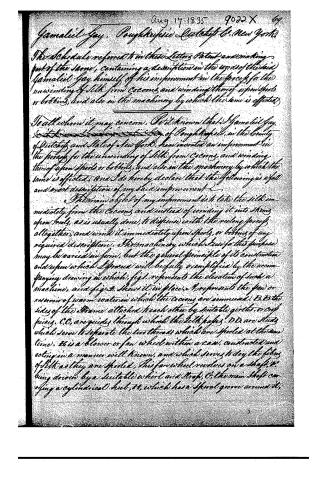
The Schedule referred to in these Letters Patent and making part of the same, containing a description in the words of the said Gamaliel Gay himself of his improvement in the process for the unwinding of silk from Cocons and winding thereof upon Spools or Bobbins, and also in the machinery by which the same is effected.
To all whom it may concern. Be it known that I Gamaliel Gay, of Poughkeepsie, in the County of Dutchess and State of New York, have invented an improvement in the process for the unwinding of Silk from Cocons, and winding thereof upon Spools or Bobbins, and also in the machinery by which the same is effected, and I do hereby declare that the following is a full and exact description of my said improvement.
The main object of my improvement is to take the silk immediately from the Cocons and instead of winding it into Shews upon reels, as is usually done, to dispense with the reeling process altogether, and wind it immediately upon Spools, or Bobbins of any required description. The machinery which I use for this purpose may be varied in form, but the general principle of its construction and upon which I propose will be fully exemplified by the accompanying drawing in which fig 1. represents the elevation of such a machine, and fig 2. shows it in place. A represents the pan or reservoir of warm water in which the Cocons are immersed. B B the sides of the Frame attached to each other by suitable girdles or cross pieces. C C, are guides through which the Silk passes. D D, are studs which serve to separate the two threads which are Spooled at the same time. E is a blower or fan wheel within a case, constructed and acting in a manner well known, and which serves to dry the fibers of Silk as they are Spooled. This fan wheel revolves on a shaft, F, being driven by a suitable wheel and strap, G, the main shaft carrying a cylindrical hub, H, which has a spiral groove around it,
Page 3.
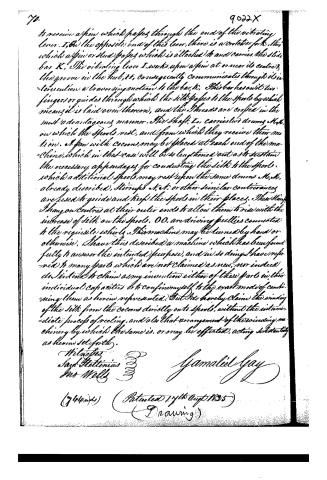
to receive a pin which passes through the end of the vibrating lever, I, on the opposite end of this lever, there is a crook or fork, this which a pin or stud passes which is attached to and carries the slide bar K. The vibrating lever I, works upon a pin at or near its centre, the groove in the hub, F, consequently communicates through its intervention a traversing motion to the bar, K. This bar has on it two fingers or guides through which the silk passes to the spools by which means it is laid even thereon, and the threads are cropped in the most advantageous manner. The shaft, Z, carries two drums M, M, on which the spools rest, and from which they receive their motion. A few with cocoons may be placed at each end of the machine, which in that case will be so lengthened out as to sustain the necessary appendages for conducting the silk to the spools, which additional spools may rest upon the same drums M, M, already described, stirrups N, N, or other similar contrivances are used to guide and keep the spools in their places. The slings I hang on centres at their outer ends to allow them to rise with the increase of silk on the spools. O, O, are driving pulleys connected to the requisite wheels. This machine may be turned by hand or otherwise. I have thus described a machine which has been found fully to answer the intended purpose, and in so doing I have referred to many parts which are not claimed as new, nor indeed do I intend to claim as my invention either of these parts in their individual capacities or to confine myself to the exact mode of combining them as herein represented. But I do hereby claim the winding of the silk from the cocoons directly onto spools, without the intermediate process of reeling, and also that arrangement of the winding machinery by which the same is, or may be effected, acting substantially as herein set forth.
Witnesses
Sam Hettinius
Geo Wells
Samuel Gay
(744 words) (Patented 17th Augt 1835) (Drawing)
Published accounts: journal notice
Notice in the monthly list of patents
Journal of the Franklin Institute, new ser., vol. 16 (1835), p. 287 · View the page
469. Silk, unwinding and spooling. Gamaliel Gay, Poughkeepsie, N. Y.
Published accounts: journal notice
Notice in the monthly list of patents
Journal of the Franklin Institute, new ser., vol. 17 (1836), p. 201 · View the page
28. For Winding Silk from the Cocoons, without Reeling; Gamaliel Gay, Poughkeepsie, Dutchess county, New York, August 17.
About this record
- Patentee
- DATAMP
- Date
- DATAMP, USPTO records, Burke's List of Patents (1847)
- Invention
- DATAMP
- Listed in
- the Name and Date index of patents, DATAMP, USPTO records, Jim Shaw's X-patent list, the Journal of the Franklin Institute, Burke's List of Patents (1847)
- The sources give different dates; the date shown is the one most of them agree on.
- The Franklin Institute's journal confirms the date shown.
- Burke's 1847 Patent Office list gives the same patent.