

Drawings and documents
National Archives restored drawings: drawing
Julius Hatch's Patent Drawing for an Improvement in Sowing Raister, Lime, and Ashes

National Archives, Restored Patent Drawings (Record Group 241) · Full-size scan at the National Archives · Catalog record
Show the text on the drawing Hide (154 words)
Words on the drawing as machine-read by the National Archives; not checked. Useful mainly for searching.
Findered / 133 / classification / 111 SII: SEEDERS&PL AN7-'S / 9024. / Moutchis / (133) , / DIV ISION. / Antorovements in Showing Puister, Dime and ashes. / patented 17 me 18357 / referred 1838 / Reference / Band or Cog wheel / (ounly of wailing low 34 / Revolving shaft / Dirbut of Columbia / Perious 00 whire. / Charred. / Owchis 12th day of September / Longitudinal rodform / 1837 Peace before any foo Julius they County Great federally Bend of / the subscriber a Prustice / For / RodD / no (and / apifecared Haleld a of / sung County Penni and made / that the is interested as inventor / Ki, Regulating guages / Is / in a Patent for w anachine foo souring / M Fenders. / Plaister / N° Elbow. / good dated / the Sence the of (and caskes of with august ifsued the to 1835 them / and above Braving referen / or sherelo are as he verily believes a true / a the Said Potter Patent. / delemation of the envention as described / 05 / mind / of
USPTO scan
The patent as scanned by the USPTO
-
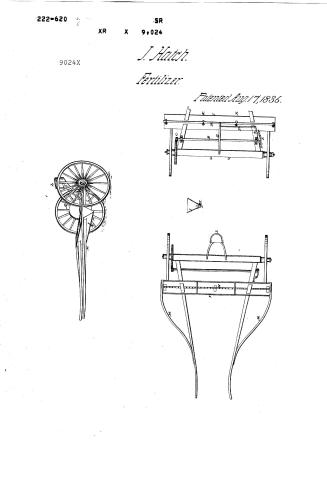 Page 1
-
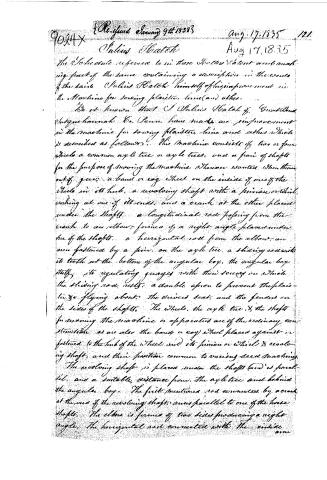 Page 2
-
 Page 3
-
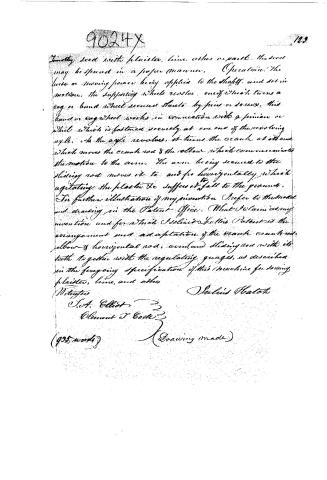 Page 4


U.S. Patent and Trademark Office · Google Patents
Show the transcription Hide (998 words)
Machine transcription (LightOnOCR) of the pages as scanned by the USPTO, most of them the handwritten copies made when the records were restored after the 1836 fire. Not checked; it can misread handwriting, so compare it with the scan.
Page 1.
222-620
SR
XR X 9,024
9024X
J. Hatch.
Fertilizer.
Patented Aug. 17, 1836.
Page 2.
9024X {Re-issued January 9th 18383} Aug. 17, 1835 121.
Julius Hatch
Aug 17, 1835
The Solemnly referred to in these Letters Patent and making part of the same, containing a description in the words of the said Julius Hatch himself of his improvement in the Machine for sowing flax, linseed and other.
Be it known that I Julius Hatch of Great Britain and Independent Co. Penn. have made an improvement in the machine for sowing flax, linseed and other which is described as follows: The machine consists of two or four wheels, a common axle tree or axle trees, and a pair of shafts for the purpose of moving the machine whenever wanted, then there are: a band or cog wheel on the inside of one of the wheels in its hub, a revolving shaft with a pinion or wheel, working at one of its ends, and a crank at the other placed under the shaft, a longitudinal rod passing from the crank to an elbow, formed of a right angle placed under one of the shafts, a horizontal rod from the elbow, an arm fastened by a pin, on the axle tree, a sliding rod with its teeth at the bottom of the angular box, the angular box itself, its regulating gears with their screws on which the sliding rod rests, a double apron to prevent the plaiting or flying about, the universal seat, and the fenders on the sides of the shafts. The wheels, the axle tree, & the shafts for moving the machine or apparatus are of the ordinary construction, as are also the bands or cog wheel placed against or fastened to the hub of the wheel and its pinion or wheel & revolving shaft, and their position common to various seed machines.
The revolving shaft is placed under the shaft (and is parallel, and a suitable distance from, the axle tree and behind the angular box. The first mentioned rod connected by a crank at the end of the revolving shaft, runs parallel to one of the horse shafts. The elbow is formed of two sides producing a right angle. The horizontal rod connected with the inside arm
Page 3.
arm of the elbow runs to the arm. The arm is fastened at one end by a pin or screw to the axle tree which is its fulcrum; its other end is secured by a staple or otherwise & is fastened about the centre of the sliding rod. The angular box for the reception of the plaster &c is formed of two sides about 8 inches deep, each, and are about 14 inches apart at top. They are confined at their ends by angular pieces of wood and at suitable distances, inside are angular pieces running partly down towards the bottom of the sides, not only to strengthen the box but to permit the plaster &c to fall underneath. The lower sides of the angular box are regulated by the screws to suit the nature of the matter to be distributed. The box may have a cover for protection from the weather. It is partly suspended by the shafts &c is in front of the driving wheels. The sliding rod is placed beneath the sides of the box and has teeth placed at suitable distances apart to agitate the plaster &c. The regulating gauges are fastened by screws to the sides of the box, and a screw to the ends of every couple of gauges placed at suitable distances apart the whole length of the box pierce or open the aperture at the lower sides of the box. The double apron for preventing the flying off of the plaster &c is suspended from the lower side of the box to within a suitable distance of the ground. In some cases the apron may be dispensed with. The driver's seat is placed on inclined arms fastened on the upper side of the axle tree, running back, to preserve the equilibrium of the machine and for the driver's convenience. The feeders are bent pieces of wood which are fastened about the middle of the outer part of each shaft & run to each end of the box, and their object is to protect the angular box from injury. This arrangement for a cast fixture can be adapted to a wagon when the invention is wanted for extensive operations. By mixing clover or Timothy
Page 4.
Timothy used with plaster, lime, ashes or earth, the sheet may be spread in a proper manner. Operation: The force or moving power being applied to the shaft, and set in motion, the supporting wheels revolve, one of which turns a cog or hand wheel secured thereto by pins or screws, this hand or cog wheel works in connection with a pinion or wheel which is fastened securely at one end of the revolving axle. As the axle revolves, it turns the crank at its end, which moves the crank rod & the elbow, which communicates the motion to the arm. The arm being secured to the sliding rod, moves it to and fro horizontally, which agitating the plaster &c. suffuses it to fall to the ground.
For further illustration of my invention I refer to the model and drawing in the Patent Office. What I claim as my invention and for which I solicit Letters Patent is the arrangement and adaptation of the crank, crank rod, elbow & horizontal rod, arm and sliding rod with its teeth to gether with the regulating gauges, as described in the foregoing specification of this machine for sowing plaster, lime, and other.
Witnesses
S.A. Elliot
Olemon J. Coote
(935 words)
(Drawing made)
Philip H. Hatch
Published accounts: journal notice
Notice in the monthly list of patents
Journal of the Franklin Institute, new ser., vol. 16 (1835), p. 287 · View the page
481. Composition of Plaster, &c.-Julius Hatch, Great Bend, Penn.
DATAMP: illustration
Illustrations from DATAMP
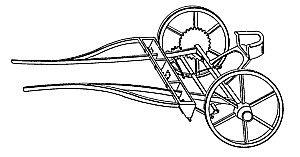

DATAMP (Directory of American Tool and Machinery Patents), via the Internet Archive · Archived DATAMP page
About this record
- Patentee
- DATAMP
- Date
- DATAMP, USPTO records, Burke's List of Patents (1847)
- Invention
- DATAMP
- Listed in
- the Name and Date index of patents, DATAMP, USPTO records, Jim Shaw's X-patent list, the Journal of the Franklin Institute, Burke's List of Patents (1847)
- The sources give different dates; the date shown is the one most of them agree on.
- The Franklin Institute's journal confirms the date shown.
- Burke's 1847 Patent Office list gives the same patent.