

Drawings and documents
National Archives restored drawings: drawing
John Goulding's Patent Drawing for a Machine for Hatchelling Tow

National Archives, Restored Patent Drawings (Record Group 241) · Full-size scan at the National Archives · Catalog record
Show the text on the drawing Hide (43 words)
Words on the drawing as machine-read by the National Archives; not checked. Useful mainly for searching.
fgs / 196, / JOHN COULDINC'S / 13. BRAKES & GINS. / Hackling Machines. / Machine for Hatchelling Tow. / Iio. / CHESSIVICATION / 9023 / parented 17 auoust 1835. / DIVISION. / 00 / FiG2: / MI / a a / IN / G.S.Dett / or
USPTO scan
The patent as scanned by the USPTO
-
 Page 1
-
 Page 2
-
 Page 3
-
 Page 4


U.S. Patent and Trademark Office · Google Patents
Show the transcription Hide (1,238 words)
Machine transcription (LightOnOCR) of the pages as scanned by the USPTO, most of them the handwritten copies made when the records were restored after the 1836 fire. Not checked; it can misread handwriting, so compare it with the scan.
Page 1.
J. GOULDING.
HACKLING MACHINE.
Patented Aug. 17, 1835.
9023X

THE NORRIS PETERS CO., PHOTO-LITHO., WASHINGTON, D. C.
Page 2.
7020X Aug. 17, 1835 22
John Goulding, of Boston, Mass.
Letter Patent
The schedule referred to in their Letter Patent and making part of the same, containing a description in the words of the said John Goulding himself, of his improvement, in the mode of preparing & hatching hemp, flax, tow or manilla grass & producing thereby a continuous strain or sliver.
To all persons to whom these presents shall come: I John Goulding of Boston, in the County of Suffolk & Commonwealth of Massachusetts, machinist, send greeting. Be it known that I the said John Goulding have invented, constructed made and applied to use a new & useful improvement in the mode of preparing & hatching hemp, flax, tow or manilla grass, & producing thereby a continuous strain or sliver, specified & described in the words, figures & plates following whereunto annexed. Fig. 1st represents a breaker used to break fibers, and hatchell the hemp, flax or tow or grass, from which yarn is to be spun. T is the trough into which the hemp is laid X is the roller under which the hemp passes from T. B are rollers between which the hemp passes to be received by the first or receiving cylinder A. this cylinder has iron or steel teeth or pins S.S., projecting about two inches from its outer surface which may be put through wood or set in iron or other metal, these pins are set in rows nearly across & all around the cylinder the pins equidistant & in quincunx order so that the pins in each row shall be neither exactly behind the pins in the preceding row nor exactly before the pins in the succeeding row. F.F.F. are rules with wires or rods running from head to head & fixed therein — (e.g. are wires hung or fastened to the edge or rim of cylinder A. by staples (as in fig. 2. II. or by a joint & screw. these wires go across and upon the outer surface of the cylinder & between the rows of teeth or pins S.S. H is a piece of iron or metal fixed upon the frame over which the wires pass as the cylinder revolves. M.M. are springs fastened upon the inside of said cylinder and attached through the surface of the cylinder by a stirrup to the wires G.G. so as to bring them back to their places on the outer surface of the cylinder after they have been raised by passing over the piece of metal H. C is the second cylinder
Page 3.
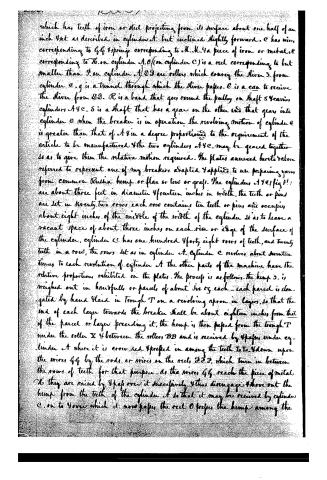
which has teeth of iron or steel projecting from its surface about one half of an inch but as described in cylinder A but inclined slightly forward. C has wires corresponding to G G, springs corresponding to M M. A piece of iron or metal, corresponding to K, on cylinder A, O (on cylinder C) is a reel corresponding to but smaller than F on cylinder A. D D are rollers which convey the sliver 3 from cylinder C. g is a tunnel through which the sliver passes. E is a can to receive the sliver from D D. R is a band that goes round the pulley on shaft S carrying cylinders A & C. S is a shaft that has a gear on the other end that gears into cylinder C. When the breaker is in operation, the revolving motion of cylinder C is greater than that of A in a degree proportioned to the requirement of the article to be manufactured. The two cylinders A & C may be geared together so as to give them the relative motion required. The plates annexed hereto refer to represent one of my breakers adapted & applied to use preparing yarn from common Russia hemp or flax or tow or grass. The cylinders A & C (fig 1) are about three feet in diameter & fourteen inches in width, the teeth or pins are set in seventy-two rows, each row contains ten teeth or pins and occupy about eight inches of the middle of the width of the cylinder so as to leave a vacant space of about three inches on each rim or edge of the surface of the cylinder, cylinder C has one hundred & forty-eight rows of teeth, and twenty teeth in a row, the rows set as in cylinder A. Cylinder C revolves about seventeen times to each revolution of cylinder A. The other parts of the machine have the relative proportions exhibited on the plates. The process is as follows: the hemp 3 is weighed out in handfuls or parcels of about six oz. each—each parcel is elongated by hand & laid in trough T on a revolving apron in layers, so that the end of each layer towards the breaker shall be about eighteen inches from that of the parcel or layer preceding it. The hemp is then passed from the trough T under the roller X & between the rollers B B and is received by paper under cylinder A where it is crowded & pressed in among the teeth I I. It is then drawn upon the wires G G by the rods or wires on the reel F F F which turn in between the rows of teeth for that purpose. As the wires G G reach the piece of metal K they are raised by H H over it successively & thus disengage & throw out the hemp from the teeth of the cylinder A so that it may be received by cylinder C. On to V V over which it now passes, the reel O presses the hemp among the
Page 4.
4023 X
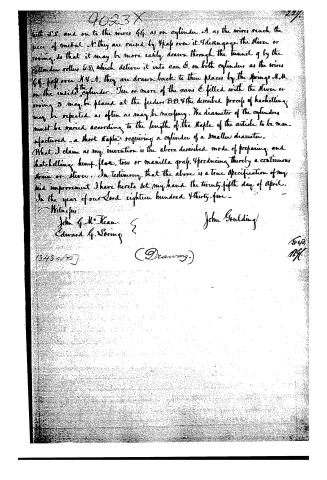
with S.S. and on to the wires 44, as on cylinder A, as the wires reach the piece of metal N, they are raised by 44f over it. I disengage the sliver or string, so that it may be more easily drawn through the tunnel q by the cylinder rollers E.D, which deliver it into can E, on both cylinders as the wires 44, pass over N.V.A, they are drawn back to their places by the springs M.M. on the inside cylinder. Ten or more of the cans E filled with the sliver or string D may be placed at the feeders B.B. The described process of hatching may be repeated as often as may be necessary. The diameter of the cylinders must be varied according to the length of the staple of the article to be manufactured — a short staple requiring a cylinder of a smaller diameter.
What I claim as my invention is the above described mode of preparing and hatching hemp, flax, tow or manilla grass, producing thereby a continuous strain or sliver. In testimony that the above is a true specification of my said improvement I have hereto set my hand the twenty-fifth day of April, in the year of our Lord eighteen hundred & thirty-five.
Witnesses
John G. McKeen
Edward G. Soring
John Goulding
(Drawing)
1343
To 40
N.H.
Published accounts: journal notice
Notice in the monthly list of patents, with remarks
Journal of the Franklin Institute, new ser., vol. 17 (1836), p. 207 · View the page
49. For Preparing and Hatcheling Hemp, Flax, &c.; John Goulding, Boston, Massachusetts, August 19.
Remarks. In this machine, the hemp is to be laid in a trough, in small handsful, and carried forward by a feeding apron, between feeding rollers, which deliver it on to a large hatcheling cylinder, set with suitable teeth, between which it is pressed, so as to lie closely on the cylinder, by means of a reel-like roller, the longitudinal wires of which mash between the wire teeth. After passing under this cylinder, the hemp is raised, by a contrivance for that purpose, upon a second cylinder, revolving about seventeen times more rapidly than the former, and, of course, drawing out the fibres. From this second cylinder, it passes through a trumpet-mouthed tube, between rollers, and into a can. The slivers from ten, or any other convenient number, of such cans, may afterwards be passed together through the same circuit, and this may be repeated as often as may be thought necessary. The claim is to "the above described mode of hatcheling hemp, flax, tow, or Manilla grass, and producing thereby a continuous strand, or sliver." We think that this claim is in terms too general, unless it can be made to appear that the machine is new in all its arrangements, as applied to the purpose for which it is to be used.
About this record
- Patentee
- DATAMP
- Date
- DATAMP, USPTO records, Burke's List of Patents (1847)
- Invention
- DATAMP
- Listed in
- the Name and Date index of patents, DATAMP, USPTO records, Jim Shaw's X-patent list, the Journal of the Franklin Institute, Burke's List of Patents (1847)
- The sources give different dates; the date shown is the one most of them agree on.
- The Franklin Institute's journal gives a different date.
- Burke's 1847 Patent Office list gives the same patent.