

Drawings and documents
National Archives restored drawings: drawing
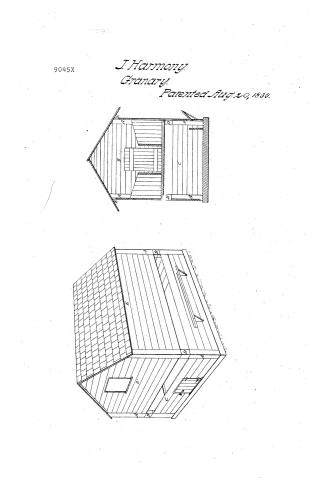
J. Harmony's Patent Drawing for a Granary

National Archives, Restored Patent Drawings (Record Group 241) · Full-size scan at the National Archives · Catalog record
Show the text on the drawing Hide (73 words)
Words on the drawing as machine-read by the National Archives; not checked. Useful mainly for searching.
130. THRASHING. / Granaries and Bins. / ins. / .HARMONY'S / Grana l'y. / Intented Aug 1833, / CL LESIFICA 2703 / 9045X / DIVISION. / Section / References / Patent Office / A. Posts Ie support the granary / Made under the direction of the of patens / B. Granary / C.Pen or sty / inconformity with the ach 3"March Assy. / D.Zin en posts. / Ex Crening under the eaves. / Commissions,
USPTO scan
The patent as scanned by the USPTO
-
 Page 1
-
 Page 2
-
 Page 3


U.S. Patent and Trademark Office · Google Patents
Show the transcription Hide (685 words)
Machine transcription (LightOnOCR) of the pages as scanned by the USPTO, most of them the handwritten copies made when the records were restored after the 1836 fire. Not checked; it can misread handwriting, so compare it with the scan.
Page 1.
9045X
J. Harmony.
Granary.
Patented Aug. 20, 1835.

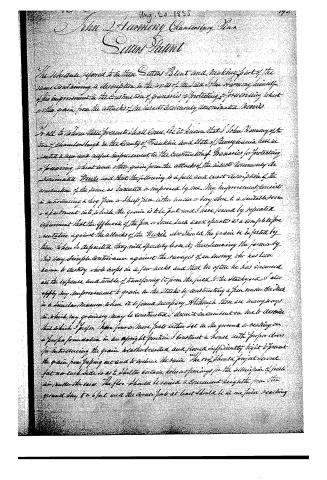
Page 2.
Aug. 20, 1855
John J. Harmony Chambersburg Penn
Letters Patent
The disclosure referred to in these Letters Patent and making part of the same containing a description in the words of the said John Harmony himself of his improvement in the construction of granaries for protecting & preserving wheat & other grain from the attacks of the insects commonly denominated Weevils.
In all to whom these presents shall come. Be it known that I John Harmony of the town of Chambersburg in the County of Franklin and State of Pennsylvania have invented a new and useful improvement in the construction of Granaries for protecting & preserving wheat and other grain from the attacks of the insects commonly denominated Weevils and that the following is a full and exact description of the construction of the same as invented & improved by me. My improvement consists in introducing a hop pipe or sleep pipe either under a long slat to a suitable room or apartment into which the grain is to be put and I have found by repeated experiment that the influence of the pipe or since such cause operates as a complete preventive against the attacks of the Weevils. Also should the grain be infected by them when so deposited they will speedily leave it; thus leaving the former by this very simple contrivance against the ravages of an enemy who has been known to destroy whole crops in a few weeks and that too often he has incurred all the expense and trouble of transferring it from the field to the stackyard. I also apply my improvement to grain in the stacks by constructing a pipe under the stack in a similar manner when it is found necessary. Although there are many ways in which my granary may be constructed I deem it incumbent on me to describe that which I prefer. When four or more pits are set in the ground so resting on a proper foundation in an upright position I construct a house with proper doors for introducing the grain weather-tight and floored sufficiently tight to prevent the grain from getting out and to exclude the rain. The roof should project somewhat far on each side so as to shelter certain holes or openings for the admission of fresh air under the roof. The floor should be raised a convenient height from the ground say 5 or 6 feet and the corner posts at least should be in one piece reaching
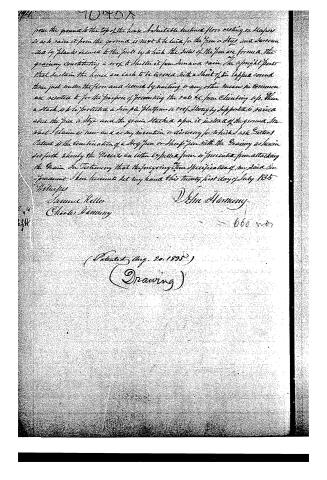
Page 3.
from the ground to the top of the house. A suitable wooden floor resting on the posts is to be raised from the ground as near to the level of the floor of the house as is deemed by the posts by which the sides of the pen are formed. The grainery constituting a roof to shelter it from sun and rain. The upright posts that sustain the house are each to be covered with a sheet of tin, copper, or lead, then just under the floor and secured by nailing or any other means in common use, so as to prevent the rats &c. from climbing up. When a stack is to be protected, a simple platform or roof, strongly supported, is raised above the floor or stage, and the grain stacked upon it instead of the ground. In what I claim is new and as my invention is a discovery for which I ask Letters Patent, is the combination of a Hay pen or Sheep pen with the Grainery as herein set forth, whereby the Steers or Cattle are kept from or prevented from attacking the Grain. In Testimony that the foregoing is the specification of my said invention, I have hereunto set my hand this twenty-first day of July 1835.
Witnesses:
Samuel Keller
Charles Harmony
D. M. Harmony
(Patented Aug. 20, 1835)
(Drawing)
Published accounts: journal notice
Notice in the monthly list of patents
Journal of the Franklin Institute, new ser., vol. 16 (1835), p. 287 · View the page
502. Granaries.-John Harmony, Chambersburg, Penn.
Published accounts: journal notice
Notice in the monthly list of patents, with remarks
Journal of the Franklin Institute, new ser., vol. 17 (1836), p. 210 · View the page
60. For Constructing Granaries; John Harmony, Chambersburg, Franklin county, Pennsylvania, August 20.
Remarks. The thing here patented is very simple, and, it effectual, is of great value. The "improvement consists in introducing a hog or sheep pen, either under or very close to a suitable room, or apartment, into which the grain is to be put, having found, by repeated experiment, that the effiuvia of the pen, or some such cause, operates as a complete preventative against the attacks of the weevil, and also that, should the grain be infected by them, they will speedily leave it." After this information, the patentee describes what he esteems a good plan for the erection of such an establishment; but the particular mode is not considered as important, the claim being simply to "the combination of a hog pen, or sheep pen, with a granary, as set forth."
About this record
- Patentee
- the Journal of the Franklin Institute, Journal
- Date
- USPTO records, Jim Shaw's X-patent list
- Invention
- the Name and Date index of patents
- Listed in
- the Name and Date index of patents, USPTO records, Jim Shaw's X-patent list, the Journal of the Franklin Institute, Burke's List of Patents (1847)
- The sources give different dates; the date shown is the one most of them agree on.
- The patentee's full name comes from the Franklin Institute's journal.
- The residence comes from the Franklin Institute's journal.
- The Franklin Institute's journal confirms the date shown.
- Burke's 1847 Patent Office list gives the same patent.