

Drawings and documents
National Archives restored drawings: drawing
W. and J.D. Collins' Patent Drawing for a Washing Machine

National Archives, Restored Patent Drawings (Record Group 241) · Full-size scan at the National Archives · Catalog record
Show the text on the drawing Hide (62 words)
Words on the drawing as machine-read by the National Archives; not checked. Useful mainly for searching.
68. LAUNDEY. / [91] WASHING MACHINES, / Cylinder. / $1. / Nastina Machini / 9052nd / DIVISION. / WETTI COLLINS / March / Patenled) anth "aug 1935 / a.Box / 6. Gylinder / slats / d. c. Pins / Sections / KIII / Patent office Oct 31 1842 / Made under the decrection of the commission / of Patents in componuty with ait, 3' March 1837 / Strickland Del / Commission of Patents
USPTO scan
The patent as scanned by the USPTO
-
 Page 1
-
 Page 2
-
 Page 3


U.S. Patent and Trademark Office · Google Patents
Show the transcription Hide (597 words)
Machine transcription (LightOnOCR) of the pages as scanned by the USPTO, most of them the handwritten copies made when the records were restored after the 1836 fire. Not checked; it can misread handwriting, so compare it with the scan.
Page 1.
9052X
W. & J. D. Collins,
Washing Machine,
Patented Aug. 27, 1835.
Page 2.
Aug. 27, 1835 9052X 157
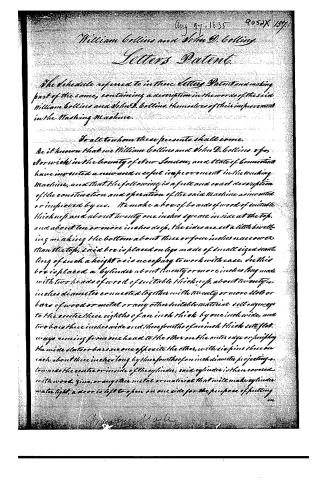
William Collins and John D. Collins.
Letters Patent.
The schedule referred to in these Letters Patent and making part of the same, containing a description in the words of the said William Collins and John D. Collins, themselves of their improvement in the Washing Machine.
To all to whom these presents shall come.
Be it known that we William Collins and John D. Collins of Norwich in the county of New London, and state of Connecticut have invented a new and useful improvement in the Washing Machine, and that the following is a full and exact description of the construction and operation of the said Machine as invented or improved by us. We make a box of boards of wood of suitable thickness and about twenty one inches square inside at the top, and about ten or more inches deep, the sides are set a little bowing making the bottom about three or four inches narrower than the top, said box is placed on legs made of small sized scantling of such a height as is necessary to work with ease. In this box is placed a cylinder about twenty or more inches long made with two heads of wood of suitable thickness, about twenty five inches diameter connected together with twenty or more slats or bars of wood or metal or any other suitable material set edgeway to the center three eighths of an inch thick by one inch wide, and two and three inches wide and three fourths of an inch thick set flat ways running from one head to the other on the outer edge or periphery the wide slats or bars are one opposite the other, with six pins three on each about three inches long by three fourths of an inch diameter projecting towards the center or inside of the cylinder, said cylinder is then covered with wood, zinc, or any other metal or material that will make cylinder watertight, a door is left to open on one side for the purpose of putting in
Page 3.
in and taking out clothes and water, this door may be of any suitable size and kept shut by two or more small buttons. This cylinder revolves on two guide bars made of iron or any suitable material with a flange on one end for the purpose of securing the guide bars to the ends of the cylinder by means of iron screws or bolts. On one guide bar is fitted a crank or winch by means of which the cylinder is put in motion; this crank may be of wood or iron. When the machine is at work the cylinder is turned by the crank which carries the clothes to the upper side of the cylinder by means of the pins, from thence they fall to the bottom of the cylinder upon the narrow flats or bars in the water. What we claim as our invention is the covering the cylinder as above described, setting the clothes bars edgewise, that is to the centre, and the principle of washing the clothes in the water, that is, putting the clothes and water together into the cylinder and shut them up tight while washing.
Wm. Stephen Allen
Chas. Carpenter
William Collins
John D. Collins
542 Words
Published accounts: journal notice
Notice in the monthly list of patents
Journal of the Franklin Institute, new ser., vol. 16 (1835), p. 287 · View the page
507. Washing machine.-W. &. J. Collins, Norwich, Conn.
Published accounts: journal notice
Notice in the monthly list of patents, with remarks
Journal of the Franklin Institute, new ser., vol. 17 (1836), p. 212 · View the page
65. For a Washing Machine; William and John Collins, Norwich, New London county, Connecticut, August 27.
Remarks. This machine is so much like that patented by Charles Otis, on the 15ht of June last (see p. 62) that we need not repeat the description.
About this record
- Patentee
- Jim Shaw's X-patent list
- Date
- the Name and Date index of patents, USPTO records, Jim Shaw's X-patent list
- Invention
- the Name and Date index of patents
- Listed in
- the Name and Date index of patents, USPTO records, Jim Shaw's X-patent list, the Journal of the Franklin Institute, Burke's List of Patents (1847)
- Burke's 1847 Patent Office list gives the same patent.