

Drawings and documents
National Archives restored drawings: drawing
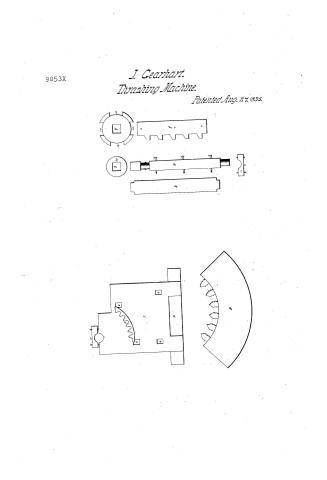
Iohn Gearhart's Patent Drawing for a Threshing Machine

National Archives, Restored Patent Drawings (Record Group 241) · Full-size scan at the National Archives · Catalog record
Show the text on the drawing Hide (33 words)
Words on the drawing as machine-read by the National Archives; not checked. Useful mainly for searching.
130. THRASHING. / [159 / Thrashing Machines. / Fintered. / A. Cylinder Machines. / IOHN CEARHART. / Threshing Machine / CLASSIDICATION / 9053-1 / DIVISION. / Patented 27th augits. / 11 / 10 / 1% / 10 / 10 / 11 / 11
USPTO scan
The patent as scanned by the USPTO
-
 Page 1
-
 Page 2
-
 Page 3


U.S. Patent and Trademark Office · Google Patents
Show the transcription Hide (783 words)
Machine transcription (LightOnOCR) of the pages as scanned by the USPTO, most of them the handwritten copies made when the records were restored after the 1836 fire. Not checked; it can misread handwriting, so compare it with the scan.
Page 1.
9053X
J. Gearhart.
Thrashing Machine.
Patented Aug. 27, 1835.

Page 2.
Aug. 22, 1835 9053 X 161
John Gearhart, Rush, Pennsylvania.
Letters Patent.
The Schedule referred to in these Letters Patent and making part of the same containing a description in the words of the said John Gearhart himself of his improvement in the machine for threshing grain and seed.
To all to whom these presents shall come.
Be it known that I John Gearhart of Rush in the county of Northumberland and State of Pennsylvania have invented a new and useful improvement in the machine for threshing grain and seed and that the following is a full and exact description of the said improvement. This machine consists of a frame, concave bed cylinder, pulley, and the necessary fixtures for putting the whole together. The frame may be made as represented in the drawing or in any other way the mechanic may prefer so as to correspond with the other parts of the machine. I frame two pieces of plank upright (fig 1) into two sills (fig 2) and join them by four girders (fig 3) entering the Mortices (fig 4) the concave bed (fig 5) is made whole, of best iron or any other material that may be preferred of any desired size, with rows of teeth on the concave surface of such number and size as may be preferred, and is secured on the two upper girders (fig 3) in such a manner as the mechanic may choose. concave beds of different degrees of fineness suited to the grain or seed to be threshed may be used in the same frame by having them so put in as to be removed at pleasure. The cylinder is composed of the shaft (fig 6) the circular pieces (fig 7) which may if preferred, be made whole; of the flanches (fig 8) and of the pulley (fig 9) and must correspond with, and be made to fit the concave bed, one end of the shaft projects beyond the side of the frame to receive the pulley with grooves at each end when it rests on the frame with
Page 3.
162.
9053X
with as many circulars upon it as the length may require and holes through it to receive the bolts (fig 8) The circulars if key and the shaft are of wood or metal, maybe made together whole, if of wood by turning, if of metal to be cast by running them in, if of metal to be forged by welding them together. The circulars must be of a diameter to correspond with the concave bed with boxes in (fig 10) of any desired number to receive the flanches on their periphery. The flanches made of cast iron or any other material are of a concave form of the same length with the concave bed, of the same circular concavity and of a width and thickness to correspond with the boxes in the circulars on the shaft with teeth on their periphery corresponding with those on the concave bed and holes through them corresponding with those on the shaft, and of a number to correspond with the number of boxes in the circulars. These form the outside of the cylinder and are secured to the circulars by long bolts (fig 12) passing through them and the shaft with a head at one end and a bar at the other. The pully on the end of the shaft must be of a size to correspond with the circumference of the cylinder. The cylinder thus formed is put into the frame and secured by the caps and screws (fig 11) and is put in motion by putting a strap or other fixture upon the pully and connecting it with any propelling power that may be deemed proper. What I claim as my invention or improvement in the Machine for threshing grain and seed is the mode of constructing concave beds and cylinders as above set forth. The concave bed differs from those of other threshing machines by being whole instead of being in segments and of course is more solid and thus can be put in or taken out of the frame with much greater facility. The cylinder differs from those of other threshing machines by being open instead of close which gives a much greater proportion of weight to the periphery and consequently greatly increases its force without increasing friction, and is propelled by a less power than the close cylinders. July 10th 1835.
H. W. Wither & Co. Jackson
Lyman Moles
John Benchart
(806 words)
(Drawing)
Published accounts: journal notice
Notice in the monthly list of patents
Journal of the Franklin Institute, new ser., vol. 16 (1835), p. 287 · View the page
515. Thrashing machine.-John Gearhart, Rush township, Northumberland county, Pennsylvania,
Published accounts: journal notice
Notice in the monthly list of patents, with remarks
Journal of the Franklin Institute, new ser., vol. 17 (1836), p. 214 · View the page
73. For a Thrashing Machine; John Gearhart, Rush township, Northumberland county, Pennsylvania, August 27.
Remarks. "What I claim as my invention, or improvement, in the machine for thrashing grain and seed, is the mode of constructing the concave beds and cylinders as above set forth. The concave bed differs from those of other thrashing machines by being whole, instead of being segments, and of course is more solid and true, and can be put in, or taken out of, the frame, with much greater facility. The cylinder differs from those of other thrashing machines by being whole, instead of being in segments, and of course is more solid and true." If the patentee had seen one half of the thrashing machines which have been devised and made, the above supposed difference would have vanished from his imagination.
About this record
- Patentee
- Jim Shaw's X-patent list
- Date
- the Name and Date index of patents, USPTO records, Jim Shaw's X-patent list
- Invention
- the Name and Date index of patents
- Listed in
- the Name and Date index of patents, USPTO records, Jim Shaw's X-patent list, the Journal of the Franklin Institute, Burke's List of Patents (1847)
- The residence comes from the Franklin Institute's journal.
- Burke's 1847 Patent Office list gives the same patent.