

Drawings and documents
National Archives restored drawings: drawing
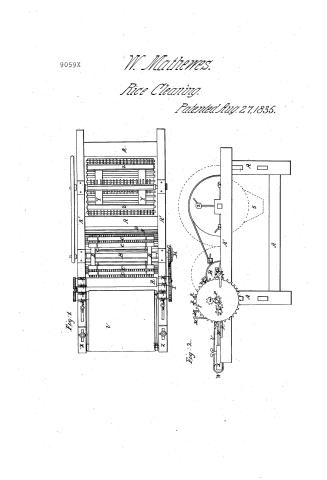
William Mathewes' Patent Drawing for an Improvement for Thrashing Rice and Other Small Grain

National Archives, Restored Patent Drawings (Record Group 241) · Full-size scan at the National Archives · Catalog record
Show the text on the drawing Hide (137 words)
Words on the drawing as machine-read by the National Archives; not checked. Useful mainly for searching.
93, MILLS. / Miller Michael / [67] / Rice Cleaning. / 20 / Throwning Aachines, / Class I30. Thasking / & Oylinder Machines / Thasking for chrashing Rice, & other small grain / Cylindi lea clumes / Patented August 27 th 1835 / 180, / The dachines, / A. Cylinder Machines / Fig 1 / clasulFication / 9059-4 / the / alk / 22 / A¹ / References / The framework A1 top piece / The lower teeding roller. / Beating cylinder / The small spuz wheel on the top zoller. / Upright bars. / Beaters / Pulley 4 bars of the bed / Toproller / 1) / Concare bed / Hopper / Small pulley of thebeaters therefrom. / 6 covers / Spur roheel for connecting / L. / Groove / on feeding table roller. / connect bars / cloth / Crots (speur whell of & cogs. / Feeding table rollers. / Tightening roller / Large cog shaffed / Thumb sever / Small sput wheel on the lower roller / Piece to chumb screiu / Revolving comb. / Bars and teeth
USPTO scan
The patent as scanned by the USPTO
-
 Page 1
-
 Page 2
-
 Page 3
-
 Page 4


U.S. Patent and Trademark Office · Google Patents
Show the transcription Hide (1,278 words)
Machine transcription (LightOnOCR) of the pages as scanned by the USPTO, most of them the handwritten copies made when the records were restored after the 1836 fire. Not checked; it can misread handwriting, so compare it with the scan.
Page 1.
9059X
W. Mathewes.
Rice Cleaning.
Patented Aug. 27, 1835.
Fig. 1.
Fig. 2.
Page 2.
1902 9059 X Aug 27 1835 981.
William Matthews of Charleston South Carolina
Letters Patent
The Schedule referred to in these Letters Patent and making part of the same containing a description in the words of the said William Matthews himself of his improvement in the machine for Threshing Rice or any other small grain
To all whom these presents shall come. Be it known that I William Matthews of Charleston in the District of Charleston and State of South Carolina, have invented a new and useful improvement in the machine for Threshing Rice or any other small grain, and that the following is a full and exact description of the construction and operation of the said machine as invented or improved by me. The method of construction will be best understood by reference to the annexed drawings, in which the letter A represents the frame which is of an oblong shape and enclosed. A¹ The top piece of this frame upon which is supported a beating cylinder B, which may be made either with stationary Beaters having pins or teeth along the outer edge of each Bar of an oblong shape say at half an inch by three quarters, or the beaters may be of that kind called hinge beaters, which have already been used and are moveable upon a bar passing from head to head of said cylinder and forming partial revolutions thereon, pins or teeth being used on the outer edge; The letter C represents these beaters. D. is the bed of these beaters and forms the concave in which they revolve. The surface of this bed is cut into angular projections E, fortified by the application of a strip of sheet iron along the angle. These angles are opposed to the direction of the revolution of the beaters. F is a small pulley of about one inch and a half diam. on the end of the axis of the beating cylinder. On the other end is a small spur wheel of eight teeth or cogs at G, and this is the driving end, and instead of a pulley which is apt to slip, and does not give a sufficiently steady and continuous motion. I use a small prop shaft H let in to the said axis by a square hole into a crop, which shaft is applied the fixture from the driving power. The cog wheel G works into a larger one I, of twenty nine teeth which is fastened on to the end of the feeding Roller J, which revolves between the upright bars K which are connected at the bottom and run forward in front of the feeding
Page 3.
roller as is shown in fig 1. where there is a cut groove L, in the said projection for the purpose of adjusting the other pair of upright connected bars M in which the roller of the feeding table N, moves. The feeding rollers turning, a groove being also cut therein so that by lowering the screw O the rollers N, may be set nearer to the feeding rollers at pleasure. The method I prefer of keeping this feeding roller down to the proper pressure is by means of the lever and weight. To the other end of the lower feeding roller J, is secured a small spur wheel P, of eight teeth working into another Q, on the top one of the like number of teeth which produces the reverse motion in the top feeding roller R. The lower feeding roller J also, turns a small connecting spur wheel S, which drives another T, each having eight teeth and that one marked T is secured to the end of the feeding table roller N thereby giving it the same motion as the lower J and consequently brings forward the feeding cloth U, which is kept stretched by means of the tightening roller W, which can be set further off by means of the thumb screw and groove in the piece X at the other end of the frame and behind the beating cylinder B, is placed another cylinder or revolving comb Y consisting of arms through the axis supporting bars along this axis, armed with long teeth thereby forming combs Z, which teeth are set so as when they begin to descend into their concave bed they assume a horizontal position. The axis of this cylinder or comb carries a pulley of about five inches in diameter (3) on the same side of the frame as the pulley on the beating cylinder, and is driven by said beating pulley and a belt. The bed of this cylinder is composed of bars, H, set at such a distance apart as to let the grain fall through into a kind of hopper beneath, when I sometimes apply a common fan to clear the rice or grain from what chaff may remain, but generally the comb carries all off, leaving the grain sufficiently clean. covers an adapter to both cylinders
Operation. The straw containing the grain is spread upon the feeding table and by the motion communicated from the beating cylinder B to the roller there nearest the feeder, the cloth is set revolving over its two rollers and carries the grain and straw forward between the feeding rollers J & R where it is caught by the teeth of the beaters and driven over the concave bed D, which breaks out the grain and throws all over to the bed of bars under the comb Z, here the grains fall through, and the straw is driven to the back over the frame being
Page 4.
9059X
separated from the grain. What I claim as my invention in the above described machine and not before known is first the plan of setting the forward feeding table roller nearer to or farther from the feeding rollers as the length or strength of straw may require according to the arrangement I have set forth of the connected upright bars and pieces sliding upon the thumb screws. Second the application of the cog wheel gearing according to the plan and proportions set forth for driving the feeding rollers. Third, the application of a beating cylinder with stationary bars and squares, or rather oblong teeth (or with the hinge beaters) though I do not claim the invention thereof to a cone or bed as described above. Though I do not claim said form of bed as my invention. Fourth, the application of the comb driven as above set forth and over the bed above described, though I do not claim the invention of said comb and bed. The machine above described has been fully tested as to its efficiency and practicability, and has been decidedly approved of as by far the best combination for the planter or grower of rice or any other small grain, that has been heretofore devised for their use whether taking into consideration the ease and cheapness of construction, the facility with which any repairs can be made as above all the great perfection with which the work is executed. In testimony that the above is a full clear and exact description of the construction and use or mode of operation of my machine as invented or improved by me, I have hereunto set my hand this thirteenth day of July eighteen hundred & thirty five
Witnesses
Henry Stone
Robt Clarke.
William Matthews
(Seal)
Published accounts: journal notice
Notice in the monthly list of patents, with remarks
Journal of the Franklin Institute, new ser., vol. 17 (1836), p. 213 · View the page
We do not think it necessary to trace the movement any further, but will add the fashionable claim of the arrangement and adaptation of the several parts of the before described machinery for the gearing of water, wind, horse, hand, steam, saw, cotton, thrashing, and fanning mills." 72. For a Thrashing Machine, for Rice and other grain; William Matthews, Charleston, South Carolina, August 27.
Remarks. Most of the parts of this thrashing machine are so similar to many others before used, that it would be time lost to describe them: in making out his claim, the patentee seems to be at some loss to divide the new from the old, as will appear from the following. "What I claim as my invention is, first, the plan of setting the forward feeding table roller nearer to or further from the feeding rollers. Second. The application of the cog wheel gearing, according to the plan and proportions set forth, for driving the feeding rollers. Third. The application of a beating cylinder, either with stationary bars, and square, or rather oblong teeth, (or with the hinge beaters, though I do not claim the invention thereof) to a concave bed as described above; though I do not claim said form of bed as my invention. Fourth. The application of the comb, driven as above set forth, and over the bed above described; though I do not claim the invention of said combs or bed." The foregoing may serve well to exemplify the absurdity of the claim so frequently made to the application of what belongs either to an individual, or to the public. It is the application of what a patentee himself invents, that gives to his patent its whole value.
About this record
- Patentee
- Jim Shaw's X-patent list
- Date
- the Name and Date index of patents, USPTO records, Jim Shaw's X-patent list
- Invention
- the Name and Date index of patents
- Listed in
- the Name and Date index of patents, USPTO records, Jim Shaw's X-patent list, the Journal of the Franklin Institute, Burke's List of Patents (1847)
- The Franklin Institute's journal spells the name differently.
- The residence comes from the Franklin Institute's journal.
- Burke's 1847 Patent Office list gives the same patent.