

Drawings and documents
USPTO scan
The patent as scanned by the USPTO
-
 Page 1
-
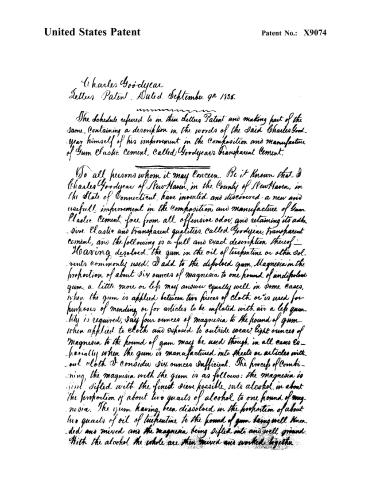 Page 2
-
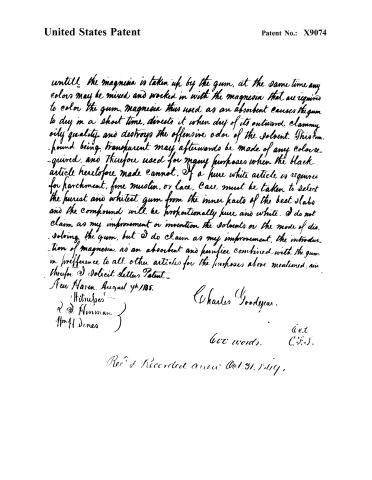 Page 3


U.S. Patent and Trademark Office · Google Patents
Show the transcription Hide (599 words)
Machine transcription (LightOnOCR) of the pages as scanned by the USPTO, most of them the handwritten copies made when the records were restored after the 1836 fire. Not checked; it can misread handwriting, so compare it with the scan.
Page 2.
United States Patent
Patent No.: X9074
Charles Goodyear
Letters Patent Dated September 9th 1888.
The schedule referred to in these Letters Patent and making part of the same, containing a description in the words of the said Charles Goodyear himself of his improvement in the Composition and Manufacture of Gum Elastic Cement, called Goodyear’s Transparent Cement.
To all persons whom it may concern. Be it known that I Charles Goodyear of New Haven, in the County of New Haven, in the State of Connecticut, have invented and discovered a new and useful improvement in the Composition and Manufacture of Gum Elastic Cement, free from all offensive odor, and retaining its adhesive, elastic and transparent qualities, called Goodyear’s transparent cement, and the following is a full and exact description thereof:
Having dissolved the gum in the oil of turpentine or other solvents commonly used, I add to the dissolved gum, Magnesia in the proportion of about six ounces of Magnesia to one pound of undissolved gum. A little more or less may answer equally well in some cases, when the gum is applied between two pieces of cloth or is used for purposes of mending or for articles to be inflated with air a less quantity is required, say four ounces of Magnesia to the pound of gum when applied to cloth and exposed to outside wear. Eight ounces of Magnesia to the pound of gum may be used though in all cases especially when the gum is manufactured into sheets or articles without cloth I consider six ounces sufficient. The process of combining the magnesia with the gum is as follows: the magnesia is first sifted with the finest sieve possible, into alcohol, in about the proportion of about two quarts of alcohol to one pound of magnesia. The gum having been dissolved in the proportion of about two quarts of oil of turpentine to the pound of gum being well kneaded and mixed and the magnesia being sifted into and well ground with the alcohol the whole are then mixed and worked together.
Page 3.
United States Patent
Patent No.: X9074
until the magnesia is taken up by the gum, at the same time any colors may be mixed and worked in with the magnesia that are required to color the gum. Magnesia thus used as an absorbent causes the gum to dry in a short time, directs it when dry of its outward clammy oily quality, and destroys the offensive odor of the solvent. This compound being transparent may afterwards be made of any color required, and therefore used for many purposes when the black article heretofore made cannot. If a pure white article is required for parchment, fine muslin, or lace, care must be taken to select the purest and whitest gum from the inner parts of the best slabs and the compound will be proportionally pure and white. I do not claim as my improvement or invention the solvents or the mode of dissolving the gum, but I do claim as my improvement, the introduction of magnesia, as an absorbent and purifier, combined with the gum in preference to all other articles for the purposes above mentioned, and therefore I solicit Letters Patent.
New Haven, August 4th/1885.
Charles Goodyear.
Witnesses:
R. D. Ninnman
H. H. Jones
Act
C.F.S.
Rec’d & Recorded anew Oct 31, 1885.
Published accounts: journal notice
Notice in the monthly list of patents
Journal of the Franklin Institute, new ser., vol. 16 (1835), p. 358 · View the page
531. Gum elastic cement. Charles Goodyear, New Haven, Conn.
Published accounts: journal notice
Notice in the monthly list of patents, with remarks
Journal of the Franklin Institute, new ser., vol. 17 (1836), p. 253 · View the page
11. For an improvement in the Composition and Manufacture of Gum Elastic Cement; Charles Goodyear, New Haven, Connecticut, September 9.
Remarks. VOL. XVII.-No. 4.-ARPIL, 1836. 25 After dissolving the gum by means of spirits of turpentine, using two quarts of the spirits to one pound of the gum, magnesia is to be combined with it in the following way. One pound of magnesia is to be sifted through a fine sieve, into about two quarts of alcohol, with which it is to be well incorporated; a proper portion of the magnesia and alcohol is then to be mixed intimately with the dissolved gum, the quantity varying for different purposes, but being generally, in the proportion of six ounces of magnesia to the pound of gum. When applied between cloths, or to vessels to be filled with air, four ounces will suffice. When used to cover cloth on one side, eight ounces is preferred. If the whiter parts of the caoutchouc be taken, a solution will be obtained nearly colourless, and capable of receiving any desired tint. We are not told that the magnesia is to be calcined, but being used as an absorbent and dryer, we suppose this to be case. This compound, it is said, dries very readily, is not tackey, and has the usual unpleasant odour corrected. The claim is to the application of magnesia. We have been informed by a manufacturer that he has used magnesia with the solution, repeatedly; whether before it was used by the present patentee, or under such circumstances as to interfere with his patent, we do not know.
About this record
- Patentee
- the Journal of the Franklin Institute, Journal
- Date
- the Name and Date index of patents, USPTO records, Jim Shaw's X-patent list
- Invention
- the Name and Date index of patents
- Listed in
- the Name and Date index of patents, USPTO records, Jim Shaw's X-patent list, the Journal of the Franklin Institute, Burke's List of Patents (1847)
- The patentee's full name comes from the Franklin Institute's journal.
- Burke's 1847 Patent Office list gives the same patent.