

Drawings and documents
National Archives restored drawings: drawing
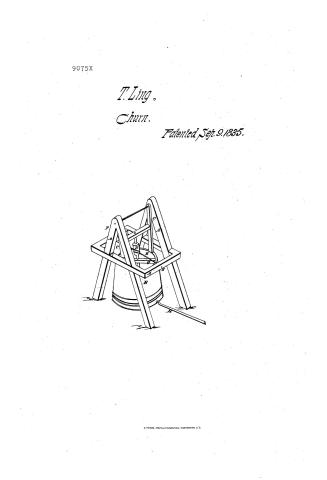
Thomas Ling's Patent Drawing for a Churn and Washing Machine

National Archives, Restored Patent Drawings (Record Group 241) · Full-size scan at the National Archives · Catalog record
Show the text on the drawing Hide (33 words)
Words on the drawing as machine-read by the National Archives; not checked. Useful mainly for searching.
Findered / 31. 31 DAIRY. / Working-Body Churns. / immire 3. Chums / f1 / agriproducts / 9075-7 / Churn go washing Machine / DIVISION: / Paiented Sepi. / of
USPTO scan
The patent as scanned by the USPTO
-
 Page 1
-
 Page 2
-
 Page 3


U.S. Patent and Trademark Office · Google Patents
Show the transcription Hide (449 words)
Machine transcription (LightOnOCR) of the pages as scanned by the USPTO, most of them the handwritten copies made when the records were restored after the 1836 fire. Not checked; it can misread handwriting, so compare it with the scan.
Page 1.
9075X
T. Ling,
Churn.
Patented Sept. 9, 1835.
Page 2.
9075X Sept. 9, 1835 217
Thomas Ling, Winthrop, Fennobuck Co. Maine
Letters Patent
The Schedule referred to in these Letters Patent and making part of the same containing a description in the words of the said Thomas Ling himself of his Improvement in the Churn and Washing Machine
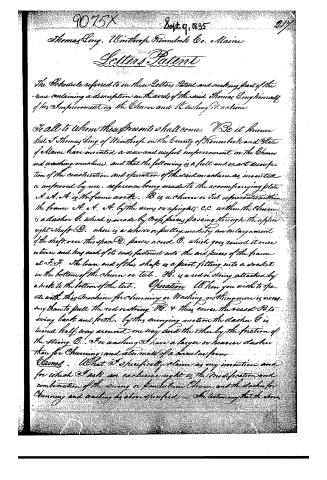
To all to whom these Presents shall come. Be it known that I Thomas Ling of Winthrop in the County of Fennobuck and State of Maine have invented a new and useful improvement in the Churn and washing machine, and that the following is a full and exact description of the construction and operation of the said machine as invented or improved by me, reference being made to the accompanying plate A. A. A is the frame or tube. B is a churn or tub represented within the frame A. A. A by the arms or uprights C. C. within the churn is a dasher G, which is made by loops pieces passing through the upper right shaft D, which is a wheel or pulley made by an enlargement of the shaft over this space D, passes round G, which goes round it once or twice and has each of its ends fastened into the end pieces of the frame at F. F. The lower end of this shaft is a pivot fitting into a socket in the bottom of the churn or tub. H. is a rod or string attached by a hook to the bottom of the tub. Operation When you wish to operate with this machine for churning or washing nothing more is necessary than to pull the rod or string H. & thus cause the vessel B to swing back and forth. by this swinging motion the dasher G is turned half way around one way and the other by the friction of the string G. For washing I have a larger or heavier dasher than for Churning and also made of a circular form.
Claims. What I specifically claim as my invention and for which I ask an exclusive right is the modification and combination of the swing or pendulum Churn and the dasher for Churning and washing as above specified — So testifying that the above
Page 3.
218. 9075X
is a true specification of my said Improvement as above described.
have hereunto set my hand this thirtieth day of July 1835.
Test. Witnessed
Wm. B. Holmes
Sam'l B. Bimson (Drawing)
Thomas King
$40.00 (in 50s)
Published accounts: journal notice
Notice in the monthly list of patents
Journal of the Franklin Institute, new ser., vol. 16 (1835), p. 358 · View the page
522. Churn, and washing machine. Thomas Ling, Winthrop, Maine,
Published accounts: journal notice
Notice in the monthly list of patents, with remarks
Journal of the Franklin Institute, new ser., vol. 17 (1836), p. 251 · View the page
2. For a Churning and Washing Machine; Thomas Ling, Winthrop, Kennebec county, Maine, September 9.
Remarks. This is a swinging, or pendulum churn, which really has some novelty about it, and even in this fact alone, their is something cheering, as originality has long been a rare element in churns and washing machines. The churn is a round tub suspended vertically within a frame, so that it can swing like a pendulum. A vertical shaft within the tub carries dashers, as is the case in many other churns. To cause the dashers to operate, the shaft projects above the tub, and a string, or cord, passed once or twice round it, the two ends of the string being attached to opposite sides of the frame; on vibrating the tub, the string operates like a drill bow, as will be readily perceived. The claim is to "the modification and combination of the swing or pendulum churn and the dasher, for churning and washing."
About this record
- Patentee
- the Journal of the Franklin Institute, Journal
- Date
- the Name and Date index of patents, USPTO records, Jim Shaw's X-patent list
- Invention
- the Name and Date index of patents
- Listed in
- the Name and Date index of patents, USPTO records, Jim Shaw's X-patent list, the Journal of the Franklin Institute, Burke's List of Patents (1847)
- The patentee's full name comes from the Franklin Institute's journal.
- Burke's 1847 Patent Office list gives the same patent.