

Drawings and documents
National Archives restored drawings: drawing
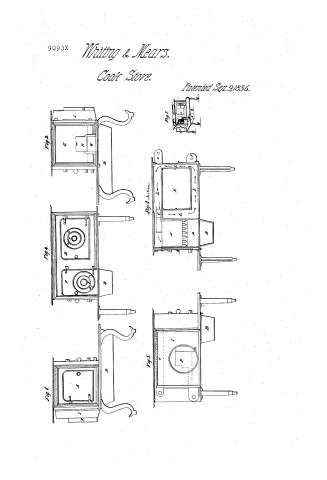
Whiting and Mear's Patent Drawing for a Cooking Stove

National Archives, Restored Patent Drawings (Record Group 241) · Full-size scan at the National Archives · Catalog record
Show the text on the drawing Hide (17 words)
Words on the drawing as machine-read by the National Archives; not checked. Useful mainly for searching.
DEL
USPTO scan
The patent as scanned by the USPTO
-
 Page 1
-
 Page 2
-
 Page 3
-
 Page 4
-
 Page 5


U.S. Patent and Trademark Office · Google Patents
Show the transcription Hide (1,425 words)
Machine transcription (LightOnOCR) of the pages as scanned by the USPTO, most of them the handwritten copies made when the records were restored after the 1836 fire. Not checked; it can misread handwriting, so compare it with the scan.
Page 1.
9093X Whiting & Mears.
Cook Stove.
Patented Sept. 9, 1835.
Fig. 1.
Fig. 2.
Fig. 3. Section.
Fig. 4.
Fig. 5.
Fig. 6.
Page 2.
9093x Sept 9, 1835 17
John Whiting & John Means of Boston Massachusetts
Letters Patent
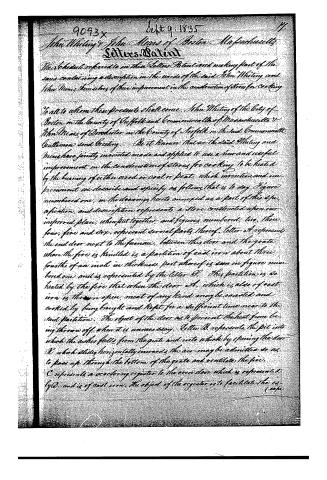
The schedule referred to in this Letter Patent and making part of the same containing a description in the words of the said John Whiting and John Means, themselves of their improvement in the construction of stoves for cooking
To all to whom these presents shall come, John Whiting of the City of Boston in the County of Suffolk and Commonwealth of Massachusetts, & John Means of Dorchester in the County of Norfolk in the said Commonwealth, Gentlemen and Greeting. Be it known that we the said Whiting and Means have jointly invented made and applied to use a new and useful improvement in the construction of stoves for cooking to be heated by the burning of either wood or coal or peat, which invention and improvement we describe and specify as follows, that is to say Figure numbered one, in the drawings hereto annexed as a part of this specification, and description represents a stove constructed upon our improved plan, when put together, and figures numbered, two, three, four, five and six, represent several parts thereof. Letter A represents the end door next to the furnace, between this door and the grate where the fire is kindled is a partition of cast iron about three fourths of an inch in thickness part whereof is seen in figure numbered one and is represented by the letter B. This partition is so heated by the fire that when the door A, which is also of cast iron is thrown open, meat of any kind may be roasted and cooked, by being brought and kept for a sufficient time near to the said partition. The object of the door as to prevent the heat from being thrown off when it is unnecessary. Letter B represents the pit into which the ashes falls from the grate and into which by opening the door R which slides horizontally inwards, the air may be admitted so as to pass up through the bottom of the grate and ventilate the fire. C represents a cooling register to the oven door which is represented by D, and is of cast iron. The object of the register is to facilitate the ex- (page)
Page 3.
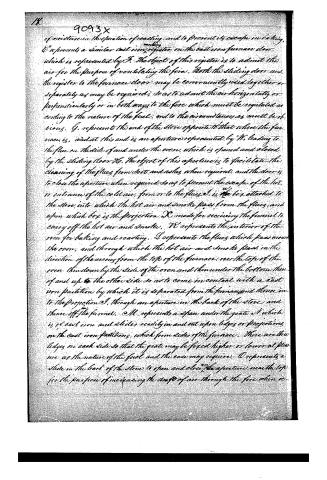
of moisture in the operation of roasting, and to prevent its escape in baking. E represents a similar cast iron register on the cast iron furnace door, which is represented by F. The object of this register is to admit the air for the purpose of ventilating the fire. Both the sliding door and the register to the furnace door may be conveniently used together or separately as may be required, so as to admit the air horizontally or perpendicularly or in both ways to the fire, which must be regulated according to the nature of the fuel, and to the circumstances as must be obvious. G represents the end of the stove opposite to that where the furnace is, and at this end is an aperture represented by W, leading to the flue on the side of and under the oven, which is opened and closed by the sliding door H. The object of this aperture is to facilitate the cleaning of the flues from soot and ashes when required, and the door is to close the aperture when required so as to prevent the escape of the hot air or entrance of the cold air from or to the flues. It is a box attached to the stove, into which the hot air and smoke pass from the flues, and upon which box is the projection X made for receiving the funnel to carry off the hot air and smoke. K represents the interior of the oven for baking and roasting. L represents the flues which pass around the oven, and through which the hot air and smoke pass in the direction of the arrows from the top of the furnace, over the top of the oven, then down by the side of the oven and then under the bottom thereof and up to the other side so as to come in contact with a cast iron partition by which it is separated from the furnace and thence into the projection I, through an aperture in the back of the stove and thence off the funnel. M represents a space under the grate N, which is of cast iron and slides readily in and out upon ledges or projections on the cast iron partitions, which form sides of the furnace. There are the ledges on each side so that the grate may be fixed higher or lower at pleasure as the nature of the fuel and the case may require. O represents a slide in the back of the stove to open and close an aperture near the top for the purpose of increasing the draft of air through the fire when re-
Page 4.
9093x
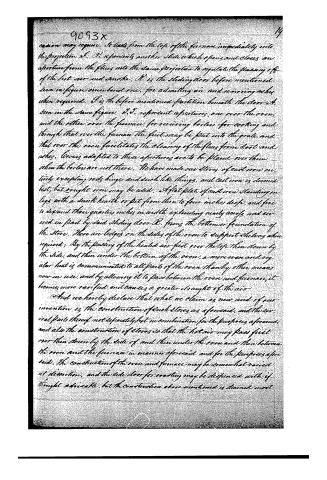
cession may require. It leads from the top of the furnace immediately into the projection of. B. represents another slide which opens and closes an aperture from the flues into the same projection to regulate the passing off of the hot air and smoke. A is the sliding door before mentioned seen in figure numbered one, for admitting air and removing ashes when required. F is the before mentioned partition beneath the door A. seen in the same figure. D. D. represent apertures, one over the oven, and the other over the furnace for receiving boilers for cooking and through that over the furnace the fuel may be put into the grate, and that over the oven facilitates the cleaning of the flues from soot and ashes. Covers adapted to these apertures are to be placed over them when the boilers are not there. We have made our stoves of cast iron entirely excepting rods, hinges and such like things, and cast iron is deemed best, but wrought iron may be used. A flat plate of cast iron standing on legs with a sunk hearth or pit from three to four inches deep and five to six and three quarters inches in width extending nearly across and covered in part by said sliding door B. forms the bottom or foundation of the stove. There are ledges on the sides of the oven to support shelves when required; By the passing of the heated air first over the top then down by the side, and then under the bottom of the oven, a more even and regular heat is communicated to all parts of the oven than by other means now in use, and by allowing it to pass between the oven and furnace, it becomes more rarified and causes a greater draught of the air.
And we hereby declare that what we claim as new, and of our invention is the construction of such stoves as aforesaid, and the several parts thereof not separately, but in combination for the purposes aforesaid, and also the construction of stoves so that the hot air may pass first over then down by the side of, and then under the oven and then between the oven and the furnace in manner aforesaid and for the purposes aforesaid. The construction of the oven and furnace may be somewhat varied at discretion, and the side door for roasting may be dispensed with, if thought advisable, but the construction above mentioned is deemed most
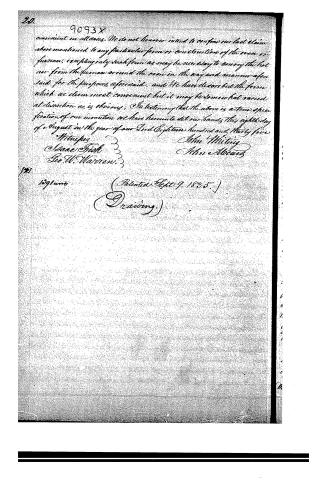
Page 5.
convenient in all cases. We do not however intend to confine our last claim above mentioned to any particular form or construction of the oven or furnace; excepting only such form as may be necessary to convey the hot air from the furnace around the oven in the way and manner above said for the purposes aforesaid, and we have described the form which we deem most convenient but it may be somewhat varied at discretion as is obvious. In testimony that the above is a true specification of our invention we have hereunto set our hands this eighth day of August in the year of our Lord Eighteen hundred and thirty five.
Witnesses
Isaac Fish
Geo. W. Warren
John Whiting
John Moran
1291 words (Patented Sept. 9, 1835.)
(Drawing)
Published accounts: journal notice
Notice in the monthly list of patents, with remarks
Journal of the Franklin Institute, new ser., vol. 17 (1836), p. 258 · View the page
The claim is to "the arrangement of the parts described, to cause a log to be sawed into any required thickness marked upon the graduated edge of the slide." ㅓ 25. For a Cooking Stove; John Whiting, of Boston, and John Mears, of Dorchester, Norfolk county, Massachusetts, September 9.
Remarks. The main, or only, novelty in this cooking stove, consists, like that of most others, in the particular arrangement of the respective parts, as devised by the patentees. The claim is to "the construction of such stoves, as aforesaid, and the several parts thereof, not separately, but in combination for the purposes aforesaid; and also the construction of stoves so that the hot air may pass first over, then down by the side of, and then under, the oven, and then between the oven, and the furnace, in manner aforesaid, and for purposes aforesaid. The construction of the oven and furnace may be somewhat varied, at discretion, and the side door for roasting may be dispensed with, if thought advisable; but the construction above mentioned is deemed most convenient, in all cases." We cannot attempt a description of the particular arrangement, which is well shown in the drawing, referred to throughout in the specification.
About this record
- Patentee
- Jim Shaw's X-patent list
- Date
- the Name and Date index of patents, USPTO records, Jim Shaw's X-patent list
- Invention
- the Name and Date index of patents
- Listed in
- the Name and Date index of patents, USPTO records, Jim Shaw's X-patent list, the Journal of the Franklin Institute, Burke's List of Patents (1847)
- Burke's 1847 Patent Office list gives the same patent.