

Drawings and documents
National Archives restored drawings: drawing
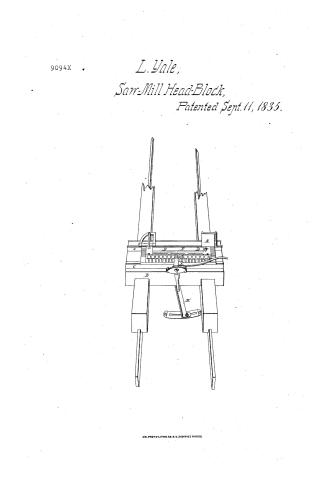
L. Yale's Patent Drawing for an Improvement in the Saw Mill


National Archives, Restored Patent Drawings (Record Group 241) · Full-size scan at the National Archives · Catalog record
Show the text on the drawing Hide (123 words)
Words on the drawing as machine-read by the National Archives; not checked. Useful mainly for searching.
Sheet 1. 110. saws. / 143, WOOD SAWING. / [130] Head Blocks. / Saw Mil Set Works, / L. YALE'S / #1- / Improvement in theSam nill / Patented Sep" / Patent office anril 24.1338 / 90947 / DIVISION. / Made under direction the commence of Patients / in conformity with the act of 3" lanch 1837 / ML: sumorth / the / old / References / The,dog as described in / on the specification vertical shaft. / turning / Block.- CRibs. / D. Graduated bar. Ei.Lever. / E.Hand. G. small Leven. / H Inclined Plane.-
Sheet 2. 144. wnnn WORKING. / 3. SPECI / ORK MACHINERY. / [40] Making Hoops. / #1- / lives Kaull / classizication / 9104-X / DIVISION. / WILLIAM B. KIMBALIA, ABIEL PERCY and FRANKLIN SPALDIN G / for Dressing Hoops and Barrels. / Patented Septs 18th 1835 / finance / Copied by 1837.
USPTO scan
The patent as scanned by the USPTO
-
 Page 1
-
 Page 2
-
 Page 3
-
 Page 4
-
 Page 5


U.S. Patent and Trademark Office · Google Patents
Show the transcription Hide (1,496 words)
Machine transcription (LightOnOCR) of the pages as scanned by the USPTO, most of them the handwritten copies made when the records were restored after the 1836 fire. Not checked; it can misread handwriting, so compare it with the scan.
Page 1.
9094X
L. Yale,
Saw-Mill Head-Block,
Patented Sept. 11, 1835.

A.M. PHOTO-LITHO. CO. N.Y. (OSBORNE'S PROCESS)
Page 2.
Sept 11, 1835
Linus Yale, of Utica in the County of Onedea and State of New York
Letters Patent
The schedule referred to in these letters Patent and making a part of the same, containing a description in the words of the said Linus Yale, himself of his improvement in the Saw-Mill:
To all to whom these presents shall come.
Be it known that I Linus Yale, of Utica in the County of Onedea and State of New York, have invented a new and useful improvement in the "Saw-Mill" called the self-setting dog and block, and that the following is a full and exact description of the construction and operation of the said machine, as improved or improved by me.
Upon that portion of the plank or piece of timber that is to form the body of the block I bolt on a plate of cast iron on the top. This plate is to contain the two rails through the whole length thereof, projecting sufficiently high or above it to admit of the two inner sides being sloped, or dovetailed, so as to admit another plate having the sides sloped in a similar manner, to slide backward or forward between them. One of these dovetailed ribs is to be placed flush with the side of the block, and the other at the distance from it, intended for the width of the sliding piece, and this plate and ribs are cast in one. Upon the top of this sliding piece and over the rib which is flush with the side of the block, is to be placed a bar of iron of a square form, say about one and a half inches square, and is to be graduated or divided into different distances on each of the four sides, so as to allow of cutting various sized boards, according as their distances are laid off—each side to be regularly divided throughout and the notches or grooves will be sufficiently deep to form as it were a groove, as upon a common rack; the bar to be about three feet long and to have at each end a round tenon to fall into a hole for that purpose between the ends of two pieces rising on the top of each end of the sliding piece so as
Page 3.
to hold it fast, and yet to be movable at pleasure when it is desired to change the side in order to cut or saw to a different thickness. At one end of the sliding plate is placed a dog which is constructed to turn or revolve upon a vertical shaft so that the dog is formed by, as it were, an arm of any height and length desired; having at one end a hole to fit on said upright, and at the other a perpendicular row of teeth, or in a line parallel with the shaft, revolving round the shaft as its centre; behind the end containing the teeth, or between them and the bar, I place a small knob or projection, also vertical, intended as a stay or support so as to work in a between it and the back of the dog teeth when driven into the log in order to keep all firm. About midway of the block and again on that side with which the bar is flush, I secure the end of a lever bent up at an elbow, or right angle, by means of a hole through it at said elbow for the passage of a pin, or pivot made fast to the side of the block and upon which this lever revolves. The elbow or short arm, has at its top a hole formed through it just above the top of the bar which it reaches intended to receive a pin to project horizontally over the bar, upon this pin revolves a hand of about four inches long having at one end a hole to pass on to the pin, and at the other a sharp angular projection on each side, intended to drop into the grooves or bores formed on the bar, so that it will catch when laid upon either side upon the bar so as to force it forwards or backwards as the lever may be worked. Beneath the lever is to be suspended a small arm of about twelve inches in length, by means of a hole at one end of it, by which it is hung on the same pin or pivot, that passes through the elbow of the lever, and the other end is rounded to a point intended to work against the inclined plane below and close beneath the pivot, there are formed on this arm two cross arms, or horns at right angles projecting about three and a half or four inches each way and in the same plane as the lever. Through the end of each cross arm a small pin projects under the lever horizontally and at right angles with the cross arms, intended
Page 4.
have brought in contact with the lever, to raise it by means of the iron under it. Directly under this arm & at the bottom of the carriage is secured the inclined plane, which consists of a flat bar of iron of about four feet long, having at each end a hole to receive a pin or bolt. One of these secures the bar to the floor, but still allows it to play or revolve on it as a centre; the other pin is intended to pass through the flat bar and drop into holes formed in the bottom of the floor or into a quadrangular slot in which the bolt is secured by a nut in the circle described by the bar in swinging on the first pivot, so as to be secured at any inclination desired and still to be movable at pleasure. These holes are at distances to correspond with those in the notched bar. The inclined plane has one side at each end rounded off so as to meet the other side in a sharp edge like a chisel edge, and these edges are placed on opposite sides so that the round pointed arm strikes against one rounded edge as the plane moves on under it, & is thereby compelled to follow this side on until the board is cut in the whole length, when the arm drops into a perpendicular again and is met by the other rounded edge at that end of the plane & follows on at that inclination as the carriage runs back until it returns to the first edge & so on. In running back, the pin at the end of the cross arm under the lever raises it by means of the elevation produced by the lateral motion of the pointed arm as it is forced to one side by the inclined plane in passing it & this elevation of the lever forces the small arm forward, and with it the hand which consequently advances the cog or notch in which it rests, & with it the dog and log for a fresh bite. This description is applied to the tail block, that at the head has no inclined plane nor consequently any small pointed or setting arm, but in order to set it there the lever is raised by hand and after the sawing is finished the hand is reversed and then by working the lever by hand the dogs are brought back to the proper situation to start afresh.
Page 5.
244.
9094X
What I claim as my invention and not before used in the above described Machine is not the use of the levers, nor the sliding motion of the piece containing the dog and bar but first the dogs swinging upon a Vertical Shaft as described. Second the construction and use of the Notchest bar as set forth & for that intent. Third the construction and use of the printed or setting arm as set forth. Fourth, the manner in which I construct the inclined plane as set forth, (but not the use of it) as an inclined plane of an entirely different mode of operation has been used. Fifth, the manner of fastening the plates and slides together as shown forth.
In Testimony that the above is a full and exact description of the construction and use of my improvement as invented by me I have hereunto set my hand this twentieth day of June in the year eighteen hundred and thirty-five.
Witnesses
Isaac D. Kirk
Henry Wlose
Simms Yate
(Drawing)
Filed 11/6
(Patented September 11, 1835)
71463
Published accounts: journal notice
Notice in the monthly list of patents, with remarks
Journal of the Franklin Institute, new ser., vol. 17 (1836), p. 259 · View the page
28. For an improvement in the Saw Mill; Linus Yale, Utica, Oneida county, New York, September 11.
Remarks. Upon the head block there is to be a plate of cast-iron, about three feet' in length, which slides between grooves, or ledges, on a cast-iron bed, that is fastened to the block. A bar of iron, which may be an inch and a half square, is to be placed upon the slide, along that edge of it which is farthest from the log; by means of pins and holes, properly constructed, it may be placed firmly upon the slide, with either of its sides uppermost, and these four sides are divided and notched to suit four different thicknesses of stuff, the notches serving for a setting pall to fall into, which is acted on by a lever, which lever, when raised by the hand, sets the log. A similar slide, and its appurtenances, are affixed to the tail block, but here it is rendered self-setting by an apparatus, not very clearly described, and for the study of which we cannot afford much time. A particular construction of the dog is also described, but so obscurely that we know little, or nothing, about it, although it forms one of the matters claimed. Neither the use of the lever, nor of the slide containing the dog and bar, is claimed, but, "first. The dogs swinging upon a vertical shaft, as described. Second. The construction and use of the notched bar, as set forth. Third. The construction and use of the pointed, or setting, arm, as set forth. Fourth. The manner in which I construct the inclined plane, as set forth. Fifth. The manner of casting the plates and slides together." The third and fourth claims refer to the self-setting part; the fifth at least, it might have been better to have omitted.
About this record
- Patentee
- Jim Shaw's X-patent list
- Date
- the Name and Date index of patents, USPTO records, Jim Shaw's X-patent list
- Invention
- the Name and Date index of patents
- Listed in
- the Name and Date index of patents, USPTO records, Jim Shaw's X-patent list, the Journal of the Franklin Institute, Burke's List of Patents (1847)
- Burke's 1847 Patent Office list gives the same patent.