

Drawings and documents
National Archives restored drawings: drawing
Unknown Patent for Circle Combs

National Archives, Restored Patent Drawings (Record Group 241) · Full-size scan at the National Archives · Catalog record
Show the text on the drawing Hide (27 words)
Words on the drawing as machine-read by the National Archives; not checked. Useful mainly for searching.
CLASSIFICATION / 9098-x / DIVISION. / h. / OF / Right side view / Left sid view
USPTO scan
The patent as scanned by the USPTO
-
 Page 1
-
 Page 2
-
 Page 3
-
 Page 4


U.S. Patent and Trademark Office · Google Patents
Show the transcription Hide (976 words)
Machine transcription (LightOnOCR) of the pages as scanned by the USPTO, most of them the handwritten copies made when the records were restored after the 1836 fire. Not checked; it can misread handwriting, so compare it with the scan.
Page 1.
W. W. Calvert. 9098X
Combing Mach.
Patented Sep. 18, 1835.

Page 2.
Sept. 18, 1835
97.
9098X
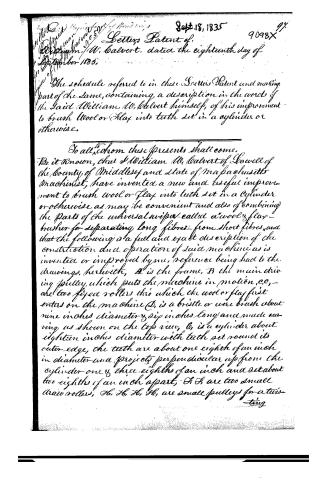
Letters Patent of.
William W. Balvert, dated the eighteenth day of September 1835.
The schedule referred to in these Letters Patent and making part of the same, containing a description in the words of the said William W. Balvert himself, of his improvement to brush wool or flax into teeth set in a cylinder or otherwise.
To all to whom these presents shall come.
Be it known, that I William W. Balvert of Lowell of the County of Middlesex and State of Massachusetts Machinist, have invented a new and useful improvement to brush wool or flax into teeth set in a cylinder or otherwise as may be convenient and also of combining the parts of the universal wiper called a wool & flax brusher for separating long fibres from short fibres, and that the following is a full and exact description of the construction and operation of said machine as is invented or improved by me, reference being had to the drawings herewith, A is the frame, B the main driving pulley which puts the machine in motion, etc., are two fixed rollers thro which the wool or flax first enters on the machine C, is a bristle or wire brush about nine inches diameter & six inches long and made curving as shown on the top view, D, is a cylinder about eighteen inches diameter with teeth set round its outer edge, the teeth are about one eighth of an inch in diameter and project perpendicular up from the cylinder one & three eighths of an inch and set about two eighths of an inch apart, E & F are two small draw rollers, H, H, H, H, are small pulleys for a twisting
Page 3.
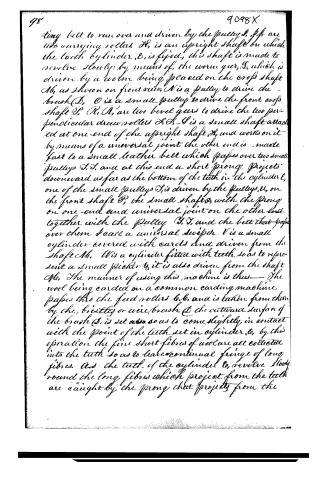
ting belt to run over and driven by the pulley J. J, J, are two carrying rollers. H, is an upright shaft on which the tooth cylinder, E, is fixed, this shaft is made to revolve slowly by means of the worm gear, G, which is driven by a worm being placed on the cross shaft M, as shown on front view. N is a pulley to drive the brush D, O is a small pulley to drive the front cross shaft P. R, R, are two bevel gears to drive the two perpendicular draw rollers S, S. S is a small shaft attached at one end of the upright shaft H, and works on it by means of a universal joint the other end is made fast to a small leather belt which passes over two small pulleys T, T, and at this end a short prong projects downward as far as the bottom of the teeth in the cylinder E, one of the small pulleys T, is driven by the pulleys U, on the front shaft P, the small shaft S, with the prong on one end and universal joint on the other end together with the pulley T, T, and the belt that passes over them I call a universal swiper. V is a small cylinder covered with cards and driven from the shaft M. W is a cylinder fitted with teeth so as to represent a small picker & it is also driven from the shaft M. The manner of using this machine is this—The wool being carded on a common carding machine passes thru the feed rollers L, L, and is taken from them by the bristles or wire brush @ the outward surface of the brush S, is set so as to come slightly in contact with the point of the teeth set in cylinder E, by this operation the fine short fibres of wool are all collected into the teeth so as to leave a continual fringe of long fibres. As the teeth of the cylinder E, revolve slowly round the long fibres which project from the teeth are caught by the prong that projects from the
Page 4.
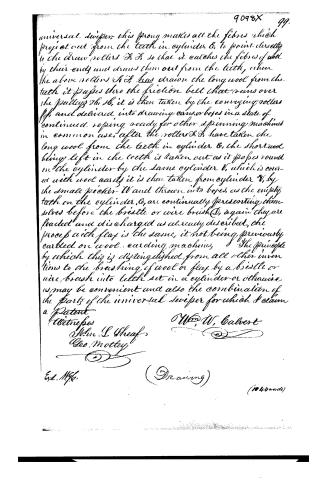
universal swiper, this prong makes all the fibres which project out from the teeth in cylinder C, to point directly to the draw rollers S, S, so that it catches the fibres of wool by their ends and draws them out from the teeth, when the above rollers S, S, has drawn the long wool from the teeth it passes thro the friction belt that runs over the pulleys V, V, it is then taken by the conveying rollers F, F, and delivered into drawing cans or boxes in a state of continued roping ready for other spinning machines in common use. after the rollers S, S, have taken the long wool from the teeth in cylinder C, the short wool being left in the teeth is taken out as it passes round on the cylinder by the same cylinder V, which is covered with wool cards; it is then taken from cylinder V, by the small picker W and thrown into boxes, as the empty teeth on the cylinder C, are continually presenting themselves before the bristle or wire brush D, again they are loaded and discharged as already described, the process with flax is the same, it not being previously carded on wool carding machines, The principle by which this is distinguished from all other inventions to the brushing of wool or flax by a bristle or wire brush into teeth set in a cylinder or otherwise as may be convenient and also the combination of the parts of the universal swiper for which I claim a Patent
Witnesses
John L. Sheaf
Geo Motley
Wm W. Calvert
Exd. M.96.
(Drawing)
(1044 words)
Published accounts: journal notice
Notice in the monthly list of patents, with remarks
Journal of the Franklin Institute, new ser., vol. 17 (1836), p. 261 · View the page
34. For a Wool and Flax Brusher; William W. Calvert, Lowell, Middlesex county, Massachusetts, September 18.
Remarks. "The principle by which this is distinguished from all other inventions, is the brushing of wool, or flax, by a bristle, or wire, brush, into teeth set on a cylinder, or otherwise, as may be convenient. And also the combination of the parts of the universal swiper, for which I claim a patent." The object in view is the separating the long and short fibres from each other. The machine is well represented in the drawings, and clearly described; without the former, however, we should fail in an attempt at the latter. We think that much ingenuity and skill are manifested in the mode adopted for carrying out the conceptions of the patentee, but we are unable to offer any opinion of the probable success of the plan, as it is, in the present instance especially, a question of experience.
About this record
- Patentee
- DATAMP
- Date
- the Name and Date index of patents, DATAMP, USPTO records
- Invention
- DATAMP
- Listed in
- the Name and Date index of patents, DATAMP, USPTO records, Jim Shaw's X-patent list, the Journal of the Franklin Institute, Burke's List of Patents (1847)
- The National Archives' catalog gives the name differently.
- Burke's 1847 Patent Office list gives the same patent.