

Drawings and documents
National Archives restored drawings: drawing
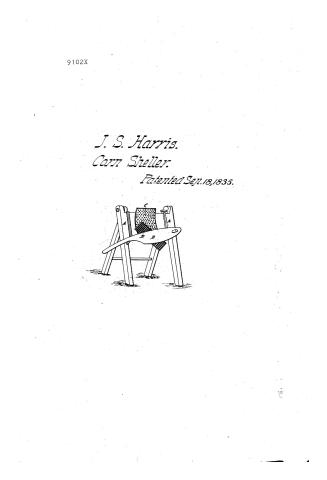
James S. Harris' Patent Drawing for a Corn Sheller

National Archives, Restored Patent Drawings (Record Group 241) · Full-size scan at the National Archives · Catalog record
Show the text on the drawing Hide (70 words)
Words on the drawing as machine-read by the National Archives; not checked. Useful mainly for searching.
130. THRASHING. / Patented the is Sept. 1835 / 134 / Corn Shellers. / Implements. / h's / [G / Patented Sep 18-1835 / classIrication / Impt. / JAMES S. HARRIS. / 9102+ / CORN SHELLER / DIVISION. / A.A / The frame / The lever. / upper under prater. / grater / Patent office 3 Nov 1838 / Made under the direction of the Commitioner of / Patents in comformity with ack 3 March 183y / Herry sumorth / of Patients
USPTO scan
The patent as scanned by the USPTO
-
 Page 1
-
 Page 2
-
 Page 3


U.S. Patent and Trademark Office · Google Patents
Show the transcription Hide (647 words)
Machine transcription (LightOnOCR) of the pages as scanned by the USPTO, most of them the handwritten copies made when the records were restored after the 1836 fire. Not checked; it can misread handwriting, so compare it with the scan.
Page 1.
9102X
J. S. Harris.
Corn Sheller.
Patented Sep. 18, 1835.

Page 2.
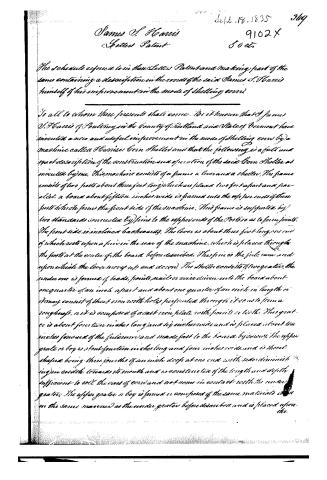
Sept. 18, 1835 369
James S. Harris
Letters Patent
9102X
50 ct.
The schedule referred to in these Letters Patent and making part of the same containing a description in the words of the said James S. Harris himself of his improvement in the mode of shelling corn.
To all to whom these presents shall come. Be it known that I James S. Harris of Poultney in the county of Chittenden and State of Vermont have invented a new and useful improvement in the mode of shelling corn by a machine called Harris’s Corn Sheller and that the following is a full and exact description of the construction and operation of the said Corn Sheller as invented by me. This machine consists of a frame, a lever and a sheller. The frame consists of two posts about three feet long which are placed two feet apart and parallel. A board about fifteen inches wide is fastened unto the upper ends of these posts which forms the front side of the machine. This frame is supported by two standards connected by pins to the upper ends of the Posts so as to form joints. The front side is inclined backwards. The lever is about three feet long, one end of which rests upon a pin in the rear of the machine, which is placed through the posts at the centre of the board before described. This pin is the fulcrum and upon which the lever moves up and down. The sheller consists of two graters, the under one is formed of heads, points, nails or wire driven into the board about one quarter of an inch apart and about one quarter of an inch in length; or it may consist of sheet iron with holes perforated through it so as to form a roughness, or it is composed of a cast iron plate with points or teeth. This grater is about fourteen inches long and six inches wide and is placed about ten inches forward of the fulcrum and made fast to the board by screws. The upper grate or box is about fourteen inches long and four inches wide and is shovel shaped, being three fourths of an inch deep at one end with sides diminishing in width towards its mouth and is constructed of the length and depth sufficient to roll the ears of corn and not come in contact with the under grate. The upper grate or box is formed or composed of the same materials as in the same manner as the under grate before described and is placed upon the
Page 3.
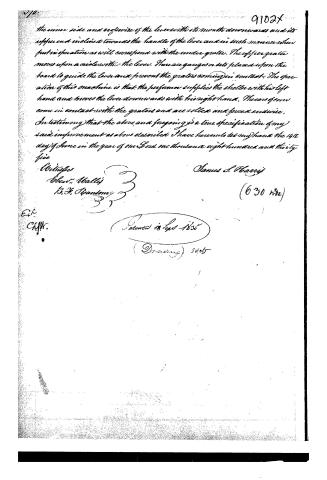
the inner side and edge-wise of the lever with its mouth downwards and its upper end inclined towards the handle of the lever and in such manner when put in operation as will correspond with the under grater. The upper grater moves upon a rod with the lever. There are gauges or sets placed upon the board to guide the lever and prevent the graters coming in contact. The operation of this machine is that the performer supplies the shells with his left hand and moves the lever downwards with his right hand. The cans of corn come in contact with the graters and are rolled and forced endwise.
In testimony that the above and foregoing is a true specification of my said improvement as above described I have hereunto set my hand the 14th day of June in the year of our Lord one thousand eight hundred and thirty five.
Witnesses
Robert Wallis
B.H. Roanomy
James S. Harris
(630 wds)
Patented 18 Apr 1835
(Drawing) 5065
Published accounts: journal notice
Notice in the monthly list of patents, with remarks
Journal of the Franklin Institute, new ser., vol. 17 (1836), p. 262 · View the page
37. For a Machine for Shelling Corn; James S. Harris, Poultney, Rutland county, Vermont, September 18.
Remarks. We apprehend that this will prove to be one of the least valuable of all the corn shelling machines, from its being inconvenient and laborious to operate with, whilst it will not be recommended by its efficiency. It consists of a fixed rubbing board, set with teeth, or otherwise furnished with projecting points, and a movable rubbing board, to be worked up and down by a lever, which is moved by the right, whilst the feeding is to be performed by the left hand. No other provisions are spoken of, nor is any claim made.
About this record
- Patentee
- DATAMP
- Date
- the Name and Date index of patents, DATAMP, USPTO records
- Invention
- DATAMP
- Listed in
- the Name and Date index of patents, DATAMP, USPTO records, Jim Shaw's X-patent list, the Journal of the Franklin Institute, Burke's List of Patents (1847)
- Burke's 1847 Patent Office list gives the same patent.