

Drawings and documents
USPTO scan
The patent as scanned by the USPTO
-
 Page 1
-
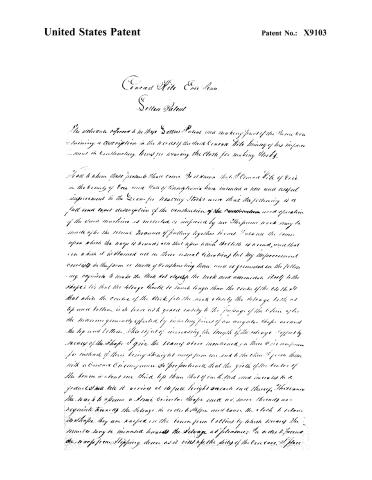 Page 2
-
 Page 3
-
 Page 4
-
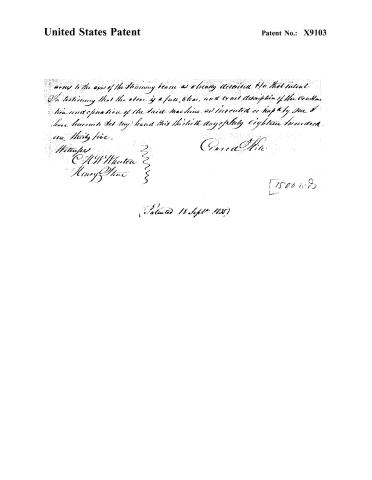 Page 5


U.S. Patent and Trademark Office · Google Patents
Show the transcription Hide (1,466 words)
Machine transcription (LightOnOCR) of the pages as scanned by the USPTO, most of them the handwritten copies made when the records were restored after the 1836 fire. Not checked; it can misread handwriting, so compare it with the scan.
Page 2.
United States Patent
Patent No.: X9103
Conrad Hile Erie Penn.
Letters Patent
The invention referred to in these Letters Patent and making part of the same contains a description in the words of the said Conrad Hile himself of his improvement in constructing beams for drawing the cloth for making Stocks.
I shall be known, these present shall come to it known that Conrad Hile of Erie in the County of Erie and State of Pennsylvania have invented a new and useful improvement in the Beam for Drawing Stocks and that the following is a full and exact description of the construction and operation of the said machine as invented or improved by me. The frame work may be made after the usual manner of putting together beams. I use the terms upon which the warp is wound; also that upon which the cloth is wound, and that in which it is drawn out in their usual relations but my improvement consists in the form or mode of constructing them and is premised on the following requisite to make the Stock set closely the stock and accommodate itself to the shape; viz that the selvage should be much longer than the centre of the cloth so that when the centre of the Stock fits the stock closely the selvage both at top and bottom is so loose as to yield easily to the passage of the cloth after the manner generally effected by inserting pieces of an angular shape around the top and bottom. This object of increasing the length of the selvage is effected by means of the shape I give the beams above mentioned, on their circumference for instead of their being straight warp from one end to the other I form them with a convex circumference so proportioned that the girth of the centre of the beam is about one third less than that of each end and increases in a gradual manner till it arrives at its full height on each end thereof. This causes the warp to assume a semi-circular shape such as more threads are requisite towards the Selvage in order to slipper and cause the cloth to retain its shape they are warped in the beam from bottom by which means the number may be increased towards the Selvage at pleasure. In order to prevent the warp from slipping down as it rises up the sides of the circumference I place
Page 3.
United States Patent
Patent No.: X9103
a number of pins rising perpendicularly from the surface of each wheel so as not to interrupt the winding of the warp, upon a off the beam; Aatchet wheel and band is applied thereon as usual; the gears through which the ends of the warp are passed are brought into the requisite semi-circular shape by means of the bars on the top, having their upper side cut into the same concave as the beam; and the bottom of the lower bar cut into a concave of the same proportions which brings the loops of the straight yarn into the requisite curve; the ends of the warp are brought over the straining beam in front and remain on the cloth beam beneath this said straining beam which has such a portion of its under surface beveled out as to unite the cloth beam to fit or work in this hollowed place; the latter being about one half the circumference of the former (though the length will be the same) and consequently the concavity of the latter will be in the same proportion say one half or whatever other proportion may be used. The cloth beam is also sufficiently in the front of the latter towards the straining beam to bring the line of concavity of the former to correspond as nearly as possible with that of the latter so that the cloth has no hindrance in passing from one to the other in the same semi-circular shape and the straining beam is allowed to be loose upon its axis so that as the cloth beam fills up it continues to press against the upper part of the bottom and consequently causes the former to revolve and loose room for the accumulation of the cloth; the band and ratchet wheel are adapted to the cloth beam as usual, I construct say two unequal in a different manner from the common principle it being necessary to suit it to the concavity of the beam. This is effected by giving to the lower bar into which the needles or rather their strips of steel such as clock springs) are secured, the same semi-circular shape as the straining beam so as to fit the circumference exactly and it must also be brought with a sharp edge, since that makes this purpose better than need and on the upper or sharp edge slots are cut for the reception of the needles which when placed around of course assume the curved shape of the metal plate and exactly fit the hollow of the beam. They are then soldered and secured. The upper or top bar is made straight as usual and if of wood it must have a metal plate (though without a sharp edge) in the slot of
Page 4.
United States Patent
Patent No.: X9103
which the ends of the steel posts are bolted and secured. Springs at each end either of metal or wood are used to insert the ends of the top & bottom plates so as to keep them steady and by means of a motion and tension with a thrust screw the pieces or plates may be released, with the rod changed for another, the mode of operating my rod being different from the common method. I connect the bottom of each upright in arms to the same plane but in obtuse angle though not much more than a right angle which is the sufficiently long to reach to the axle of the revolving beam on which it is secured so as to play or revolve on said axis one arm being projected on each side and is the sufficiently long just to bring the sharp edge of the rod close upon the circumference of the beam, consequently to cause it by the motion given to the rod to revolve at a regular distance around the said beam. The arrangement of the needles here is the same as other beams which are to move or play according to the position intended to be produced which can be varied in this beam as well as any other in operating the warp is effected by the motion of the needles and by means of a small shuttle one shot is made to pass through a thread either of cotton or silk then a little is placed and then another shot made and so on to suit the intention of the weaver. I prefer acting the thread for the purpose of preventing the bobbins from slipping out. When it will be seen that at each long of the rod the sharp edge brings the bobbins straight by the side of each other in the place of a section through the diameter by which means they are not strained out of a straight line or straight by the side of each other otherwise than according to the curve of the beam. I have the invariable quality of warp prevents the possibility of there ever falling flat again. I propose to construct my beams to work not only singly but even exactly as power beams. See the quantity of strain is increased as much into the warp and selvage as to fill up the space between the bobbins as will be requisite to give the cloth a uniform even appearance. That I claim as my invention is the above described machine used for previously known to the common shape I give to all my claims & to the use and security the manner of making the lower semi-circular bar of the rod, lastly the manner of joining the uprights of the rod by means of
Page 5.
United States Patent
Patent No.: X9103
...and to the end of the drawing herein as already described in the specification.
In testifying that the above is a full, clear, and exact description of the construction and operation of the said machine, as invented or improved by me, I have hereunto set my hand this thirtieth day of July eighteen hundred and sixty-five.
Witnesses:
C. H. W. Wharton
Henry White
Patented 18 Sept. 1865
[1500 w.d.]
Published accounts: journal notice
Notice in the monthly list of patents, with remarks
Journal of the Franklin Institute, new ser., vol. 17 (1836), p. 259 · View the page
There is not any claim made; the whole must, therefore, be considered as new, or the patent cannot be sustained. 30. For a Loom for Weaving the Cloth for Stocks; Conrad Kile, Erie, Erie county, Pennsylvania, September 18.
Remarks. The frame, warp, and cloth beams, &c., are placed in the usual manner, the improvement consisting "in the form, or mode, of constructing them, and is grounded on the following requisite, to make the stock set closely to the neck, and accommodate itself to the shape, viz: that the selvage should be much longer than the centre of the cloth, so that, while the centre of the stock fits the neck closely, the selvage, both at top and bottom, is so loose as to yield easily to the motion of the chin, after the manner generally effected by inserting pieces of an angular shape around the top and bottom. This object of increasing the length of the selvage, I effect by means of the shape I give the beams above mentioned on their circumference, for, instead of their being straight from one end to the other, I form them concave, so proportioned that the girth of the centre of the beam is about one-third less than that of each end." The particular arrangements necessary, or adopted, in completing the plan, are described at considerable length, and a claim is made to "the concave shape given to all the beams, and to the reed; to the manner of making the lower semicircular bar of the reed; and the manner of joining the uprights of the reed, by means of arms, to the axis of the straining beam."
About this record
- Patentee
- the Journal of the Franklin Institute, Journal
- Date
- the Name and Date index of patents, USPTO records, Jim Shaw's X-patent list
- Invention
- the Name and Date index of patents
- Listed in
- the Name and Date index of patents, USPTO records, Jim Shaw's X-patent list, the Journal of the Franklin Institute, Burke's List of Patents (1847)
- The patentee's full name comes from the Franklin Institute's journal.
- Burke's 1847 Patent Office list gives the same patent.