

Drawings and documents
USPTO scan
The patent as scanned by the USPTO
-
 Page 1
-
 Page 2
-
 Page 3


U.S. Patent and Trademark Office · Google Patents
Show the transcription Hide (747 words)
Machine transcription (LightOnOCR) of the pages as scanned by the USPTO, most of them the handwritten copies made when the records were restored after the 1836 fire. Not checked; it can misread handwriting, so compare it with the scan.
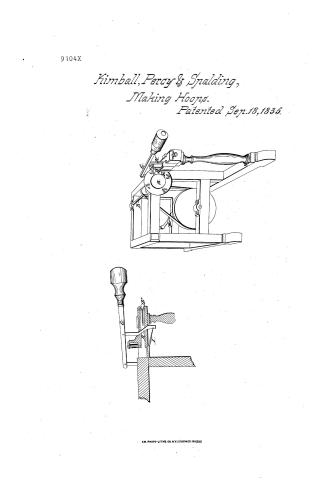
Page 1.
9104X
Kimball, Percy & Spalding,
Making Hoops.
Patented Sep. 18, 1835.

AM. PHOTO-LITH. CO. N.Y. (OSBORNE'S PROCESS)
Page 2.
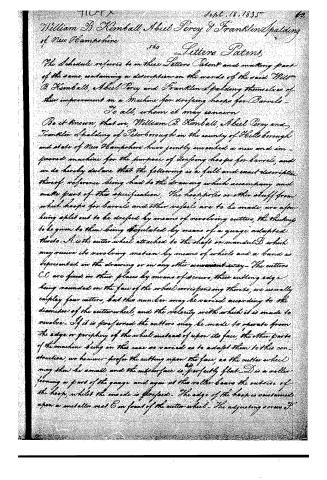
William B. Kimball, Abel Percy & Franklin Spalding
of New Hampshire
Sept. 18, 1835
560 Letters Patent
The Schedule refers to in these Letters Patent and making part
of the same, containing a description in the words of the said William
B. Kimball, Abel Percy and Franklin Spalding themselves of
their improvement on a Machine for drefing hoops for Barrels—
To all, whom it may concern
Be it known, that we, William B. Kimball, Abel Percy and
Franklin Spalding of Peterborough in the county of Hillsborough
and state of New Hampshire have jointly invented a new and im-
proved machine for the purpose of drefing hoops for barrels, and
we do hereby declare that the following is a full and exact description
thereof reference being had to the drawing which accompany and
make part of this specification. The hoop-poles or other stuff from
which hoops for barrels and other vessels are to be made, are after
being split out to be drefed by means of revolving cutters, the thickness
to be given to them being regulated by means of a gauge adapted
thereto. A is the cutter wheel attached to the shaft or mandrel B which
may receive its revolving motion by means of wheels and a band as
represented in the drawing or in any other convenient way. The cutters
C.C are fixed in their places by means of screws, their cutting edge
being rounded on the face of the wheel corresponding thereto, we usually
employ four cutters, but this number may be varied according to the
diameter of the cutter wheel, and the velocity with which it is made to
revolve. If it is preferred the cutters may be made to operate from
the edge or periphery of the wheel instead of upon its face, the other parts
of the machine being in this case as varied as to adapt them to this con-
struction, we however prefer the cutting upon the face, as the cutter wheel
may then be small, and the outer surface is perfectly flat. D is a roller
forming a part of the gauge and again at this roller bears the outside of
the hoop, whilst the inside is drefed. The edge of the hoop is constrained
upon a metallic rest E in front of the cutter wheel. The adjusting screw F.
Page 3.
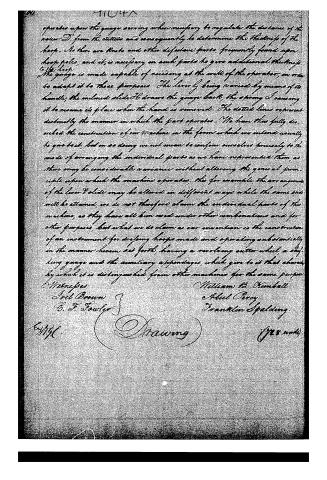
operates upon the gauge screw when necessary to regulate the distance of the roller D from the cutter and consequently to determine the thickness of the hemp. As there are knots and other defective parts frequently found upon hemp poles, and it is necessary on such parts to give additional thickness to the hemp, the gauge is made capable of rising at the will of the operator, in order to adapt it to these purposes. The lever G being raised by means of its handle, the inclined slide H draws the gauge back, the spring I causing it to resume its place when the hand is removed. The dotted lines represent distinctly the manner in which the part operates. We have thus fully described the construction of our machine in the form which we intend usually to give to it, but in so doing we not mean to confine ourselves precisely to the mode of arranging the individual parts as we have represented them, as there may be considerable variance without altering the general principle upon which the machine operates, this for example, the arrangement of the lever I slide may be altered in different ways while the same end will be attained, we do not therefore claim the individual parts of this machine, as they have all been used under other combinations and for other purposes, but what we do claim as our invention is the construction of an instrument for dressing hemp made and operating substantially in the manner herein set forth, having a revolving cutter wheel, a shifting gauge and the auxiliary appendages, which give to it that character by which it is distinguished from other machines for the same purpose.
Witnesses
Joel Brown
E. F. Fowler
William B. Kimball
Abiel Perry
Franklin Spalding
Expt. Drawing (728 words)
Published accounts: journal notice
Notice in the monthly list of patents, with remarks
Journal of the Franklin Institute, new ser., vol. 17 (1836), p. 263 · View the page
40. For a Machine for Dressing Hoops; B. Kimball, A. Pevey, and F. Spalding, Petersborough, Hillsborough county, New Hampshire, September 18.
Remarks. A wheel furnished with cutters on its face, near to its periphery, is made to revolve by means of a mandrel, like that of a lathe. A gauge stands in front of the cutters, having a roller, against which the outside of the split bears; this gauge is capable of being made to recede, by means of a lever, so as to allow the necessary increase of thickness in case of knots, &c. The following is the claim. After stating the various modes of arrangement which may be adopted, the patentees say: "We do not, therefore, claim the individual parts of this machine, as they have all been used under other combinations, and for various other purposes; but what we do claim as our invention, is the construction of an instrument for dressing hoops, made and operating, substantially, in the manner herein set forth; having a revolving cutter wheel, a shifting gauge, and the auxiliary appendages which give to it that character by which it is distinguished from other machines for the same purpose." This machine has, we are informed, been found of very great value in its application to the purpose for which it was constructed.
About this record
- Patentee
- Jim Shaw's X-patent list
- Date
- the Name and Date index of patents, USPTO records, Jim Shaw's X-patent list
- Invention
- the Name and Date index of patents
- Listed in
- the Name and Date index of patents, USPTO records, Jim Shaw's X-patent list, the Journal of the Franklin Institute, Burke's List of Patents (1847)
- Burke's 1847 Patent Office list gives the same patent.
- Residence from Burke's 1847 Patent Office list; the standard lists give none.