

Drawings and documents
National Archives restored drawings: drawing
Mills and Fernald's Patent Drawing for a Pneumatic and Hydrostatic Machine and Engine

National Archives, Restored Patent Drawings (Record Group 241) · Full-size scan at the National Archives · Catalog record
Show the text on the drawing Hide (78 words)
Words on the drawing as machine-read by the National Archives; not checked. Useful mainly for searching.
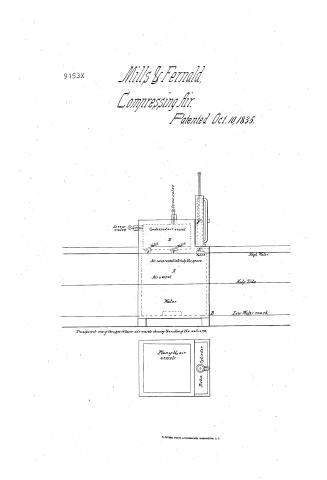
Hydraulic / in / Sis reside / 23° AIR AND GAS PUMPS / fi / Fluid Piston, / MILLS FERNALDS / Reciprocating Piston. / # 9153x / is, / PNEUMATIC AND HYDROSTATIC MACHINE AND ENGINE. / CLASSIFICATION / 9153x / DIVISION. / Serewvalue / Condensedair vessel / value / High Water. / Air com pressed into half the space / Air vessel. / Half tide. / Water / Low Watermmark / Transparent View of the uppert lower air vessels shewing the action of the valves *G / vessels.
USPTO scan
The patent as scanned by the USPTO
-
 Page 1
-
 Page 2
-
 Page 3


U.S. Patent and Trademark Office · Google Patents
Show the transcription Hide (584 words)
Machine transcription (LightOnOCR) of the pages as scanned by the USPTO, most of them the handwritten copies made when the records were restored after the 1836 fire. Not checked; it can misread handwriting, so compare it with the scan.
Page 1.
9153X
Mills & Fernald,
Compressing Air.
Patented Oct. 10, 1835.

Transparent view of the upper & lower air vessels showing the action of the valves.

M. PETERS, PHOTO-LITHOGRAPHER, WASHINGTON, D. C.
Page 2.
Oct. 10, 1855
Robert Mills and Henry B. Sernald 9153X
Letters Patent.
The schedule referred to in these Letters Patent and making part of the same containing a description in the words of the said Robert Mills and Henry B. Sernald themselves of their improvement in the application of Hydraulics & Pneumatics to the propulsion of Machinery &c.
Know all men by these presents that we Robert Mills (now) of the City of Washington District of Columbia, and Henry B. Sernald of Portland in the County of Cumberland and State of Maine, have discovered a new and useful improvement in Hydraulics & Pneumatics, which consists in applying the rising and falling of the tide and other water, to condensing atmospheric air and using such condensed air as a motive power to drive machinery; and that the following is a full and exact description of the plan and operation of the same,
An air tight room or rooms of sufficient strength and dimensions either of wood or metal must be constructed and immovable fixed in such a manner that the water shall be allowed to flow into it; this an aperture or apertures, in the bottom or sides, or the top of these air chambers are to be placed one or more water opening upward into a recipient or recipients, which are to receive the air after it is condensed they being provided with suitable screw valves to admit of using the condensed air at pleasure (see drawing annexed) Operation.
The air tight room or rooms, &c. being placed so that the bottom will be as near low water mark B, as circumstances will admit; and being filled with Atmospheric air) the rising water will compress and force the air upwards through the valves C.C., into the air tight recipient or recipients D, from whence it may be applied like steam by means of the screw valves 1, 2, and in the falling of the water there will be a vacuum created or a tendency to that effect in the air chamber or room A, and the atmosphere being admitted through a valve E, opening inward, will rush with a force proportionable to the base of the air
Page 3.
Air Room, or chamber, and thus a power will be gained in the falling of the tide, or water, which may also be employed to condense more air, or other use by making the pressure of this air to work a wheel or piston as it before it enters the air chamber.
It will be perceived from the above description that a profiting power will be thus obtained at little expense, and that it will be a perpetual power, as long as the tide shall continue to rise and fall.
In testimony that the above is a full specification of our said improvement as above described, we have hereunto set our hands this twenty-first day of September in the year of our Lord one thousand eight hundred and thirty-five.
Witness
S. D. Fletcher
David Wilkinson
Robt. Mills
Henry D. Fernald
(Drawing) 574 w-87
Published accounts: journal notice
Notice in the monthly list of patents
Journal of the Franklin Institute, new ser., vol. 17 (1836), p. 70 · View the page
609. Hydrostatics and Pneumatics.-R. Mills H. B. Fernald, City of Washington,
Published accounts: journal notice
Notice in the monthly list of patents, with remarks
Journal of the Franklin Institute, new ser., vol. 17 (1836), p. 330 · View the page
21. For Applying Hydraulic Power; Robert Mills, Washington city, and Henry B. Fernald, Portland, Cumberland county, Maine, October 10.
Remarks. The rising and falling of the tide is to be employed for the purpose of condensing atmospheric air, which condensed air is to be afterwards applied, as a motive power, to machinery. The mode of condensing consists in placing a reservoir in the water, which shall rest on the bottom. This reservoir is to be open at bottom, to admit the water, but closed at top, to retain the air; the top is to rise to a convenient height above the line of high water; at this line there must be a horizontal partition, or diaphragm, furnished with valves, opening upwards, to admit the air as the water rises, and to retain it in the air chamber when it falls. This chamber is to be "provided with suitable screw valves, to admit of using the condensed air at pleasure;" it is to be "applied like steam." "In the falling of the water, there will be a vacuum created, or a tendency to that effect, in the air chamber, or room; and the atmosphere being admitted through a valve, opening inward, will rush with a force proportionable to the base of the air room, or chamber, and thus a power will be gained, in the falling of the tide, or water, which may also be employed to condense more air, or otherwise, by making the pressure of this air to work a wheel, or piston, as it enters the air chamber." At p. 203 we noticed a patent, obtained, about two months since, by one of the above named gentlemen, for applying the rising and falling of the tide to the propelling of machinery, and showed that the plan then proposed was old, referring to a former patent for the same thing, and our remarks thereon. Although the mode there proposed is not, we think, likely to come into extensive use, there are situations where the power obtainable might be usefully applied; but if that now brought forward is intended as an improvement thereon, we are very certain that the thing will be "mended worse." To use the condensed air to advantage, would be an undertaking of great practical difficulty, and, in the present case, could not be effected, but by a very considerable loss of power; the patentees, however, have furnished us with no plan for doing this, and we will not attack windmills. We do not know, even, what they mean by "screw valves;" these are certainly novelties in mechanics. There is no point more clearly ruled than that a patent cannot be sustained for a principle, but only for the carrying of a principle into effect by certain means; but, in the case before us, no means are given.
About this record
- Patentee
- Jim Shaw's X-patent list
- Date
- the Name and Date index of patents, USPTO records, Jim Shaw's X-patent list
- Invention
- the Name and Date index of patents
- Listed in
- the Name and Date index of patents, USPTO records, Jim Shaw's X-patent list, the Journal of the Franklin Institute, Burke's List of Patents (1847)
- Burke's 1847 Patent Office list gives the same patent.
- Residence from Burke's 1847 Patent Office list; the standard lists give none.