

Drawings and documents
National Archives restored drawings: drawing
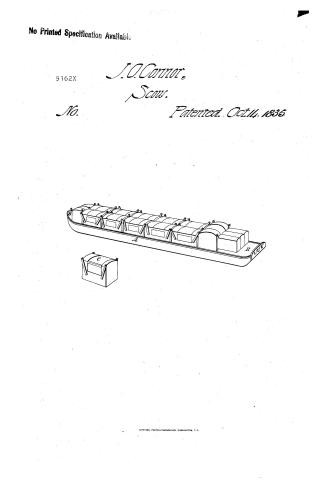
James O'Connor's Patent Drawing for an Improvement in the Transhipment of Merchandise

National Archives, Restored Patent Drawings (Record Group 241) · Full-size scan at the National Archives · Catalog record
Show the text on the drawing Hide (65 words)
Words on the drawing as machine-read by the National Archives; not checked. Useful mainly for searching.
11 / 114. SHIPS. / 1. CONSTRUCTION / [137] Scowa / 9162-t / Clus / Smp! in the Transhipment of etherchandise. / Patented: 14 Cat: 1835. / References / A. Boat. / B. Bow and Sterm Dech's / c. Baxes. / note. / Copied from a drawing sent to the / office with the Original Patent, detached, / and apparently having never been attacked / to it. / OF.O. / English
USPTO scan
The patent as scanned by the USPTO
-
 Page 1
-
 Page 2
-
 Page 3
-
 Page 4


U.S. Patent and Trademark Office · Google Patents
Show the transcription Hide (794 words)
Machine transcription (LightOnOCR) of the pages as scanned by the USPTO, most of them the handwritten copies made when the records were restored after the 1836 fire. Not checked; it can misread handwriting, so compare it with the scan.
Page 1.
No Printed Specification Available
9162X
J.O. Connor,
Scow.
No. Patented Oct. 14, 1835

Page 2.
9162X James O'Connor
Letters Patent
Oct. 14, 1835
The Schedule referred to in these Letters Patent, and making part of the same, containing a description in the words of the said James O'Connor himself of his Improvement in Canal Boats for the Transshipment of Merchandise.
Schedule or Specification of James O'Connor’s improved Canal Boat for carrying merchandise and general freight to be used when transshipment from Canal to Rail or other roads and vice versa is necessary.
Construct the hull of the Boat Flat or Skow in all respects similar to those used on the Canal to be navigated. Construct a short stern deck such as is used say four or five feet long next to which deck or close in 6 feet for a cabin. Also construct a short bow deck say four or five feet long.
These decks and cabin will occupy from fourteen to sixteen feet in length of the Boat, Skow, or Flat. The remaining or greater part of the Boat Skow or
Page 3.
filling them again, thus the honey is secured in summer time, by the bowls and drawers, in abundance; every morning one or the other bowl or drawer can be removed with the slightest danger or trouble. As soon as the bees have run their combs to the holes behind the doors, two other large bee houses are screwed on, hole upon hole, behind the doors, with some of the above mentioned combs, thinly smeared around the holes; when the slides are removed, a great quantity of bees will come out of the full into the empty houses, (and after they have worked their way into the empty ones they are removed and others replaced for the reception of more, &c.) Thus the main body below, the honey is taken in winter time, when a door is opened in a cold morning before the palace is quite full, the bees will retire and become stiffened, then the combs are cut through right in the middle, between the sticks, with a sharp pointed, thin board, tin plate, and a stick with its adhesive removed. Thus a stick full can be taken out from the warped banquet halls every morning, until the one half end is conveyed away. On the flying these sticks are all to be replaced; thus the honey of every other half end can be taken out every winter. By pursuing this plan the bees continue in making new combs, and filling up every other half end every summer. N.B. These are some of these "fortifications" so large as to contain upwards of three hogsheads (and commenced with eighteen hives. One hundred and sixty gallons of honey have been taken out of one house in one year. The superiority of this invention over anything of the kind hitherto in use, is unquestionable. (and individuals who have made a trial of this plan all concur in saying that the bees thrive better, and make ten times the quantity of honey which they did on the former places.
Know all men by these Presents, That we the undersigned have had a perfect trial and examination of Mr. Jones' Patent Bee House, two summers (and we candidly believe that it will answer every purpose, as it is recommended; any person wishing to see a honey comb built in two summers, eight feet long and four wide can be gratified with the sight by calling with us. Jacob Jackson, Cornelius Richardson, Wm. Trent, Philip Gable, Reading Berks County, Pa. December 7, 1834. On this 26th day of May 1835, before the subscribers, a justice of the Peace in
Page 4.
and for said County, personally appeared the aforesaid William Groves, and made solemn oath according to law, that he verily believes himself to be the true and original inventor and discoverer of the invention above specified and described for a Bee House, and that he is a citizen of the United States.
C. H. Wharton.
Given under my hand at the City of Washington this 12th day of June A.D. 1835. Andrew Jackson
By the President, John Forsyth, Secretary of State:
"I do certify that the foregoing Letters Patent, were delivered to me on the 17th day of June A.D. 1835, to be examined and I have examined the same and find them conformable to law.
B. H. Butler, Attorney General of the United States
1950 words (Drawings)
James O'Connor
Letters Patent
Oct. 14, 1835
Published accounts: journal notice
Notice in the monthly list of patents, with remarks
Journal of the Franklin Institute, new ser., vol. 17 (1836), p. 333 · View the page
31. For improvement in the Transhipment of Merchandise, on Canal and Rail Road Lines; James O. Conner, city of Philadelphia, October 14.
Remarks. This improvement consists in the construction of water-tight boxes, capable of holding about three tons of ordinary freight, and so shaped that they shall fit into canal boats, and also form the bodies of cars for transportation on rail roads. The boxes are to be lifted from one vehicle to the other, at the places of transhipment, by means of powerful cranes. The claim is to "the principle of using large boxes, or car bodies, fitted to the interior of open canal boats, which boxes are to contain goods, or merchandise, for transhipment on rail roads, and on canals, without separating the contents of the boxes, or car-bodies."
About this record
- Patentee
- the Journal of the Franklin Institute, Journal
- Date
- the Name and Date index of patents, USPTO records, Jim Shaw's X-patent list
- Invention
- the Name and Date index of patents
- Listed in
- the Name and Date index of patents, USPTO records, Jim Shaw's X-patent list, the Journal of the Franklin Institute, Burke's List of Patents (1847)
- The patentee's full name comes from the Franklin Institute's journal.
- The residence comes from the Franklin Institute's journal.
- Burke's 1847 Patent Office list gives the same patent.